[Tsatskes]


Twitterverse Coffee
Popular Coffee Websites

Cafes by Zip Code
Coffee Podcasts

[Readers]

Locations of visitors to this page

[About]


[Blogroll]

43 Folders
Anders Fagerjord
Bay Area Bloggers
Berkeley Blogs
Blue Bottle Clown College
Cafexperiment
Coffeegeek
Denver Coffeehouses
Dogmilque
Doug Miller
Emily Chang's eHub
Hewn & Hammered
Jill's Definition of Weblog
Jonas Luster
Laughing Squid
Le Blaugue à Beleg
Loïc Le Meur Blog
Mark Bernstein
Moleskinerie
Seesmic Blog
Tant Mieux
The Dynamist
Tonx Dot Org

[Go]

Send Me Email:

coffeeblogger (at) doublesquids.com

Other Berkeley Blogs


SF Bay Bloggers
<<
#
Blogs That Flickr
?
>>
Blogcritics: news and reviews
Who Links Here


"The meaning of life and other trivia." Copyright ©2004, 2005, 2006, 2007, 2008 Jonathan David Leavitt. All rights reserved.

Every page now has Seesmic/Disqus video commenting. Scroll to the bottom to see or post video comments. There are also Haloscan comments at the end of each separate blogpost article. To read a text-only version of Jonathan's Coffeeblog on your iPhone or other mobile phone, click here. Or to see the graphics with less text, click here.

Go: [ Home | Previous | Archive | Gods & Myths | Cafes | Coffee | Nations & Empires | People | Arts ]
[ Words | New Media | Cinema | Gastronomy | Productivity | Yiddish ]

Nations and Empires

9:51 PM Saturday, May 3, 2008

[Can we all get along?]

Empires and Nations

I've added a new category to the Coffeeblog: Nations and Empires. Originally I had thought of adding a "history" category. Then I realized that everything I post to the Coffeeblog is some kind of history: the history of Bettie Page and the Kefauver Commission, or the history of Andres Serrano and his "Piss Christ" image with the resulting kerfuffle. Even a movie review is a history of sorts. Thinking it over, I realized that the kind of history that has begun to interest me lately is the history of empires and the nations, peoples, tribes, ethnic groups, language groups, and other societal entities engulfed, absorbed, or instrumental in the development of such empires. I would have never predicted such an interest as a college freshman who felt overwhelmed by the huge reading assignments of my required basic history course. But back then there was no hypertext, Internet, or Wikipedia. Why such a powerful interest now, so late in life? It has to do with the world events swirling around us about which the dead tree media and the idiot box generally keep us in abysmal ignorance. Why do Shia and Sunni Muslims attack each other in Mesopotamia (the dead tree pundits call it Iraq)? There are reasons for it. "Civil war" the treekillers call it. Sort of like Antietam or the Battle of Bull Run? Please. And then there's Central Asia, the route of the Silk Road, where the focus is not silk any more but petroleum., land of many fallen empires. To paraphrase George Santayana, "Those who cannot remember the past are condemned to write for CNN."

Like most Coffeeblog topics, "Nations and Empires" turned out to be much more complex and hard to pin down than I expected. I found that the best starting point was the idea of empire itself. It comes from the Romans and their Latin word imperare, which simply means "to command." It's a military term. Commanding officer and all that. From imperare came imperium, which the was the legal concept of the power to command, vested not only in officers but in magistrates. The Romans, unlike the founding fathers of the USA, did not advocate separation of powers. Roman politicians served simulatenously as magistrates (judges), Senators, and military commanders. They had the imperium. The Romans used the same word to describe their empire: Imperium Romanum. The power derived, in principle, from the Senate and the people: Senatus Populusque Romanus (SPQR). In the 1960's, I saw manhole covers in Rome with SPQR on them.

Because Roman law codified the principles of empire, the Roman empire (east as well as west) is a good example to study, and that includes Roman imperium during the years of the republic before the first Emperor, Augustus Caesar. But Rome was by no means the first. Rome inherited (hijacked might be a more accurate term) the empires of Carthage and Alexander the Great, who in turn took over that of the Persians, who had taken over the kingdoms of the Egyptian Pharaohs. The Persian Empire (actually a series of empires) might be the best prototype of an empire to study, but for the fact that languages in which its history have been recorded are less accessible in Western translation than the Greek and Roman histories, if they were written at all. Along the Silk Road and to the north and south have been empires that are forgotten (Khitans, anyone?) and others which some want to forget (the Huns and Mongols).

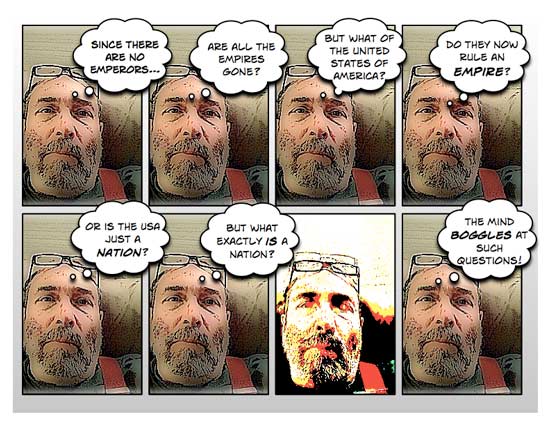
OK. So what? A point I want to make is that we are still coming off the nineteenth-century political pipe-dream high of nationalism and nation-states. In their purest forms, nation-states are not multicultural, and by definition, not multinational. Empires are both. That's the difference. Nation-states sometimes engage in ethnic cleansing to stay pure. A nasty habit. But what is a nation? The question has always been easier to ask than to answer. The word nation also comes from Latin, and it means a birth. The birth of a nation, perhaps? (That was a 1915 movie honoring the Ku Klux Klan, by the way.) Presumably a nation consist of people born sharing a common heritage, meaning language and culture. Nations, however, are almost never homogeneous, like homogenized milk, and they are never static. They change. The idea of a nation is better understood by using the word for nation in Greek: ethnos. Yup. An ethnic group. And there is a Hebrew word for nation, goi, often used Biblically in the plural, goyim, "the nations." When the Bible was translated into Greek, goyim was translated as the plural of ethnos. As many know now, goyim in Yiddish means people who are not Jewish, in other words, the "other nations," and I have read that ta ethne, the Greek plural, has been used to mean non-Greeks, the barbarians, and among Christians, the opponents of Jesus.

So, my friends, perhaps nations are not all good and empires are not all bad. As Rodney King asked, "Can we all get along?" Excellent question. And I would add to it, "Can we all get along without empires? And if not, which empires?"

More Links:

More Images:

Permanent Link to This Entry | | | Technorati Tag:

Send a message to Jonathan: coffeeblogger (at) doublesquids (dot) com


The Whole Megillah

5:42 PM Thursday, March 20, 2008

[Recited every day. It has never ended.]

The Whole Megillah (Coffeeblog)

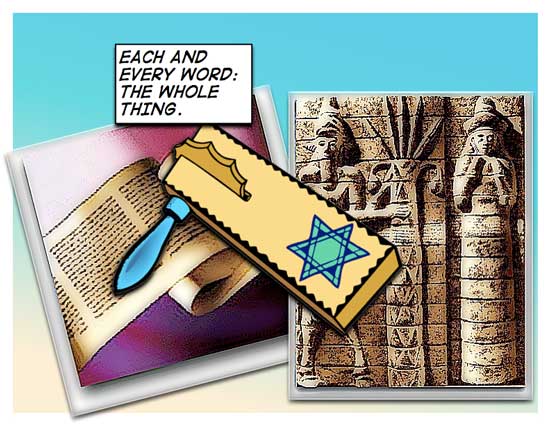
At sundown this evening it will be Purim again, the Jewish festival when Jews read from the apocryphal Book of Esther, traditionally recorded on a scroll of rolled-up parchment, papyrus, or paper. A Hebrew word for "scroll" is megillah, and the holiday has given rise to the Yiddish phrase, the "gantze (whole) Megillah." Since the rabbi reads the whole scroll aloud to the congregation in an ancient tongue, and seeming, for children at least, to go on forever, the "whole Megillah" refers to a prolonged, predictable litany which we have heard before, and are banefully expecting to hear over and over again. As it happens, "the whole Megillah" is a very timely topic today, and not just because it's Purim.

Let us begin with the Megillat Esther itself, the book that the rabbi reads aloud. It tells a tale from ancient Persia, where the king, called Achashverosh in Hebrew, is probably the very same Xerxes (Persian Khashayar Shah) featured as a villain in the recent film "300." In the Purim scroll, Esther is a Jewish woman, the niece of a Jewish official living in Persia, where many Jews have settled after a conquest by the Babyonian army. Achashverosh is not the villain of the tale, but there is a villain: Haman the Agagite. Haman, a subordinate of the Shah, wants to kill all the Jews. The threat is very real. It will very likely be carried out. Fortunately for the Jews, however, the beautiful Esther has become one of the Shah's favorite women, following an event where the Shah has been rebuffed and humiliated by the Queen. That development means that Esther has access to the Shah where she can, and does, plead the case for the Jews against Haman. After hearing from both sides, the Shah gives Esther's uncle permission to deal with the problem, which he does, backed by other Jewish men. Haman is executed on the very gallows he had built to hang Jews. End of Megillah. Or so it should be.

In Esther's Megillah the themes are ethnic and religious hatred, plots to carry out mass murder (what we now call "ethnic cleansing") or outright genocide, divine interventions on behalf of one party or another, close calls, political intrigues, and narrow escapes. Anyone reading current news about Israel, Iran, Hezbollah, Hamas, Olmert, Bush, and the "peace process," can hear the whole Megillah metaphorically recited every day. It has never ended, and Haman and threatened Jews are still in conflict.

But there's more. When the rabbi reads the Megillah, to children in the congregation have been instructed to listen very carefully for the name of the villain Haman. They have been issued toy noisemakers and told to drown out the sound of Haman's name so that it is never heard again. This is a very functional tradition. The children, who otherwise would be bored to tears listening to the whole Megillah can make a game out of paying attention. And so they try to blot out Haman's name from memory. Do they succeed? Quite the opposite. Paying attention to the name, and announcing it repeatedly with noise only ensures that Haman's name will never be forgotten. Khashayar (Xerxes, Achashverosh) was Shah of Iran from 485-468 BCE, and we still remember the name of Haman the Agagite 2493 years later. And because of that, we remember the whole Megillah. The rabbis who started this tradition knew what they were doing.

But there's more. This Haman the Agagite— who was he anyhow? There is no known ancient people called the Agagites, but there was a king name Agag who ruled over another ancient people named the Amalekites. They lived, not in Persia, but near ancient Judea. They were by reputation (and Biblical scripture) implacable enemies of the Jews. There is even a biblical passage (1 Samuel 15:1-35) where an angry God punishes the Jewish King Saul either for looting, or for being soft on Amalekites, according to one's interpretation:

Then Samuel [a prophet] said to Saul, “I was the one the Lord sent to anoint you as king over his people Israel. Now listen to what the Lord says. Here is what the Lord of hosts says: ‘I carefully observed how the Amalekites opposed Israel along the way when Israel came up from Egypt. So go now and strike down the Amalekites. Destroy everything that they have. Don’t spare them. Put them to death — man, woman, child, infant, ox, sheep, camel, and donkey alike.'"

So Saul assembled the army and mustered them at Telaim… But Saul and the people spared Agag and the best of the sheep and of the oxen and of the fattened calves and the lambs, and all that was good, and would not utterly destroy them…

[later] Saul said to Samuel, “I have sinned, for I have transgressed the commandment of the Lord and your words, because I feared the people and obeyed their voice. Now therefore, please pardon my sin and return with me that I may worship the Lord.

As for King Agag himself, Samuel the Prophet hacked him to pieces. But Haman, the so-called Agagite, lives on in the memories of those children who tried to blot out his name, including me, who is writing this blogpost, and once upon a time was a noisemaker-cranking kid in a synagogue. The whole Megillah. But there's more…

The Baal Shem Tov, the rabbi who founded the Hasidic movement, interpreted this Biblical passage as referring to, one might say in New Age jargon, one's "inner Amalikite." Not a member of an ancient tribe, but a spiritual enemy who resides inside us. According to the Baal Shem Tov, that Amalikite is atheism, which I call monotheism minus one.

But there's more…

Recently the presidential candidate Senator Barack Obama was criticized for not repudiating his personal and family pastor, the Rev. Jeremiah Wright, who had been recorded and videotaped railing from the pulpit, not against Amalekites, but against "rich white people" and the United States of America. Senator Obama gave a long, detailed superbly articulated speech in which he defended his long-term loyalty to Rev. Wright, although he personally disagrees with the pastor's anti-wealth, anti-white, anti-American rhetoric. From the political logic of the situation, it would seem that Senator Obama is hoping that the white and pro-American voters who go to the polls in November will have forgotten all about Reverend Wright.

But the Senator's speech covered much more ground than merely addressing the Reverend Wright kerfuffle, although he addressed it clearly and in my view, extensively if not exhaustively. The ground that Senator Obama covered in his speech, in detail, concretely, abstractly, and with great inspiration, was nothing less than the whole topic of Race in America.

In other words: the whole Megillah.

More Links:

More Images:

Permanent Link to This Entry | | | Technorati Tag:

Send a message to Jonathan: coffeeblogger (at) doublesquids (dot) com


The Gefilte Fish Line

11:00 PM Monday, February 18, 2008

[Sugar? In fish?]

Litvaks v Galitzianer

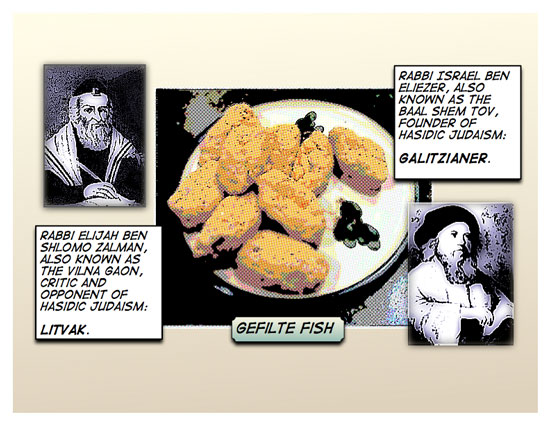
The plot, like the jelly which surrounds a piece of gefilte fish, thickens. I am referring, of course, to knowledge I have gained since my post about Yiddish. It appears that my mother's parents, both Jews, were each born on the other side of a great linguistic-religious-culinary divide known to mavens of Ashkenazi gastronomy as the Gefilte Fish Line. (Thank you, Michael Steinlauf.) All right. I realize that some of my readers are vegans, Shia or Sunni Muslims, and possibly High Church Episcopalians. Therefore I must explain what gefilte fish is before I go any further: The Jewish holiday of Passover will be coming up soon (April 20, to be exact), and in those stores which sell Passover food (most urban California supermarkets do), you will find jars of lozenge-shaped fish patties swimming in juice or jelly. That is the mass market version. To the Jewish women from whom we are descended, however, gefilte fish was a delicacy made from fresh-water fish, bones carefully removed, then lovingly shaped into fish-like shapes, cooked, and served with horseradish. The most fanatical gefilte fish makers would actually stuff the skins of the fish used to make the delicacy with the fish mixture: hence gefilte, or "filled." However, my own eyes have never observed an actual stuffed fish version of the dish.

Now, as the Shia Muslims, and perhaps even the Episcopalians (but not the true vegans) are undoubtedly asking, what is the best kind of fish from which which to make gefilte fish? For the answer, I must turn to an original source, and there is no more reliable source than my own grandmother. The answer, as I learned in my childhood: pike, whitefish, and buffle. Buffle? Did she mean buffalo fish? I think not. I think she meant buffle. So if you can't find buffle in your local fish market, you are already compromising your standards for the finest gefilte fish.

And here is the point of departure for the thickening plot, and the linguistic-religious-culinary divide to which I referred earlier. You see, even though my grandmother knew how to make the finest gefilte fish, she never made it for my grandfather. (I just learned that in an email from my mother). But why not? My dear departed grandparents have taken the answer to their graves, so we can only conjecture. And my conjecture is this: my grandfather was a Litvak, and my grandmother made Galitzianer gefilte fish.

Today, even most Jews don't know the difference between a Litvak and a Galitzianer, and I certainly didn't until recently. But a big difference it was, with roots, ultimately, in theology. And if there are any two things that Jews can and will fight each other about, theology and food are those two things. Remember the Pharisees and the Sadducees? They argued about food too, specifically the burnt offererings in the Temple.

Now the Litvaks lived mostly in Lithuania, a territory long dominated by Russia, where they founded schools of higher religious education know as yeshivas, with high intellectual standards and rigorously legalistic debates. The Galitzianer, who lived east of the Gefilte Fish Line, in territory that was dominated by Austria, came under the influence of a highly emotional, charismatic form of Judaism known as Hasidism. Remember that Austria is the land of viennoiserie, breads which are sweetened, and of course Sachertortes, Linzertortes, another other sweet goodies consumed with that famous Viennese beverage, coffee. (They drink it with whipped cream on top, I hear.)

So who would be surprised if the Galiztianer might put a little sugar, just a pinch, into their gefilte fish? A Litvak, that's who. Sugar? In fish? That does not compute, and Litvaks were into computing long before their descendants had computers. What would one expect from the kind of people who dance around in fur hats singing yam-bim-bam and only putting 9 hours a day into studying Torah instead of 14 hours?

The battle between the hair-splitting Litvak intelligentsia (called Mitnagdim) and the Galitizianer holy-rolling Hasidim raged on for centuries, and probably still does. And if that wasn't bad enough, they pronounce their Yiddish differently. A Litvak Jew named Moyshe Pupik, for example, should he have wandered recklessly across the Gefilte Fish Line, would have been addressed as "Meysh Pipik," and would have had to endure it as well as gefilte fish with (feh!) sugar in it.

So, then: what is in the supermarket gefilte fish which comes in jars? The Manischewitz website doesn't say. You can get 14 different kinds, including "whitefish" and (get this) "sweet whitefish." There is jelled and not jelled. And none of the 14 kinds contain any buffle. They are all, however, certified kosher. Be that as it may, don't expect the "sweet whitefish" to be kosher for Litvaks.

More Links:

More Images:

Permanent Link to This Entry | | | Technorati Tag:

Send a message to Jonathan: coffeeblogger (at) doublesquids (dot) com


Yiddish

1:11 PM Wednesday, January 30, 2008

[Oy, is it Jewish!]

Yiddish (and Yiddish Literature)

What chutzpah! I should schmooze with that schmegeggie? Oy, vey! Yes, we're talking Yiddish here, the fershlugginer Jewish language that refused to die. After being urged by Ksenya Gurshtein, an up-and-coming blogger, curator, and art historian, I added a Yiddish page to the Coffeeblog. As a kid, however, I was encouraged to avoid the use of Yiddish around starchy white Protestant Anglo-Saxons and other neighbors who might look down on this all-too-colorful linguistic remnant of the East European ghetto, or at the very least, find it bizarre, very foreign, and well, too Jewish. And they should have found it very, very Jewish. Because Yiddish is, you should pardon me for saying so, very, very Jewish. Oy, is it Jewish! In fact, Yiddish means "Jewish." In Yiddish. As a kid I heard some adults call the language "Jewish" rather than Yiddish. They were speaking English when they said that, of course.

Back in the 1960's, when I was making my Jewish Hadj, I heard a joke. (What's a Jewish Hadj? Why a trip to Israel, of course. But I mean another joke.) The Israelis were experiencing, as they always do, culture shock among the sabras (native-born Israelis who grew up speaking Hebrew), old Yiddish-speaking Jewish immigrants to Palestine who were nearing the end of their lives, and the numerous Jewish immigrant groups arriving at the time who did not speak Hebrew well.

So, what was the joke? Here it goes:

What are the stages of life of a Jew?

  1. Birth.
  2. Childhood.
  3. Adolescence.
  4. Adulthood.
  5. Speaking Yiddish.
  6. Death.

Well, it seemed funny at the time. Now, that I'm 65 and revisiting Yiddish all of a sudden it's not so funny. But, actually, I don't speak Yiddish, like many who still do. Yiddish, proclaimed a dead language during the last century, is not going to the gas ovens of history without a fight.

So, tell me, you ask, what is this Yiddish? (OK, you didn't ask but I'm going to tell you anyhow.) Philologists call it Judaeo-German, because it is the language spoken by Jews who lived in Germany (called Ashkenaz, a Biblical place-name, by the Jews of the time.). It's mostly German, that is, an obsolete form of German (earliest written document was 1272), full of nuggets of Rabbinic Hebrew, just as an onion bagel is full of onions. Or should be. The Hebrew is pronounced quite differently from the Hebrew of ancient or modern Israel. Syllables are accented differently and vowel sounds are changed.

Now these German Jews, who originally came from the land of Israel and settled along the Rhine, eventually migrated elsewhere, and were actually invited to settle in Poland, Russia, and other such places. They brought Yiddish with them, and they added words from the local Slavic languages to Yiddish. And the local Slavic people added Yiddish words to their languages. Sometimes it's hard to tell which started where (read my blogpost about tsatskes for an example.)

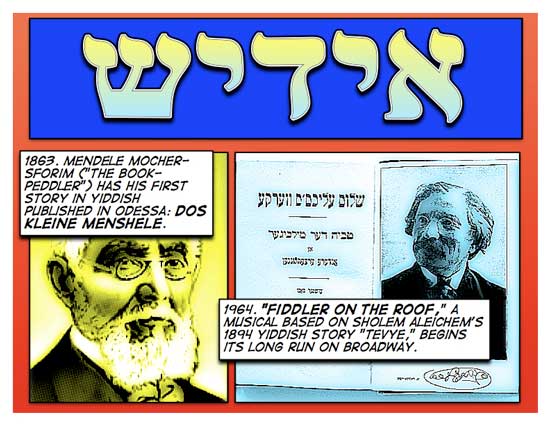
You may have heard of the Yiddish Theater (it still exists!), which was very big during the early 20th Century when zillions of Jewish immigrants were assimilating. Many Yiddish Theater veterans later did vaudeville, and from there went into the movies and then television. There's no business like show business. But the theatre was not the only major cultural flowering of the Yiddish language. Take Yiddish literature. It is said to have been started in 1863 with the book The Little Guy (Dos Kleine Menshele) by a writer who called himself Mendl the Book Peddler. Could it be that Tevye the Dairyman, from Sholem Aleichem's 1894 story of the same name, is the most beloved character of Yiddish literature, what with the hit musical Fiddler on the Roof, with music by Jerry Bock and Sheldon Harnick? Here's the Wikipedia article on that musical in (what else?) German.

More Links:

More Images:

Permanent Link to This Entry | | | Technorati Tag:

Send a message to Jonathan: coffeeblogger (at) doublesquids (dot) com


Schmegeggie

5:45 PM Saturday, April 21, 2007

[A harrowing fershlugginer Internet search.]

Schmiegeegge-Schmegeggie

It all began when I was putzing around the Internet when I should have been in bed. I had encountered a German word Schmiege, which, with various spellings, is a recurring surname in Jewish genealogical research in Poland and nearby areas. What does it mean? You would think something common and utilitarian. If you're a woodworker, it is. In eighth-grade shop class we used one, and we called it a "sliding T-bevel." It is related to a German verb schmiegen, which means to nestle up against something, which is what a sliding T-bevel does to your piece of wood if you sawed, planed, and sanded it properly.

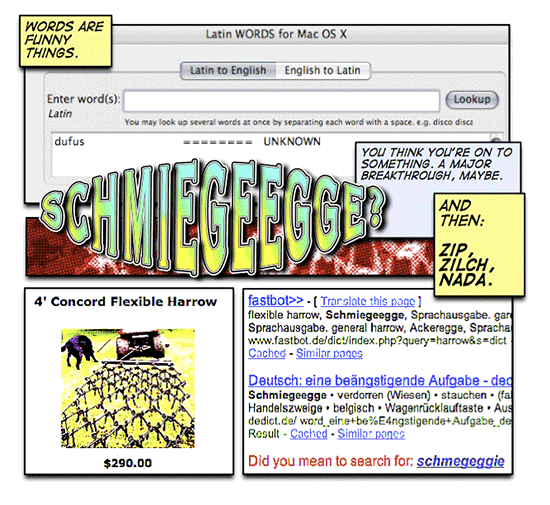
While doing this research on the extraordinary German translation site dict.cc, I came across a related word. The heavens opened. The related word was Schmiegeegge. At first glance I thought I was reading the Yiddish word schmegeggie, a mild to moderate term of opprobrium meaning roughly, or perhaps precisely, doofus. Then I noticed the extra E. In German, an Egge is a an agricultural implement called a harrow in English. Dragged behind a tractor (or, in earlier times, horses or serfs), it tears up the ground surface preparing it for planting. A Schmiegeegge is a harrow with flexible tines that nestle up against stuff, saving time and fuel. Wanna see one? OK, take a look.

But, one might ask (and the Google bots did ask), what is the relationship between a Schmiegeegge and a schmegeggie? Being Jewish, I would not find it surprising than some wag back in the mists of etymological time wanted to imply that an acquaintance of his, or perhaps a family member, had all of the intelligence of a flexible harrow. But there is no proof.

And that is when my reseach became, as it were, harrowing. I could find no definitive explanation for the source of the Yiddish word schmegeggie. On a Yiddish-origin bulletin board I encountered the opinion that the word came from "megege", as in "megege, schmegeggie." I found no evidence, however, that megege is Yiddish, although it happens to be a town in Mozambique. And so, dear reader, the Schmiegeegge-schmegeggie connection remains unresolved. At this point, I shall depart this fershlugginer topic, only to open another briefly. Is dufus (doofus), English for schmegeggie, a Latin word? As far as I know, it's not. Too bad.

More Links:

More Images:

Permanent Link to This Entry | | | Technorati Tag:

Send a message to Jonathan: coffeeblogger (at) doublesquids (dot) com


Tsatskes

4:14 PM Friday, March 2, 2007

[Is an RSS feed a toy? ]

Tsatskes (Tchotchkes)

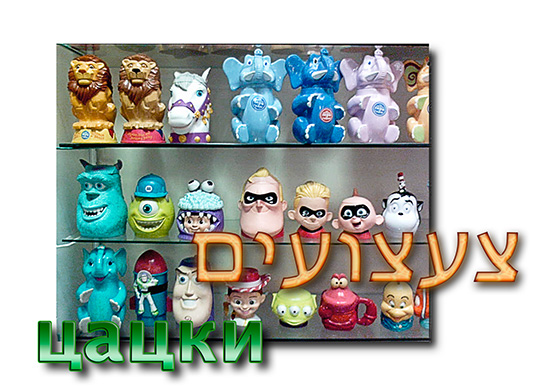
When I was a kid my father often used a wonderful Yiddish word, tsatskes. When he used it, it was usually in the sense of the current term "collectible, " an object valued for its novelty and appeal, but lacking in gravitas (this.) In other words, a tsatske, according to him, was rather trivial, a knick-knack, a bibelot, a gewgaw, a gimcrack, an item of kitsch or schwag, a trinket, a low-end curio. My mother tastefully collected antiques and other curios, and I acquired from her a passion to collect all of the ephemera and linkable stuff which adorn this Coffeeblog (and which clutters my living space). However, I believe that my father's frequent use of the term tsatske was a warning to her that collectibles which did not rise above the level of tsatskes were not terribly welcome in the house.

As I write this, I am sitting in the El Cerrito Central Perk, surrounded by one of the greatest collections of tsatskes in the local region, perhaps in the world. True, there is a great folk art museum in Santa Fe, but although it houses collectibles, it is not dedicated exclusively to tsatskes. Hanging above me in the Central Perk is a series of 1950's era lighting fixtures, not the design museum kind but the tacky kitschy kind. Tsatskes? You bet. However, the Central Perk collection is primarily a collection of toys.

Like many Yiddish words, tsatske has variations in spelling, even in the original Hebrew letters which were used for written Yiddish in its heyday. For one thing, the combination of letters "ts", as in "tsetse fly" or "tsutsugamushi fever" is hard to pronounce for many, though Greeks, like the erstwhile presidential candidate Paul Tsongas, have no trouble with it. Perhaps for that reason, some Yiddish speakers pronounced, and spelled, tsatske as "tchotchke". Having learned tsatske as a small child, I dislike the tchotcke variant, but that is the one which, sadly, appears in the Wikipedia. They are pronounced differently: tsatskes rhymes with "tot's kiss" whereas "tchotchkes" rhymes with "crotch keys." Various Internet sources credit Russian and other Slavic languages as the source of these words (the Russian "tsatski" can mean toys, trinkets, or, well, tsatskes), and I have no doubt that the "ka", plural "ki" ending is Slavic. It appears that the Russians love their tsatski, as this page demonstrates, and a Google search for the Russian word spelled properly yielded 79,400 hits! However, there is a Hebrew word tsa'atsu'a (it even has its own Hebrew Wikipedia page) which means a toy. The word is found in the Bible, where it means "image work." Was the Slavic word derived from Hebrew via Yiddish, or was it incorporated into modern Hebrew by the Zionist revivers of the once-dead Hebrew language? Given the Hebrew spelling of the word for toy, with the very Semitic letter ayin used twice, I am inclined to believe that tsatske was originally Hebrew or an earlier Semitic language. Does a similar word appear in Arabic or Aramaic? I don't know.

I have added a "tsatskes" item to the sidebar of the Coffeeblog, to which I have relocated my RSS feed and my brand new Yahoo Pipes links. I therefore have done nothing less than create a new Internet entity, the cybertsatske. Is an RSS feed a toy? Sort of. Is it too serious to be a tsatske? Not by me. It's definitely something to play with, as Netvibes and Yahoo Pipes have demonstrated. What looks like a tsatske, delights like a tsatske, and appeals to a geek like a tsatske? A tsatske.

Permanent Link to This Entry | | | Technorati Tag:

Send a message to Jonathan: coffeeblogger (at) doublesquids (dot) com


Schmoozer, Spammer, or Squirrel?

9:18 PM Friday, February 23, 2007

[Are 3000 contacts about 2600 too many?]

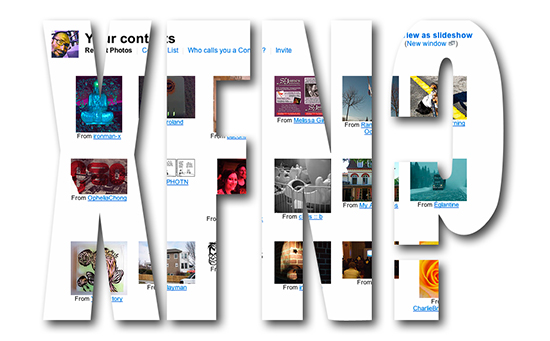
Is XFN the future of social software?

Almost two years ago I wrote an item for Jonathan's Coffeeblog about online social networking, which I called cyberschmoozing. Later I blogged about photo-sharing sites such as Flickr, and about "Web 2.0", a somewhat controversial catchall term for websites which enhance networking of people by enabling tagging and social relationship technology. In Flickr, for example, each member can designate contacts, who may or may not be friends or family members.

Having joined Flickr about two years ago, I have noticed a recent trend which has me a little baffled and a little concerned. I am getting more and more invitations to become contacts of Flickr members who have thousands of contacts and are aggressively seeking many more. In my opinion, this behavior runs contrary to the purpose of social networking, especially the kind I call cyberschmoozing. As this dictionary definition indicates, the core idea of schmoozing, cyber or otherwise, is casual conversation. With thousands of "contacts"? No way. In fact, for whatever their reason, Yahoo, who now owns Flickr, has set a limit of 3000 contacts for Flickr members. Although there was some gnashing of members' teeth when this happened, I applauded the limit, except that I still think that 3000 contacts is about 2600 too many.

One reason for the extreme contact collection which I am discovering is a kind of spamming, where Flickr members collect an audience to which they can pitch their wares through websites exernal to Flickr. However, I think that contact collecting is for many is just a kind of compulsive nut-gathering (I'm thinking squirrel here), where quantity and not quality is what counts. This thinking led me to consider the fact that for all their focus and refinement on tagging and its many splendors, Web 2.0 site creators have not paid much attention to the quality of the social networks they are creating. There is, of course, one big exception: XFN. XF who? XFN is a technology which enables web publishers to identify the kind of relationship he or she has with a specific identified person. The "FN" stands for "friends network," and the X for XHTML, a more highly refined and standardized code language for publishing web content and other stuff, than the rude, crude HTML, which stands for "hypertext markup language." (Mom, email me if you don't understand this.) Using XFN, for example I could (and did) identify Tantek Çelik, (this is his blog) a pioneer of XFN and similar technologies, as somebody I met (once). He probably doesn't remember me, but's it's there in the code for this post, should anybody care to look. What are some of the seventeen other XFN categories as of this writing? Let's see, there's

colleague
neighbor
spouse
sweetheart
acquaintance
and of course, me. Cool? I think so. However, don't expect to be able to use XFN for your Flickr contacts right now. You have to be able to write code to use it. Yahoo, are you listening?

More Links:

More Images:

Permanent Link to This Entry | | | Technorati Tag:

Send a message to Jonathan: coffeeblogger (at) doublesquids (dot) com


Chaos

12:54 PM Friday, February 9, 2007

[Eppes gornisht?]

Chaos: the Mindmap

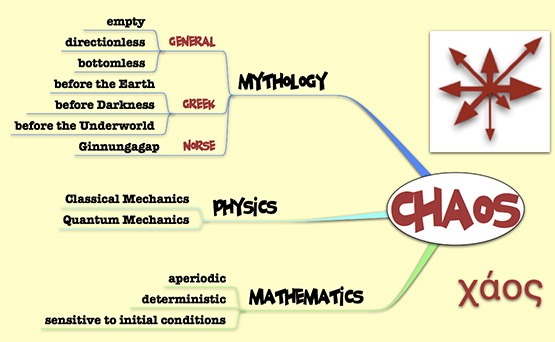
I started out writing about mindmapping, a popular technique for making notes and structuring ideas, when I realized that in order to structure something, you had to have something to structure. And that something, in its purest and most extreme form, would be chaos. And that's when I decided that I'd need to write about chaos before I wrote about mindmapping.

Chaos, of course, is a Greek word for what existed before everything else. In researching chaos I encoutered three delightful terms, Norse, not Greek: Ginnungagap, Niflheim, and Muspelheim. Niflheim was the intensely cold land of the dead to the north of Ginnungagap, and Muspelheim the realm of fire to the south. Ginungagap was the gap in between, empty, pretty much like the Greek idea of chaos. (There's also a Norwegian choral group called Ginnungagap, but that's a distraction.) According to Dickenson College's website, "Ginnungagap is a great void. This abyss is said to be deceitful for in emptiness lies the primordial energy source that will later give birth to the world's creation." As they say in Yiddish, "Eppes gornisht," which means, more or less, "absolutely nothing—now ain't that something!"

Two paragraphs already, and we haven't gotten very close to chaos, or in another sense, we haven't gotten far enough away. Maybe a mathematical definition of chaos will help: Mathematically, chaos means an aperiodic deterministic behavior which is very sensitive to its initial conditions, i.e., infinitesimal perturbations of boundary conditions for a chaotic dynamic system originate finite variations of the orbit in the phase space. (Did that clear things up for you?) Physics has given us chaos theory, according to which it turns out, "As well as being orderly in the sense of being deterministic, chaotic systems usually have well defined statistics." Fortunately, quantum chaology comes to the rescue, which is not as deterministic as the chaos theory of classical mechanics, and therefore might be considered more chaotic.

So what can we learn from this? Well, life seems to be all about bringing order out of chaos, but distinguishing chaos from all the order we are immersed in is more challenging than I would have believed. The most satisfactory description of chaos that I have found comes from the Wikipedia on Chaos (mythology): (1) it is a bottomless gulf where anything falls endlessly. This radically contrasts with the Earth that emerges from it to offer a stable ground. (2) it is a place without any possible orientation, where anything falls in every direction (3) it is a space that separates, that divides: after the Earth and the Sky parted, Chaos remains between both of them. Gee, it sorta sounds like the World Wide Web.

More Links:

More Images:

Permanent Link to This Entry | | | Technorati Tag:

Send a message to Jonathan: coffeeblogger (at) doublesquids (dot) com


Christmas, Moravian Style

3:33 PM Friday, December 22, 2006

[Yes, Virginia, there is a Putz.]

In 1415, a century before Martin Luther, Western Europe was already beginning to be torn apart by sectarian violence between Catholics and Protestants. That year, Jan Hus, a Czech priest, was burned at the stake for heresy. His followers, initially protected by King Wenceslaus IV of Bohemia (that's right, it's the guy in the Christmas carol), carried on the early Protestant tradition; many went underground. Fast forward to 1700, when a German count named Zinzendorf gave refuge to stealth Protestant refugees from Moravia, the eastern part of what is now the Czech Republic. In 1741, on Christmas Eve, Zinzendorf and a group of Moravians founded a community in Pennsylvania, which they named Bethlehem ("House of Bread") after the village in the Judean hills where Jesus was born.

Fast forward to 1950, when I was seven years old, and lived with my family in another Pennsylvania town near Bethlehem, which had become the "Christmas City," and was famous for its light display and the Star on top of a hill. We would drive into Bethlehem to gawk at the lights, which was OK for Jews like us to do as long as we didn't put up our own lights outside our house. What I didn't learn until later is how much Bethlehem and many surrounding towns had been influenced by the descendants of the Moravians, who were very fond of classical music, which was very big in the local schools including mine.

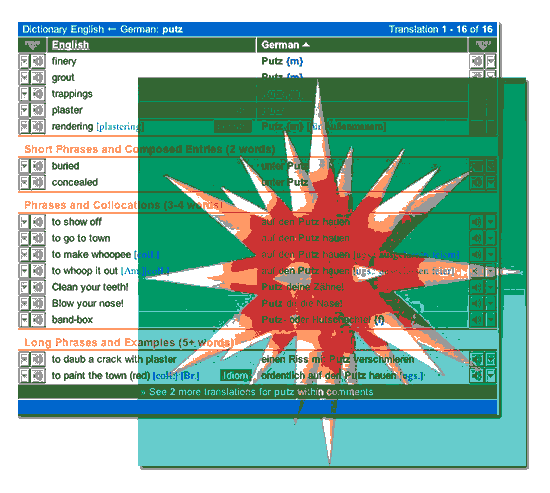
There were two other Moravian traditions that I learned about as a young adult. One was a spectacular 26-pointed three-dimensional Christmas star which is seen on houses around Bethlehem. The other was the Putz. That's right, the Putz. It's not what you're thinking, unless you happen to be Moravian. Appearing throughout Christendom at Christmastime there are Nativity scenes, the scourge of separation-of-church-and-state watchdogs in the USA because they are so popular. If you live in a country with a Christian tradition, you've seen one. Surrounding Baby Jesus in his cradle, there are Mary, Joseph, the three Wise Men (were they Zoroastrians in search of the Saoshyant? Some think so.) and the all kinds of sheep, cows, camels, the village of Bethlehem, and of course the Star. My Jewish eyes become misty when I think about it, because, frankly, it's so beautiful, and so, well, cute. Without diminishing the reputation of other Nativity-Scene builders, I hereby assert that the Moravians of Bethlehem build a Nativity Scene second to none on Earth. And what do they call it? They call it the Putz.

At this point it becomes necessary to delve into German philology. Consulting the trusty dict.cc website, one learns that Putz, in German (rhymes with "foot's") , means "finery" or "trappings", and hence is a totally accurate description of a well designed Nativity Scene. The problem arises due to the fact that the word putz also became part of the Yiddish language, where it (pronounced to rhyme with "nuts") gained the connotation of the kind of finery and trappings of the male anatomy which eventually led Sigmund Freud to postulate that women tended to become envious of such finery and trappings. Eventually, the Yiddish word took on the meaning, positive and negative, of the second word in the phrase "Tricky Dick," and from there, the verb "putzing" arose (no pun intended) as a more graphic term for dolce far niente, although in its crudest sense, it is not niente. Philip Roth, the great Jewish American novelist, incorporated a droll character in one of his books, described as a Moravian Jew, called a putz throughout the book until the final chapter, when he finds himself face to face with the renowned Moravian Putz of Bethlehem. Which leads me to this sincere recommendation: if you ever get to Bethlehem (Pennsylvania, that is) at Christmastime, visit the Putz. You will be impressed. If you're Jewish or a New Yorker, try to keep a straight face when you seen the sign. It's worth it. When Moravians build a Putz, they don't putz around.

More Links:

More Images:

Permanent Link to This Entry | | | Technorati Tag:

Send a message to Jonathan: coffeeblogger (at) doublesquids (dot) com


Search and You Shall Find...

7:53 PM Sunday, November 12, 2006

[...this fershlugginer blog.]

Fershlugginer. Yes, fershlugginer.

Go figure. My statistical service tells me that the large majority of site visits to Jonathan's Coffeeblog come from search engines like Google and Google Images. Some folks come to stay and read more, others move on.

Could I find out the most common search words which led people to the Coffeeblog? You bet. Setting aside the 28.1% of hits which don't come from search engines, and weird monosyllabic searches such as "ca" and "ro", the most common search term is fershlugginer.

For you newbies who may be wondering why a search for fershlugginer might lead you to the Coffeeblog in the first place, allow me to direct you towards this post from May, 2006.

And for those of you who want to do your own google search for fershlugginer, click the link in the next paragraph.

Search Google for Fershlugginer.

Permanent Link to This Entry | | | Technorati tag:

Send a message to Jonathan: coffeeblogger (at) doublesquids (dot) com


Putzing 2.0

5:01 PM Friday, September 15, 2006

[The Devil's Workflow.]

If idleness is the Devil's workshop, then Web 2.0 must be the Devil's workflow. Previously I've written how it's possible not only to use one's computer for Getting Things Done, but as a powerful tool of procrastination. The enhancements that have been loosely categorized under the "Web 2.0" tag have just reach a higher threat level. First there was Internet news itself, then there came blogging with its links to news items, then news aggregation software, then news aggregation sites like Digg and Netvibes. An hour ago I learned of a highly seductive addition to the Web 2.0 arsenal, newsmap, created by Markos Weskamp and Dan Albritton. Newsmap represents the headlines aggregated by Google News in a visual format, with brighter colors for more recent breaking news, and larger size for headlines related to a larger number of articles. With one click, national news including news of India and Austria can be accessed. Mindblowing. And, of course fascinating, time-consuming, and distracting.

Well, I'll give Newsmap credit for getting me to accomplish at least one item on my task list: posting something new to the Coffeeblog. Yeah, yeah, I already have a list of interesting blogposts to write in due course, but Newsmap was so interesting that it inspired me to actually write the item.

The triangle of productivity, distraction, and creativity is complex. Is that something interesting enough to post to the Coffeeblog? Maybe it is. Or maybe not.

More links:

More images:

Permanent Link to This Entry | | | Technorati Tags:

Send a message to Jonathan: coffeeblogger (at) doublesquids (dot) com


Fluff?

1:30 PM Saturday, August 12, 2006

[Michigan mishegoss and more.]

I haven't posted to the Coffeeblog in almost than two weeks. It's not that I had run out of things to post, or that I didn't feel like writing. It was something else. It took me some time to figure out what it was.

You see, the past ten days have been full of ugly stuff. Israel has been demolishing parts of Lebanon, Hisbollocks (did I spell that right?—there are so many variations!) rained retributory rockets where Jesus once preached peace, while diplomats wept, wailed, and gnashed teeth. Pundits pontificated and pontiffs promulgated pure punditry. Propagandists fomented fauxtography while the Israeli dead reposed unexposed. And that was all before the exposure of a new plot to blow up aircraft with phony hair gel and bogus beverages, and before revelation of the mass Michigan resale of cell phone parts to bomb-builders. It seemed, in the past ten days like the usual topics of Jonathan's Coffeeblog—the meaning of life, the arts, gods, myths, and coffee itself—were so much fluff, compared to the mass mayhem mishegoss.

OK. I got that rant out of my system. So what shall I write about next? Those who would roast their own (coffee that is, not citizens)? Arts festivals where there is no there there? Comic strip clowns with heads resembling bowling pins? We'll see.

More links:

More Images: War

Permanent Link to This Entry | | | Technorati Tags:

Send a message to Jonathan: coffeeblogger (at) doublesquids (dot) com


Fershlugginer

1:13 PM Wednesday, May 24, 2006

[A Jewish version of the blues, perhaps?]

In 1955, as a callow youth of twelve, I purchased Mad Magazine for the first time. I still have that dog-eared issue in my vast archive of 20th Century ephemera. I have long believed that it was Mad's first issue ever, but it was in fact the first in magazine format, as opposed to a comic book version. That was the year that comic books came under heavy fire from the US government's Kefauver commission as a root cause of crime, the Internet not yet having been invented. For a few years, I was an avid Mad reader, encountering such phenomena as "What, Me Worry?", Melvin Cowsnofsky, and potrzebie. The magazine's greatest contribution to my vocabulary, however, was the Yiddish-derived locution, "fershlugginer." I have stated elsewhere that I grew up gleaning many Yiddish words from my parents, who could not really speak that diehard Eastern European Jewish language. They never used "fershlugginer," and I did not encounter the term until I became a reader of Mad magazine. But what does "fershlugginer" actually mean?

After a long, frustrating fershlugginer Internet search of the word and its origins, I think I know, but I am still not completely certain. (Any native Yiddish speakers out there, please email me.) Since Yiddish is derived from Old High German with much influence from Hebrew and Slavic languages, I first consulted the German translation site dict.cc, performing a search for the German word "verschlagener." The website gave a translation as "artful, devious, sharp, shifty, or wily", which may describe Mad Magazine at its best, but is not the connotation in which the magazine (or anyone else) uses the term "fershlugginer."

I have long suspected that "fershlugginer" actually means "beaten up, beaten to death (figuratively, not literally!), overdone or worn out." A website published by one Michael D. Fein seems to support that viewpoint, spelling the word "farshlugginer", and defining it as "mixed up or shaken… of dubious value." The word is missing from all the other online Yiddish dictionaries I could find, and my own hardbound Yiddish-English dictionary (an actual book) defines it as a term in parliamentary procedure, a tabled motion or something like that. Part of the problem lies in the fact that Yiddish, as a living language, was written with Hebrew letters. Rendering its pronunciation in other languages, such as English, produces many variations. In the "official" YIVO Yiddish romanization, it would be the past participle of the verb farshlogn. I think Mad may have even spelled it furshlugginer (like fur) or even furshluggener (with the letter e instead of i) from time to time. In my Internet research I even discovered a song Dortn Oibn, by the great Yiddish songwriter Bentzion Witler, "Filst du dikh farshlogn, du veyst nisht vos tzu tun", which I would translate as, "Are you feeling so fershlugginer discouraged, you don't know what to do?" Sort of a Jewish version of either the blues or Gospel, perhaps, but also a very 21st Century sentiment. But, hey, this blogpost has gone on long enough. I feel as if I've beaten this fershlugginer topic to death.

Other Links:

Art and images:

Permanent Link to This Entry | | |Technorati Tags:

Send a message to Jonathan: coffeeblogger (at) doublesquids (dot) com


Purim

4:38 PM Friday, March 10, 2006

[Thanks to a Jewish woman named Myrtle]

Followers of current events in Iran may be surprised to hear that there has been a close relationship between Jews and Persians (Iranians) for thousands of years. For Jews familiar with their own history and religious holidays, however, this is no surprise. In fact, it is celebrated in the festival called Purim, which in 2006 will begin at sunset on March 13. Purim celebrates a narrow escape from annnihilation for Iranian Jews thanks to a Jewish woman named Myrtle (also called Esther and Hadassah). Esther, who had become the queen of Persia, persuaded the king to stop a plot to massacre the Jews. No, I'm not making this up— it's all there in the Judaeo-Christian bible, where Esther has her own book, called, as one might expect, the Book of Esther. The events took place in the ancient capital of Susa (Hebrew Shushan, moderrn Shush).

The king, who was probably the same powerful king known to the West via the Greek language as Xerxes (Khashayar Shah in Persian and Ahashverosh in biblical Hebrew), ruled a vast empire. An Agagite (whatever that was) named Haman hatched the plot to exterminate Jews by hanging them on gallows his men had constructed, and the plot came to the attention of Esther's cousin Mordechai, who tipped off Esther, who, in turn, tipped off the King Xerxes. The king took no action himself against Haman and his faction, but what he did was extraordinary: he gave the Jews of Persia his royal permission to defend themselves against Haman, which they promptly did, and Haman and his co-conspirators perished on the gallows that had been set up to kill Jews. The tomb of Esther and Moredechai is one of the landmarks today in the city of Hamadan, Iran.There are many Persian Jews living today, including the President of Israel (not the same office as the Prime Minister); and many exiled Iranian Jews, as well as other exiled Iranians, live in Los Angeles.

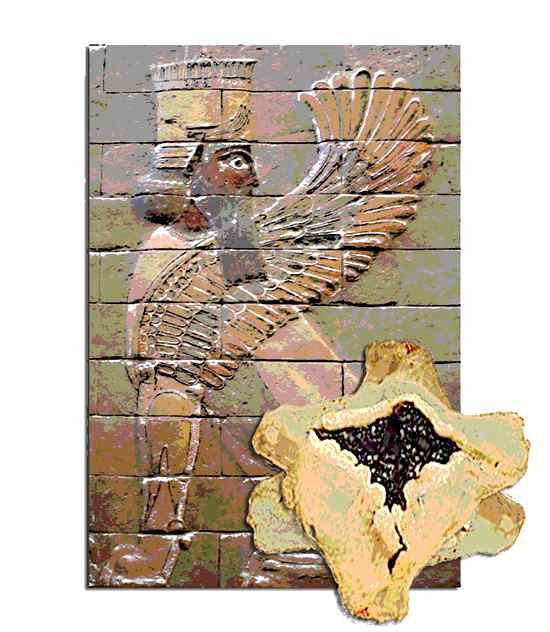
Jews celebrate this unique festival in a unique way: they encourage the liberal consumption of alcoholic beverages. (As far as I know, not even St. Patrick did that, although if you visit an Irish bar on the saint's day, coming up this year right after Purim, you might think otherwise.) The goal of Purim's hard drinking is to assist the celebrants to forget all about Haman and his ilk. The Book of Esther, known as the Megillah, is read aloud in Hebrew, having given rise to the Jewish phrase, "The whole megillah," meaning roughly, "the whole enchilada." There are special Purim cakes, three-cornered crusts filled with poppy seeds, prunes, or apricots, called hamantaschen. Purim is also an occasion for Jewish children to dress up in costumes, like Hallowe'en. But festivity aside, the whole history of Purim has an eerie resonance with what is happening today. As the French are quoted all too often, "Plus ça change, plus c'est la même chose:" the more things change the more they stay the same.

More photos and art on the subject of .

More links and bookmarks about .

| Technorati tags:

Send a message to Jonathan: coffeeblogger (at) doublesquids (dot) com


The Role of Chutzpah in Art

2:23 PM Friday, February 17, 2006

[What was Andres Serrano really trying to say?]

Chutzpah is a Hebrew word, also used in Yiddish, implying unmitigated gall, colossal nerve, unbridled arrogance, but more specifically, well, chutzpah. In a sense it's untranslatable. In today's cultural climate, we are all too familiar with chutzpah in political discourse. But what about the art world? With the exception of art which is openly political, is there an appropriate role for chutzpah? Seems to me that anyone who would like to exclude chutzpah from the art world has a hell of a lot of chutzpah. But it's not that simple.

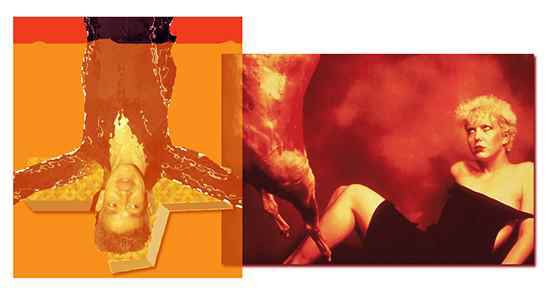
Recently, as we all know (it's old news already), Danish cartoonists had the chutzpah to portray the Muslim prophet Mohammad in a grossly insensitive manner, and certain Moslems, no strangers to chutzpah themselves, responded emphatically. The resulting media brouhaha caused a forgotten name to be brought back into the limelight, the name of Andres Serrano. Described as a native New Yorker (has anyone burned the New York State flag lately?), whose Latino name derives from his Honduran and Cuban exile parents, Serrano studied art at the Brooklyn Museum, then did drugs for a while, and later created a body of photographic work featuring KuKluxKlansmen, the homeless, and other "gross" subjects, including, and especially, disreputable bodily fluids. His most notorious work, however, was Piss Christ, a photograph of a crucifix immersed in a container of the artist's urine. As a result, he was figuratively crucified and pissed on by outraged amateur art critics in the political sphere, and is so depicted in the photomontage featured above. (No, that's not my urine, it's a Photoshop layer.) But what was Serrano really trying to say in his art? Most artists follow the WYSIWYG principle: what you see is what you got. Both Serrano and Matthias Grünewald depicted crucifixes: what was Grünewald trying to say? We can only guess. The same goes for Serrano. In fact, the same goes for the Danish cartoonists.

In the photomontage, I have added another image to that of the hapless Serrano, another of his works, entitled "The Unknown Christ." A seductively dressed woman confronts a hanging beef carcass with displeasure. Which is the Christ? Which is the raw meat? Is this image disrespectful to Roman Catholics? To vegetarian Hindus? To Methodists? To blondes? The only thing I can say with confidence about the image is that Serrano has a lot of chutzpah. So what? Is chutzpah now so banal in the art world that it only evokes boredom? Or is it in grave danger of being snuffed out by a suffocating blanket of wishy-washy, namby-pamby, smarmy, milquetoast "sensitivity"? Or both? And BTW, is cartooning art? I, for one, have the chutzpah to say, "hell, yes."

| Technorati Tags:

Send a message to Jonathan: coffeeblogger (at) doublesquids (dot) com


The Golem of Prague

5:43 PM Sunday, September 18, 2005

[And his (ulp!) ilk]

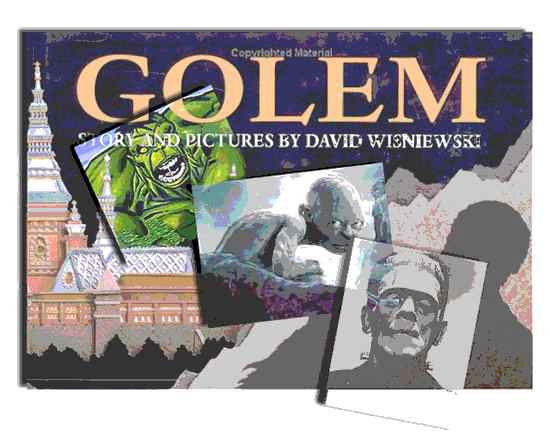
A Flickr buddy, a talented Bulgarian expatriate named Boris who lives in Toronto, recently started a Flickr group on the Golem, the subject of a Jewish legend with roots in the Bible. Whereas the most recent iterations of the Golem include Frankenstein, the Incredible Hulk, and Gollum of Tolkien's Ring saga, the definitive Golem was the Golem of Prague, said to be in permanent storage in the locked attic of an old synagogue. The general theme is that of a robot-like android animated by a misguided genius who preempts the godlike power of bestowing life on the lifeless. The android, of course, gets out of control, wreaks havoc, and has to be disabled or destroyed. Naturally, the Internet is now seen as a kind of Golem:

Norbert Wiener, the 20th Century cybernetics seer warned us in his book God and Golem, and the science fiction writer Wiliam Gibson, coiner of the word cyberspace, reportedly did the same in Neuromancer. But back to Prague. Franz Kafka, the Czech Jewish novelist was said to have walked daily past the very synagogue where the Golem's, lifeless, er, hulk was housed. The big player in the legend, however, as a brilliant rabbi named Loew (some say Loeb) who actually existed. In the legend, the rabbi, feeling very threatened by the militant anti-semites of the era (we still got 'em), made the Golem out of clay, and inserted into its mouth a password, as it were, which was the unknown and unpronounceable name of HaShem (the Name), aka (among Orthodox Jews) as G-d, which must never, ever, be taken in vain. The rest is history. And, for that matter, the future.

You have been warned. Are you ready to shut down all your computers and never go online again? Yeah, right.

An interesting etymological note: the Biblical (Psalms 139:15) word Golem is related to the Hebrew root galam, meaning " to roll or wrap up together" (poorly developed, as it were), like an embryo in a very early stage. The Latin word vulva (no, it's not a Swedish car), similarly means enveloped or wrapped, as in the words involved, convoluted, volute, and revolve. Golems may come, and Golems may go, but, as the French painter Courbet observed, the origin of the world is more interesting than any hulk, no matter how incredible.

| Technorati tags:

Send a message to Jonathan: coffeeblogger (at) doublesquids (dot) com


The Other Giotto

1:40 PM Friday, June 17, 2005

[Since when is "Schmaltz" Italian?]

Sunday afternoon, around five PM, when Midsummer is a week away and the sun is golden as it gets in the Golden State, is a strange time of transition. The weekend is not quite over, some stores are still open, there's time for a movie or a dinner out, but let's face it, it's not Saturday any more. Looming over the horizon is the day of dread, Blue Monday, when the fun will be over and the next weekend will be five long days in the future.

Returning from a Wine Country picnic, on the way home, I wanted to stop for an espresso, but this time something special. I remembered my impromptu visit to Caffe Trieste in Berkeley, where I had my first affogato, and took a detour to the same destination. When I walked in the place was buzzing because Giovanni Giotto, aka "Pappa Gianni," who founded the San Francisco cafe in 1956, was giving one of his famous music recitals for caffe patrons: a mixture of opera, American art songs, Italian-American classics, and what I call Neapolitan Schmaltz.

The word schmaltz, meaning "grease" or "fat" both in German and Yiddish, was a part of my boyhood, a reference to a certain way of playing music. Gypsies played schmaltz, or employed it in their musical art. Jewish wedding music (we called it "frailach" then; now the term "klezmer" is preferred) was schmaltzy. Romantic Russian waltzes and pop hits like "Autumn Leaves" were schmaltz to my adolescent musical ears. I loved it then, and I still do.

Rock and Roll, at least in its pure form, is totally incompatible with schmaltz. Hip hop? No way. Baroque music? No, although Vivaldi comes close. John Cage? Fageddaboutit.

So how could I apply the term schmaltz to the culture of southern Italy, where olive oil, not saturated fat, is the lipid of choice?

"O Sole Mio." "Funiculi, Funicula." "Torna a Sorrento." Listen. Learn. Schmaltz.

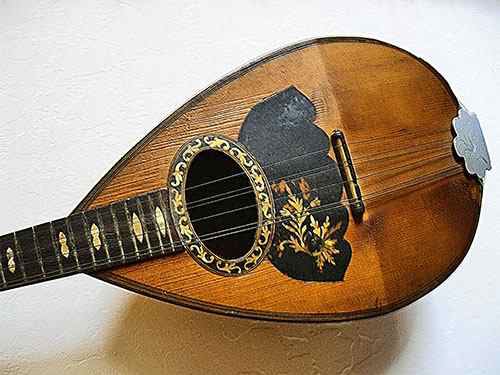
My grandfather Max A Leavitt, born in Russian Poland and Jewish to the core, played the mandolin, and passed on a crumbling "Neapolitan Songbook" when he died in 1951. My best guess is that these songs, claimed to have originated in Campania, around Naples. were part of the universal American immigrant experience about one hundred years ago. I have no idea if these songs are known or played in Campania today. Judging, however, by the enthusiasm of Papa Gianni's audience this fine Sunday afternoon, they have become as American as lasagne and bread dipped in olive oil.

The Caffe Trieste affogato, by the way, was even better than the last one. This time I asked for spumoni and vanilla gelato. Try it.

Update: judging by this website, the Canzone Napoletana is alive and well on the Italian internet.—JDL

Second Update: It seems that that Pappa Gianni's surname is Giotta, with an "A", rendering the original title "The Other Giotto" inapplicable. (The first Giotto, of course, was the Renaissance fresco painter.) Because this blogpost has now become part of Internet history, I will not change the title.—JDL

| Technorati tags:

Send a message to Jonathan: coffeeblogger (at) doublesquids (dot) com


So Much to Procrastinate, So Little Time

11:04 PM Thursday, March 10, 2005

[When is putzing around not putzing around?]

The Italians call it dolce far niente, sweetly doing nothing. In the Ashkenazi Jewish diaspora it's called putzing around. Today is a good day for it. It's a preview of spring, the Espresso Roma terrace is replete with gay chatter (not that kind of gay, the other kind of gay), and, as I write these words, it's three minutes before 3:00 PM—the hour at which most of the day has been shot to hell.

Riddle: when is putzing around not putzing around?

Answer: When a blogger is writing his or her next post.

If the blog is not updated, the Earth will still rotate on its axis, the universe will still be expanding, certain quarks will still have charm, politicians on both sides of the aisle will still be planning to raise taxes, and the gods and goddessess will still be duking it out as to who is the most omnipotent, or in some cases, as to who owns the exclusive rights to godliness.

In college I had a Japanese chum named Keisuke, whose favorite expression, stated in English with a strong Japanese accent, was "It is of no importance." It was only many years later that I realized that Keisuke was the only Zen master I would ever have, or ever need. Ah so desu. To putz or not to putz? It is of no importance.

It is Saturday, now 12 minutes after three. In few days it will be Monday, and I as a loyal American, will again believe that paying and sending out my bills, answering my non-urgent phone calls, working on my many projects, will again be important, moreover of the utmost extreme importance. But it will all be illusion, will it not, the eternal cycle of birth and death? Won't it?

Ah, but on Monday such Far-Eastern mystical questions and doubts will be of no importance. (Written Saturday, March 5, 2005 2:55 PM US/Pacific) —JDL

Send a message to Jonathan: coffeeblogger (at) doublesquids (dot) com


Yule for Jews?

1:57 PM Friday, December 24, 2004

[The festival which dare not speak its name]

As a kid I was raised as a Jewish Socialist, meaning that I got a double-dose of Christmas guilt. As a Jewish child I was not supposed to get sucked into Christian proselytizing and as a Socialist I was not supposed to get sucked into the "opium of the masses." But I lived only a few miles from Bethlehem, Pennsylvania, the "Christmas City" and site of one of the world's most spectacular nativity scenes, the Moravian Putz. (That's right, it's called the Putz. The word has radically different connotations in Yiddish and Moravian German.)

Those of you who read my previous blog entry From Solstice to Santa will know that I have become fascinated by the whole history of the holiday celebrated on December 25. This is very timely because of the "Happy Holidays" controversy: many, including me balk at the smarmy bland politically correct greeting ("the festival which dare not speak its name"), whereas others, including blogger Virginia Postrel, are not so bent out of shape about it.

The other issue raised annually for Jews is the use of Hanukkah as a Jewish substitute for Christmas. The two holidays share a few things in common: candles, lights in the darkness, and a theme of redemption.

But Hanukkah is also about oil (vegetable, not petroleum) and regime change in the Middle East (Seleucids, not Baathists). Frankly, I don't really buy the Hanukkah-Christmas connection.

So what's a Jew to do?

It's widely assumed that "yule" is a synonym for Christmas, which is literally, the eucharist service (missa, Latin) for the Anointed (Christos, Greek). But the word, related to "jolly", comes from Old Norse and predates Christmas (see below).

Personally, I like the idea of "Yule." Christians who want to celebrate the birth of Jesus on Yule are free to do so, but those of us who don't want to overlook the pre-Christian roots of the holiday can enjoy the horned gods and white-bearded bearers of merriment. If I were "frumm" or "haredi" (Yiddish and Hebrew respectively for pious Orthodox Jews), of course I would not celebrate a pagan holiday. But I am not, and so I will.

With one exception this year: I will not burn a yule log. Instead I will post a yule blog. And wish everyone a Jolly Yule.—JDL

yule

O.E. geol, geola "Christmas Day, Christmastide," from O.N. jol (pl.), a heathen feast, later taken over by Christianity, of unknown origin. The O.E. (Anglian) cognate giuli was the Anglo-Saxons' name for a two-month midwinter season corresponding to Roman December and January, a time of important feasts but not itself a festival. After conversion to Christianity it narrowed to mean "the 12-day feast of the Nativity" (which began Dec. 25), but was replaced by Christmas by 11c., except in the northeast (areas of Danish settlement), where it remained the usual word. Revived 19c. by writers to mean "the Christmas of 'Merrie England.' " First direct reference to the Yule log is 17c.

January

c. 1290, Ieneuer, from O.N.Fr. Genever (Fr. Janvier), attested from c.1120 in Anglo-Fr., from L. Januarius (mensis) "(the month) of Janus," to whom the month was sacred as the beginning of the year (see Janus; cf. It. Gennajo, Prov. Genovier, Port. Janeiro). The form was gradually Latinized by c.1400. Replaced O.E. geola se æfterra "Later Yule."

jolly

c.1305, from O.Fr. jolif "festive, merry, amorous, pretty" of uncertain origin (cf. It. giulivo "merry, pleasant"), perhaps from O.N. jol "a winter feast" (see yule), or from L. gaudere "to rejoice." Jollification "merrymaking" is from 1809; shortened form jolly led to phrase get (one's) jollies "have fun" (1957). A jolly boat (1727) is probably from Dan. jolle (17c.) or Du. jol (1682), both related to yawl (q.v.); or it may be from M.E. jolywat (1495) "a ship's small boat," of unknown origin.

Send a message to Jonathan: coffeeblogger (at) doublesquids (dot) com


blog comments powered by Disqus Comments (View)

Go: [ Home | Previous | Archive | Gods & Myths | Cafes | Coffee | Nations & Empires | People | Arts ]
[ Words | New Media | Cinema | Gastronomy | Productivity | Yiddish ]

Add to Technorati Favorites

Copyright ©2004, 2005, 2006, 2007, 2008 Jonathan David Leavitt. All rights reserved.