[Tsatskes]


Twitterverse Coffee
Popular Coffee Websites

Cafes by Zip Code
Coffee Podcasts

[Readers]

Locations of visitors to this page

[About]


[Blogroll]

43 Folders
Anders Fagerjord
Bay Area Bloggers
Berkeley Blogs
Blue Bottle Clown College
Cafexperiment
Coffeegeek
Denver Coffeehouses
Dogmilque
Doug Miller
Emily Chang's eHub
Hewn & Hammered
Jill's Definition of Weblog
Jonas Luster
Laughing Squid
Le Blaugue à Beleg
Loïc Le Meur Blog
Mark Bernstein
Moleskinerie
Seesmic Blog
Tant Mieux
The Dynamist
Tonx Dot Org

[Go]

Send Me Email:

coffeeblogger (at) doublesquids.com

Other Berkeley Blogs


SF Bay Bloggers
<<
#
Blogs That Flickr
?
>>
Blogcritics: news and reviews
Who Links Here


"The meaning of life and other trivia." Copyright ©2004, 2005, 2006, 2007, 2008 Jonathan David Leavitt. All rights reserved.

Every page now has Seesmic/Disqus video commenting. Scroll to the bottom to see or post video comments. There are also Haloscan comments at the end of each separate blogpost article. To read a text-only version of Jonathan's Coffeeblog on your iPhone or other mobile phone, click here. Or to see the graphics with less text, click here.

Go: [ Home | Previous | Archive | Gods & Myths | Cafes | Coffee | Nations & Empires | People | Arts ]
[ Words | New Media | Cinema | Gastronomy | Productivity | Yiddish ]

Chili

10:45 AM Wednesday, May 21, 2008

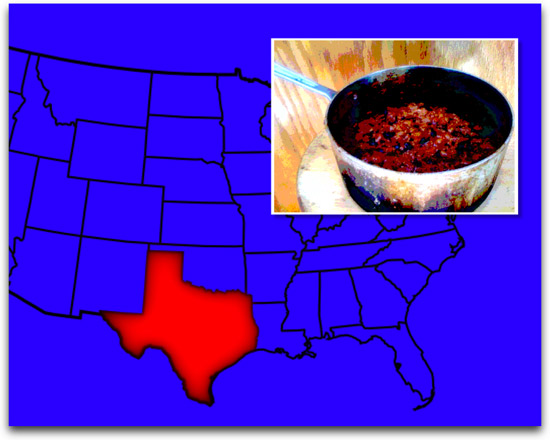
[Yes, there is the bean question.]

Chili con Carne (Texas)

On an unusually hot day last week I wanted to eat something substantial but not heavy in a local restaurant. I ended up sharing a salad and ordering a huge glass of ice tea and a cup of chili, a food that I usually ignore. The chili was just right for the occasion, and I realized that chili is a dish worthy of more attention. This blogpost is the result of that attention. (I also cooked and just ate some homemade chili just before writing this last night.) Chili, of course, is the standard American English name for chili con carne, meaning a sauce made from a Southwestern capsicum pepper combined with meat. (The Spanish spelling is "chile con carne.") Chili, the dish, is a proletarian workhorse in the USA, eaten by the cup or bowl in diners and road-houses, with saltine crackers, spread on frankfurters (sausages) in a "hot dog" bun, even eaten on spaghetti (in Cincinatti, Ohio), and available as an instant meal in cans. There are several things I find especially fascinating about chili: the seemingly infinite variation in its recipes and preparation, and the quest for its origin. But first a personal story.

In eighth grade (late 1950's, small-town Pennsylvania) girls took courses in cooking and sewing ("home economics") while the boys learned woodworking. However, my school had a special crossover program where the boys learned how to cook simple dishes and sew a woodworker's apron, while the girls learned to make a jewelry box. The first recipe taught to us boys was a peanut butter sandwich. A week later came the next lesson: that's right, chili con carne. It was made with ground beef, and ingredients I now avoid in my chili: onions and canned tomatoes. Even so, it was delicious.

An organization called the Chili Appreciation Society International sponsors an annual chili "cookoff" in a Texas town called Terlingua, near the Mexican border. Contestants come from other chili cookoffs including the men-only Chilimpiad, also Texas-based.

And this leads to the question about the origin of chili. Is it Texan, Mexican, or from somewhere else? My opinion is that chili is quintessentially Texan, and this Mexican culinary website apparently agrees, calling the dish "estilo tejano." I will present my evidence for the Texas hypothesis, but first I think a more definitive description of the dish is in order.

As the name implies, chili con carne is basically chili with meat. Chili is New World genus of the nightshade family, whose name was derived from Nahuatl, the language of the Aztecs, who called it xilli and cultivated it 5000 years ago, as found in pots from archaeological digs. The chili pod is now, of course enjoyed worldwide. In Thailand, for example, meat is combined with chili peppers, but the result is not chili con carne. What makes the Texas dish unique is the sauce, prepared from dried long red chilis that have been rehydrated, giving a distinctive flavor that is not merely the "hot" burning sensation of the capsaicin contained in the pepper. Adding tomatoes to the chili and meat, as my eighth-grade cooking teacher advised, merely extends the red color of the sauce without adding to the chili flavor. Chili powder, made of ground chilies with other ingredients, is a convenient way to add some chili flavor, but there are better ways, including starting with dried chilies (New Mexican dried red chilies may be the best), soaked, pureed, and cooked.

Then there is the question of additional ingredients. I consider myself a chili minimalist, but I cannot conceive of making chili without garlic. Perhaps that I because I am Jewish. Oregano and/or thyme can't hurt. In addition to herbal condiments, there is the bean question. I consider beans to be an optional ingredient, but a valuable one for texture and fiber content. The chili I made last evening contained ground beef, canned Las Palmas brand red chili puree (saving hours of prep time), and a can each of black beans and pinto beans, garlic, and a pinch of thyme (I couldn't find my oregano). I started it with sauteed chopped celery and I would have added chopped green bell pepper if I had any. Vegetarians, of course, could make chili with vegetables and beans without the meat.

OK, Texas. Wikipedia tells me that women sold chili on the public square in San Antonio in the 1880's, amd there was a "San Antonio Chili Stand" at the 1892 Columbian Exposition in Chicago. "Chili Parlors" have long thrived in Texas, including Dallas, and Wikipedia says that chili con carne is the official Texas state dish.

More Links:

More Images:

Permanent Link to This Entry | | | Technorati Tag:

Send a message to Jonathan: coffeeblogger (at) doublesquids (dot) com


The Gefilte Fish Line

11:00 PM Monday, February 18, 2008

[Sugar? In fish?]

Litvaks v Galitzianer

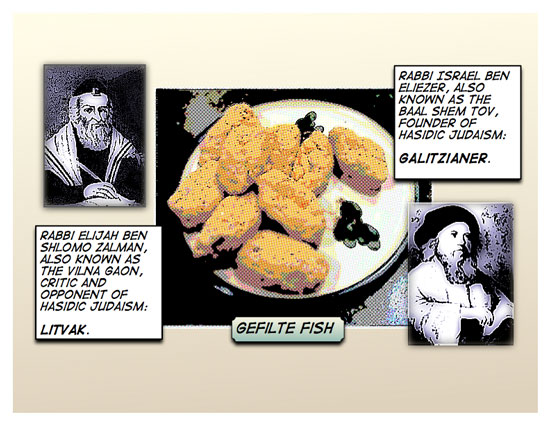
The plot, like the jelly which surrounds a piece of gefilte fish, thickens. I am referring, of course, to knowledge I have gained since my post about Yiddish. It appears that my mother's parents, both Jews, were each born on the other side of a great linguistic-religious-culinary divide known to mavens of Ashkenazi gastronomy as the Gefilte Fish Line. (Thank you, Michael Steinlauf.) All right. I realize that some of my readers are vegans, Shia or Sunni Muslims, and possibly High Church Episcopalians. Therefore I must explain what gefilte fish is before I go any further: The Jewish holiday of Passover will be coming up soon (April 20, to be exact), and in those stores which sell Passover food (most urban California supermarkets do), you will find jars of lozenge-shaped fish patties swimming in juice or jelly. That is the mass market version. To the Jewish women from whom we are descended, however, gefilte fish was a delicacy made from fresh-water fish, bones carefully removed, then lovingly shaped into fish-like shapes, cooked, and served with horseradish. The most fanatical gefilte fish makers would actually stuff the skins of the fish used to make the delicacy with the fish mixture: hence gefilte, or "filled." However, my own eyes have never observed an actual stuffed fish version of the dish.

Now, as the Shia Muslims, and perhaps even the Episcopalians (but not the true vegans) are undoubtedly asking, what is the best kind of fish from which which to make gefilte fish? For the answer, I must turn to an original source, and there is no more reliable source than my own grandmother. The answer, as I learned in my childhood: pike, whitefish, and buffle. Buffle? Did she mean buffalo fish? I think not. I think she meant buffle. So if you can't find buffle in your local fish market, you are already compromising your standards for the finest gefilte fish.

And here is the point of departure for the thickening plot, and the linguistic-religious-culinary divide to which I referred earlier. You see, even though my grandmother knew how to make the finest gefilte fish, she never made it for my grandfather. (I just learned that in an email from my mother). But why not? My dear departed grandparents have taken the answer to their graves, so we can only conjecture. And my conjecture is this: my grandfather was a Litvak, and my grandmother made Galitzianer gefilte fish.

Today, even most Jews don't know the difference between a Litvak and a Galitzianer, and I certainly didn't until recently. But a big difference it was, with roots, ultimately, in theology. And if there are any two things that Jews can and will fight each other about, theology and food are those two things. Remember the Pharisees and the Sadducees? They argued about food too, specifically the burnt offererings in the Temple.

Now the Litvaks lived mostly in Lithuania, a territory long dominated by Russia, where they founded schools of higher religious education know as yeshivas, with high intellectual standards and rigorously legalistic debates. The Galitzianer, who lived east of the Gefilte Fish Line, in territory that was dominated by Austria, came under the influence of a highly emotional, charismatic form of Judaism known as Hasidism. Remember that Austria is the land of viennoiserie, breads which are sweetened, and of course Sachertortes, Linzertortes, another other sweet goodies consumed with that famous Viennese beverage, coffee. (They drink it with whipped cream on top, I hear.)

So who would be surprised if the Galiztianer might put a little sugar, just a pinch, into their gefilte fish? A Litvak, that's who. Sugar? In fish? That does not compute, and Litvaks were into computing long before their descendants had computers. What would one expect from the kind of people who dance around in fur hats singing yam-bim-bam and only putting 9 hours a day into studying Torah instead of 14 hours?

The battle between the hair-splitting Litvak intelligentsia (called Mitnagdim) and the Galitizianer holy-rolling Hasidim raged on for centuries, and probably still does. And if that wasn't bad enough, they pronounce their Yiddish differently. A Litvak Jew named Moyshe Pupik, for example, should he have wandered recklessly across the Gefilte Fish Line, would have been addressed as "Meysh Pipik," and would have had to endure it as well as gefilte fish with (feh!) sugar in it.

So, then: what is in the supermarket gefilte fish which comes in jars? The Manischewitz website doesn't say. You can get 14 different kinds, including "whitefish" and (get this) "sweet whitefish." There is jelled and not jelled. And none of the 14 kinds contain any buffle. They are all, however, certified kosher. Be that as it may, don't expect the "sweet whitefish" to be kosher for Litvaks.

More Links:

More Images:

Permanent Link to This Entry | | | Technorati Tag:

Send a message to Jonathan: coffeeblogger (at) doublesquids (dot) com


Oil and Regime Change

4:12 PM Saturday, December 8, 2007

[Jews confront a Syrian Nut-Job.]

Hanukkah

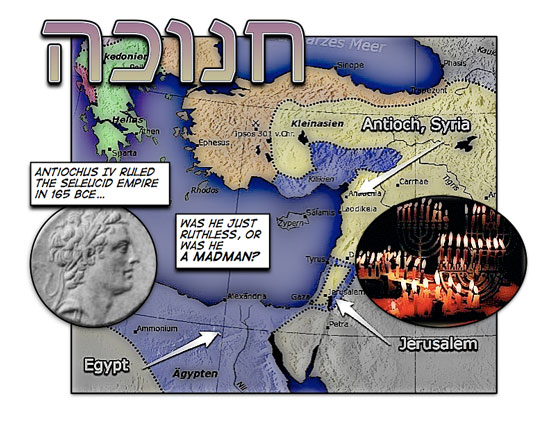
It's Hanukkah again, 5 candles tonight. For Jewish children living in Christian lands, Hanukkah has become a substitute for Christmas. In fact, it is nothing of the sort. The Jewish holiday is celebrated on the 25th day of Kislev, which is a Babylonian name for a month which occurs around the same time as the Roman month of December. The resemblance ends there. The first Hanukkah commemorates an event which took place in Jerusalem 164 years before Jesus was said to have been born nearby in Bethlehem. The event was the rededication of a temple rebuilt on the site of a previous temple built by King Solomon. The word Hanukkah, in fact means "dedication." There is a villain in the story: the king of Syria, Antiochus IV, whose admirers called Epiphanes, meaning "shining" in Greek. The Jews had another Greek name for him, Epimanes, which, translated into the contemporary American vernacular, means "Nut-Job."

The rededication of the Jerusalem temple had become possible because of regime change. The Jews had deposed Antiochus IV the Nut-Job and replaced him with their own Jewish royal dynasty, the Hasmonean Dynasty, which lasted until the Romans put their client king Herod on the throne 102 years later.

Did Antiochus deserve the epithet Nut-Job? The historical record suggests that he was overly fond of stirring up trouble unnecessarily for his subjects and for his kingdom, which he had inherited from one of Alexander the Great's generals by the name of Seleucus. Upon Alexander's death, the generals divided up his empire, and Seleucus got a huge area whose capital was Antioch (named after an earlier king Antiochus), then in Syria.The Seleucid Empire, as it was called, extended to half of today's Turkey, all of today's Iran and Afghanistan, and a chunk of India. Rule was passed down from one king to the next, but Antiochus IV the Nut-Job wanted more than what he inherited, and made war against Ptolemy IV of Egypt, heir to another of Alexander's generals. In between Syria and Egypt, as it is today, was Jerusalem, with its temple, which no longer exists. (Destroyed by the Romans after the time of Jesus, the temple lay in ruins until a Muslim caliph built a mosque on the ruins in the year 687 of the Christian Era.)

Antiochus IV Epimanes at first successfully conquered Egypt, but when he went back for yet even more, the Romans, who at the time had a republic, not yet an empire, decided to draw the line. In that case, the line was literal, a circle drawn in the dirt around Antiochus himself. A no-nonsense Roman diplomat named Gaius Popillius Laenas informed Antiochus that he must make a decision before stepping out of the circle: pull out of Egypt, or consider his kingdom at war with Rome. Antiochus thought about it, then told Popilius that he would cooperate fully with the Roman Senate, and stepped over the line to seal the deal by shaking hands with Popilius.

Antiochus Epimanes did withdraw from Egypt, but on his way back he decided to vent his frustration on the Jews. That, dear readers, is what led to the first Hanukkah. He imposed new taxes on them, and then went on a murderous rampage, torturing Jews (cutting out their tongues, stuff like that) and banning the possession of Jewish scriptures. (Remember, the Jews are called the People of the Book.) In case that there was any doubt that Antiochus was Epimanes, he took over the Jewish temple and rededicated to Zeus, chief god of the Greeks. Finally he had his men sacrifice pigs in the altar of the Jewish Holy of Holies.

Now, if you're looking for trouble, one very easy way of finding it is to invade the most sacred building belonging to a middle-Eastern monotheistic sect of people descended from Abraham, and sacrifice a pig inside it. Trouble is what Antiochus Epimanes was looking for, and trouble was what he got. In this case the trouble arrived in the form of a man named Judah "The Hammer" and his brothers, of the Hasmonean family. They and their Jewish guerilla fighters basically booted Antiochus and his Syrian army out of the Land of Israel, and the rest is history. Except for one thing: the oil.

Now oil in those days was not pumped out of wells in the earth, but manufactured by pressing olives. Though not used for transportation purposes, it was used for lighting, cosmetics, anointment of kings, and of course, food. It was precious. Most importantly, for the purpose of rededication of the temple, the Jews had to obey a Biblical commandment:

And thou shalt command the children of Israel, that they bring thee pure oil olive beaten for the light, to cause the lamp to burn always. (Exodus 27:20-22)

When the Jews cleaned the pork, lard, and other chazzerei out of the temple, they found a small container of oil left over from better times. It appeared to contain enough oil for a day, which meant that the light would go out before they could get enough olives and equipment to press more oil for the lamp. After all, it was called then, and now, the Eternal Light, and was symbolic of the eternal God. Watching the lamp go out would have been horrendously demoralizing to the Jews who has seen their relatives tortured and their books confiscated. And that's when the Miracle happened. No, the Miracle was not merely Jews expelling insane, violent Syrians from their territory. That's not a miracle. That's just business.

The Miracle, attributed by believers to God, was that the oil lasted for a full eight days, before the end of which, more oil was pressed, blessed, and readied for the lamp. And that's why Hanukkah lasts for eight nights and days, with candles burned until eight candles are burning on the eighth night. And, oily food must be consumed. There is no such thing as a low-fat Hanukkah. In Israel they eat jelly donuts, but us Jews from Northern Europe celebrate by frying spoonsful of grated potatoes and onion. Gastronomes might call them "fritters", but we call them latkes. And whenever we eat latkes we think of many things, and one of the things that we think about is this: It could happen again. The oil could run out. Because of the insane behavior of some nut-job.

Photo Credit (for the Hanukkah lights): Beth Brewer (Flickr)

More Links:

More Images:

Permanent Link to This Entry | | | Technorati Tag:

Send a message to Jonathan: coffeeblogger (at) doublesquids (dot) com


OMGWTFBBQ!

7:46 PM Tuesday, July 3, 2007

[Wondering if barbecued frog is on the menu.]

OMGWTFBBQ!

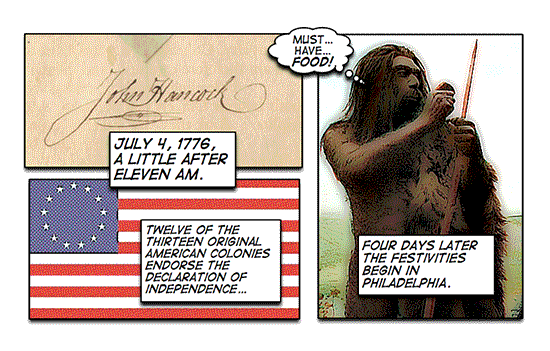
Barbecue was invented in Milwaukee, Wisconsin in 1935 by Gilbert Hockenberry, a haberdasher and amateur chef. Prior to then, all meat was either eaten raw, boiled, or buried with hot rocks. I'm kidding, right? Yes, I am kidding indeed. The necessary components of barbecue invention are a stick, a fire, some kind of dead animal, and a hominid species with a sufficiently large brain to figure out how to put them together and how good it would taste. Neanderthal Man had large braincases and noses, and there is evidence that he controlled fire, says Wikipedia, so it's possible that barbecue was invented by another hominid species than ourselves.

But the name, barbecue, or its abbreviation, BBQ, or OMGWTFBBQ among its hungriest and most enthusiastic fans, where did that come from? The usual attribution for the word origin is the language of the indigenous Taino of the Bahamas, who also reportedly gave us the words tobacco, hurricane, and hammock.

Since barbecued meat has probably been consumed by all non-vegetarian peoples of the world from time immemorial, it would be presumptuous to attribute to it a particular American character, given its connection with the July 4 Independence Day holiday. While it is said that there are certain jobs that Americans are unwilling to do, being presumptious is not one of them, so allow me, please. American barbecue's strongest traditions are centered on the southern and western heartlands, away from the coast. In hog country (Dixie), pork is barbecued, and in cattle country (the West, of course), beef is the specialty. That set me to wondering if barbecued frog is on the menu in France. I'm kidding again, right? Well, click on this link and tell me if I'm kidding. (It helps if you read French: cuisses de grenouilles means frog thighs.) The recipe sounds pretty good, actually: lots of garlic. BTW, those heartland American barbecue chefs distinguish barbecue, which is slow-cooked off the fire, from mere grilling with more direct heat.

So what is the July 4 holiday all about, besides its barbecues, its association with fires and fireworks, and its proximity to Midsummer's Day? On July 4, 1776, delegations from twelve Royal British colonies voted to support Thomas Jefferson's Declaration of Independence, which was signed by John Hancock on their behalf, and sent to the printers. The bonfires didn't start until July 8 in Philadelphia, and New York State abstained from the July 4 vote. (The ornery cuss tradition goes back far in New York, my birthplace.) And what did Jefferson say in the Declaration? Well, in Canada, the motto is "peace, order, and good government." But Jefferson, needing votes from ornery cusses from Maine to Georgia, had to come up with something more stirring. So he wrote, "life, liberty, and the pursuit of happiness." Even a Neanderthal can dig that.

More Links:

More Images:

Permanent Link to This Entry | | | Technorati Tag:

Send a message to Jonathan: coffeeblogger (at) doublesquids (dot) com


Hamburgers

8:50 PM Sunday, January 21, 2007

[Definitely not overcooked.]

McDonalds' in Hamburg and Elsewhere

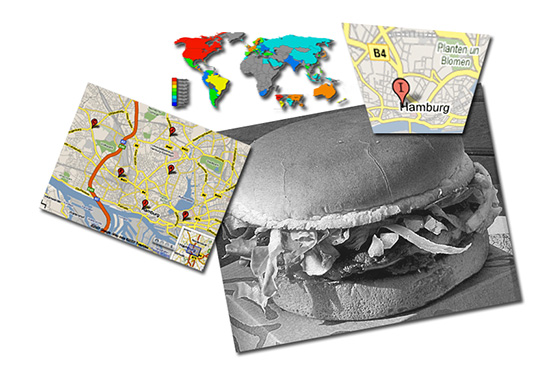
Meatballs have been eaten all over the world for time immemorial. Flatten one, put it in a bun, and you've got a hamburger. Hamburgers are now considered an American dish, but I have always wondered if they eat hamburgers in Hamburg, the north German port. Thanks to Google Maps. I now know. The Google map part of the photocollage shown above reveals the locations of McDonald's restaurants, which indicates that Hamburgians do indeed eat hamburgers. However, a long, fershlugginer internet search has only produced disputed claims about the origin of the name of the American hamburger, so I will arbitrarily assert my own theory: Meatballs, with or without bread are important fare in the cities of the old Hanseatic league on the Baltic, including Denmark, where meatballs are called frikadeller. In the mid-19th century, there was a vast immigrant wave from northern Europe to the USA, often crossing the Atlantic on ships sailing from Hamburg. One might easily presume that frikadeller would have been consumed before, during and after the voyage since chopped meat of dubious origin is cheap, and the name "Hamburger steak" would have been applied to such food, as it still is in the southern USA. The rest is history.

Now on to a comparative gastronomic tour of three hamburger restaurants in my local area (northern California), beginning with Barney's, with ten locations surrounding San Francisco bay. Barney's is where I go when I want dinner for under ten dollars and a "decent" hamburger. I always order the Barney burger, medium rare but definitely not overcooked, which comes unadorned on a bun with lettuce, tomato, onion, and pickle, without all the Baroque trappings which are also available (as they would say in Hamburg, "ohne Putz") and lately I have being eating it without condiments (not even ketchup!) to best enjoy the taste of good beef, with the bread only to absorb some of the juice and to enable me to hold the meat in my hands. That is a hamburger as the gods created it. If it's trappings you want, Barneys has the bacon cheese burger, the Greek burger with feta cheese, the Popeye burger with spinach, and others; they even have burgers made from turkey, vegetables, or tofu for beef avoiders.

But what of McDonald's, which now has restaurants everywhere except for central Africa, central Asia, Greenland, Vietnam, and Burma, and perhaps a few other places? (See the little world map: all the areas in color have McDonald's.) At times when I needed to eat some protein fast I could get a double cheeseburger for a dollar: 25 grams of all-beef protein. Yeah, there still is trans-fat in it and what about the rain forest, but hey, this is not a perfect world. I can't help thinking that McDonald's has done more for the American poor by selling them an affordable hamburger that many government programs. And now, I'll stop such talk before I alienate my government-loving, McDonald's-hating Berkeley friends. (Yes, it's true, I did once write a Coffeeblog post from a McDonald's.)

So, what's left? Why, In-N-Out Burger, of course. The California chain, which began in Irvine (south of and a little bit east of Disneyland), serves the kind of burgers I remember from when I was a child in the 1950's. Fresh ingredients, good meat, fast service, In-N-Out specializes in hamburgers and only a few side dishes such as fried potatoes. If you want tofu, you've got to go to Barney's or to a Chinese or Japanese restaurant, and if you want an Egg McMuffin, you've got to go to McDonald's. It is said that The Buddha taught what he referred to as the Middle Way, a path that led to enlightenment by avoiding the extremes of sensory self-indulgence and self-mortification. That could apply to hamburgers too. Between Barney's and McDonald's, there is the Middle Way of In-N-Out Burger. Welcome to California.

More Links:

Other Images:

Permanent Link to This Entry | | | Technorati Tag:

Send a message to Jonathan: coffeeblogger (at) doublesquids (dot) com


The Croissant

3:34 PM Thursday, October 5, 2006

[She makes you think of a latte.]

Perhaps the original and ultimate Continental breakfast consists of coffee, milk and a croissant, the crescent-shaped flaky pastry of debatable origin. Here and now, I will reopen the debate. The word croissant is French for "crescent," the way the moon appears when lit by the sun from the back and side. In France the croissant is a kind of viennoiserie, a bread-like pastry which has been sweetened like a cake. The term is associated with Marie Antoinette, the Austrian archduchess who married the French King Louis XVI.

Like milk being steamed in a coffeehouse, the plot thickens. According to legend, the Viennese version of the croissant was created as a celebration of the defeat of the Ottoman Turkish Empire on a hill outside of Vienna in 1683. Vienna's coffeehouses are said to have been started with coffee left behind by retreating Turks. The Ottoman flag at the time had a golden crescent on a red background. Today's Turkish flag has a crescent with a star on a red background, and is called Ay Yildiz, translated as "moon star." The crescent, with or without the star, is often considered to be a symbol of Islam, as in the Red Crescent organization, the equivalent of the western Red Cross in Muslim lands.

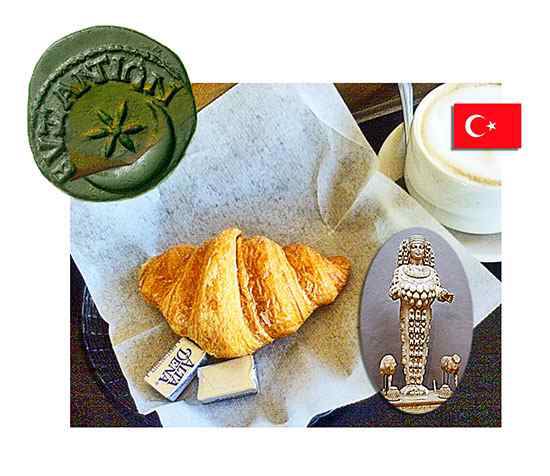
The plot, however, thickens more. As far back as 670 BCE (before Christianity and Islam), the citizens of the Greek city-state Byzantium reportedly declared the crescent moon as their state symbol in honor of Artemis, goddess of the moon and of hunting. (Wikipedia). The crescent long before that had been the symbol of goddesses including Artemis. In the photocollage above, a statue of Artemis is shown along with the Turkish flag and a coin from Byzantium, which even includes the star, long since associated by non-Muslims with Aphrodite (Venus) and the Virgin Mary (Stella Maris, the Star of the Sea). You will note that Artemis, sculpted as shown (the Artemis of Ephesus) might not remind you of a croissant, but she sure makes you think of a latte. The Wikipedia says that the Ottoman Turks adopted the symbol of Byzantium after they captured Constantinople, the name of the same city when it was the capital of the Eastern Roman Empire. Today it is the capital of Turkey and is called Istanbul. (From Jonathan's Coffeeblog).

More links:

More Images:

Permanent Link to This Entry | | | Technorati Tags:

Send a message to Jonathan: coffeeblogger (at) doublesquids (dot) com


Roast Your Own

1:16 PM Friday, September 22, 2006

[How the extremely hip prefer to do it]

I used to roast my own. Coffee, that is. It was back in the sixties, and I was living in a little basement apartment in Chicago. I had an Italian Moka coffeepot, which was how people made their own "espresso," but the proper coffee was not available outside of Italian specialty stores. I bought A&P's "eight o'clock" coffee beans, roasted them in a skillet over an electric stove, and then ground them. I think I had a hand grinder. I don't remember, but if it was, I wish I still had it.

Now lots of people and even some small cafes roast their own. I have read that the Ethiopians use to roast their own in butter right at the table when they served coffee. They invented the stuff (coffee as beverage, not coffee beans. The gods invented coffee beans.) My cousin who lives near Seattle roasts his own with a recycled thrift store corn popper, which is how the extremely hip prefer to do it. He and his wife make great coffee. They scrupulously avoid scorching it and they get their beans by mail-order from Oakland, of all places.

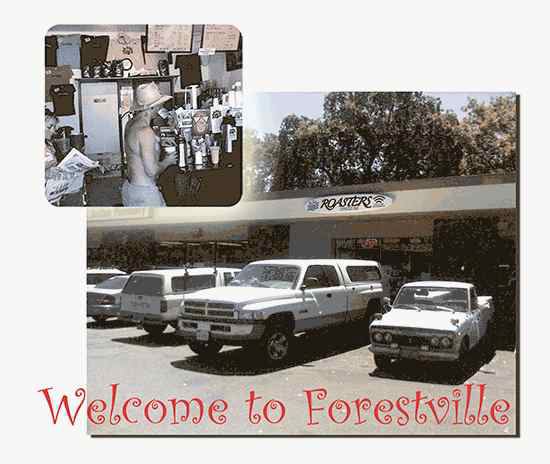
I don't roast my own any more. In fact, I rarely brew my own, although I have the gear to do so. I have fallen for the sales pitch of the global premium coffee roasting cartel, epitomized by Victrola Coffee and the somewhat more corporatized Peets. They recommend professional roasting, a combination of art and science, and consumption of the roasted coffee within a few days after roasting. In rural Forestville, California, I recently found a place which roasts its own. It is in a hideous little strip mall, but the coffee beats Starbucks in an area where good coffee is hard to come by. I tasted some espresso, and unlike the product elsewhere, it was drinkable. On the other hand, it was nothing to blog about for Mother, unless you have another angle, such as roasting your own.

Permanent Link to This Entry | | | Technorati Tag:

Send a message to Jonathan: coffeeblogger (at) doublesquids (dot) com


The Seven-Dollar Cheese Sandwich

2:50 PM Monday, July 17, 2006

[Imperial superpowers and their cheese sandwiches]

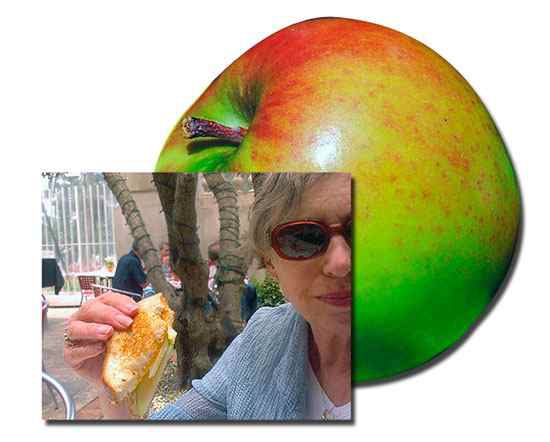
By now, the cheese sandwich has become irreversibly identified in the popular imagination with the phenomenon of weblogging (blogging), and therefore the evolution of the humble lunch item is worth following along with the evolution of the blogosphere itself. Case in point, the seven-dollar cheese sandwich consumed today by the Duchess of Kensington (no, she is not really a duchess, but she is from Kensington, California). The occasion was the "Monet in Normandy" art exhibit at San Francisco's Palace of the Legion of Honor, a handsome replica of the original Hôtel De Salm in Paris. The venue was the lovely cafe with a garden terrace. I realize, of course, that the gorgeous setting in which the cheese sandwich was consumed was worth something, so I was not totally surprised that it would cost more than the cheese sandwich one might be served, say, at a Woolworth's lunch counter. (Does Woolworth's still exist? Do lunch counters still exist?) Nevertheless, the management of the Legion of Honor cafe must have realized that seven greenbacks for a cheese sandwich could appear somewhat steep, unless the cheese sandwich were enhanced with value-adding ingredients. And so, these cheese sandwiches were not filled merely with cheese, but had apple slices added. Not just any old apples, mind you, but crunchy, tart, pie-ready Granny Smith apples.

As everybody knows, apples are good for you. An apple a day keeps the doctor away. Stuff some apples and some ground-up chicken parts into a sausage casing and you have a truly healthy sausage, unlike the kind that is made of ground-up pork. (At least that's what we do and believe in Northern California). By that logic, the managers of the Legion of Honor Cafe have not only transformed the humble cheese sandwich into a pricy gourmet specialty, they have turned it into health food. Cuisine worthy of the Duchess of Kensington. And it gets even better. The Duchess' cheese sandwich was made with cheddar, an iconic American cheese (not to be confused with "American Cheese," which is not really cheese.) Put together cheese and apples and you start to think of apple pie with a slice of cheddar on top: the quintessential symbol of the United States of America, the world's only remaining imperial superpower. Based on the 2004 election, close to half of us Americans probably feel uncomfortable with our status as citizens of an imperial superpower, nevertheless few of us would repudiate apple pie. If patriotism is indeed the last refuge of scoundrels, then apple pie is the last refuge of the American patriot.

We must, however, give credit where it is due: to a formerly glorious imperial superpower, which may be the originator of the value-added cheese sandwich, where they call it the croque-monsieur, and which contains, not apples, but sliced ham. I realize that French citizens of today, or at least their elected officials, are enthusiastic not only about cheese, but about anything that's value-added, especially the value-added tax. The first croque-monsieur, however, was reportedly served in a Parisian cafe on the Boulevard des Capucines in the year 1910, according to the Larousse Gastronomique, who should know. Unlike the apple-slice cheese sandwich nibbled by the Duchess, the pork-laden croque-monsieur is not fare suitable for observant Muslims, Jews, or vegetarians, but for apostates like myself, if I were blogging from Paris today, I would be eating a croque-monsieur as I write this. Now on to the question, has the seven-dollar (5,53 Euros at today's exchange rate) cheese sandwich arrived in France? I don't what they charge for a croque-monsieur at Le Dôme, La Rotonde, Brasserie Lipp, Les Deux Magots, or the Closerie des Lilas, if indeed they serve the humble dish at such places, but this website informs me that one can be had (scroll down) for a mere 1,80 Euros.

More links: Cheese Sandwich Croque-monsieur Apple Pie Granny Smith

More Images: .

Permanent Link to This Entry | | | Technorati Tags:

Send a message to Jonathan: coffeeblogger (at) doublesquids (dot) com


Espresso Roma Hopkins, Berkeley

1:35 PM Saturday, May 20, 2006

[Do we like our food in Berkeley?]

My traffic software just informed me that a French internaute (look it up) just spent 5 minutes and 53 seconds viewing 5 pages of Jonathan's Coffeeblog, primarily interested in the Cafe page, having been led there from an image on Google France. I then took another look at my Cafe page to see just what made it so interesting (cafés are not exactly a radical new concept in France), and I discovered that I hadn't posted a Cafe item in over a month. (And I have the chutzpah to call this a coffeeblog!) I decided forthwith to write a Cafe item, which this is. But where to start? As Aunt Em (or one of the characters) said to Dorothy in The Wizard of Oz, sometimes you just have to look in your own back yard. Although the Hopkins Street Espresso Roma is not in my back yard (in fact, I have no back yard), it is a second home to me: I am sitting there across from the barista station as I write this.

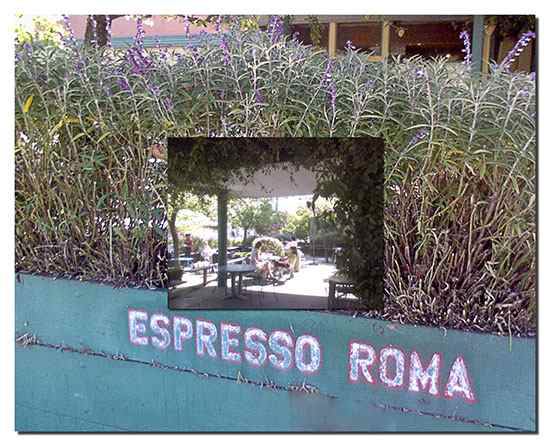
But what to write about it that I have already not addressed? Well, for one thing, it used to be a gas station. That's right a gas (gasoline, petrol, essence, benzina) station. The roof overhang that sheltered the pump operator now provides shade on sunny days, and is overgrown with vines. The front pavement, with the addition of planted trees, now serves as the cafe terrace and is surrounded by foliage and flowers in planter boxes. I am not certain I remember Espresso Roma Hopkins as a gas station, although I may have seen it as a shut-down gas station for a while before its next incarnation as an ice-cream shop, which I do remember.

Equally interesting is the surrounding neighborhood. The cafe is on at an intersection, across from which is the huge Monterey produce market where all kinds of exotic vegetables, fruits, groceries, and even fresh mushrooms (including chanterelles, fresh shiitakes, and Japanese enoki) are available in season. If you're looking for durian, star apples, and Mexican chilies, this is the place to find them. (But, sadly, no NEW Mexican GREEN chilies.) On the third corner is a string of fooderies (I just coined the word foodery, or thought I did, which for Americans is easier to pronounce than the Catalan equivalent, queviures, and more appetizing than any multilingual references to alimentation.) There is a rosticceria (which roasts chickens) called Magnani's), a Hunan restaurant, a cheese shop which even has fourme d'Ambert and reblochon, a fresh fish market, a bakery, and a pizzeria. What we have here is uncoerced multiculturalism, or, if one prefers, globalism at its best. The staff at Espresso Roma are predominantly Mexican, as is the style of their weekend scrambled eggs, which in my opinion, is their signature dish. Hey, do we like our food in Berkeley? Is the Lubavitcher Rebbe Jewish?

More links to these topics:

More art and images of:

Permanent Link to This Entry | | | Technorati Tag:

Send a message to Jonathan: coffeeblogger (at) doublesquids (dot) com


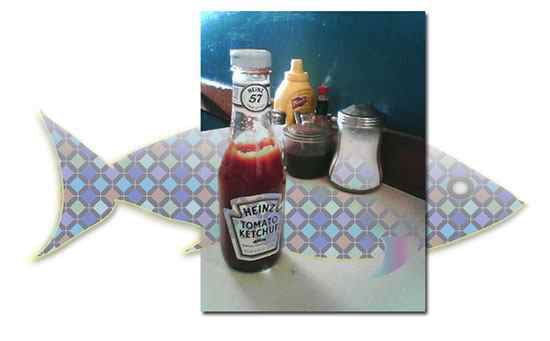
Ketchup

7:36 PM Saturday, February 25, 2006

[None will come and then a lot'll]

Ketchup (aka catsup) is seen as the quintessential American condiment, although Berliners are beginning to make it their own. (More about that later). I grew up thinking of ketchup as the tomato sauce in a bottle that didn't want to come out. My father used to say, quoting Ogden Nash, I think, "Shake, shake the ketchup bottle; none will come and then a lot'll." Here in California, where tomatoes are big agribusiness, ketchup is known as the final destination for the surplus that never makes it fresh to the table. At Hearst Castle, the San Simeon retreat of the former mainstream media mogul, the castle walls may have been transported stone by stone from Europe, but there is always a bottle of ketchup on the banquet table.

Ketchup, I have learned, did not start as a tomato sauce, but as a Chinese fish sauce. Fish sauce on its own is a fascinating topic. Fish, especially small bony ones caught in large quantities, are salted and stored in a container. As the salt leaches out the juices, it is drained off and becomes fish sauce. A paste is made of the remaining solids. On a trip to Barcelona I learned that in Roman times, the sauce, garum in Latin, was shipped all over the Empire and highly prized. High-quality anchovies are still salted and exported from the same coast. My own introduction to anchovies occurred with my first taste of a pizza from the Colonial Pizzeria in Easton, Pennsylvania. The salty little critters are still my favorite pizza topping.

So: back to ketchup. The name apparently comes from ke-tsiap, said to be literally "fish sauce" in the language of Amoy, a Chinese island now known as Xiamen. A similar fish sauce, nuoc mam, is a staple in Vietnamese cuisine. Supposedly sailors acquired a taste for ketchup and brought it back to Europe where, lacking a local version of fish sauce, it was made from such bizarre ingredients as mushrooms or walnuts. Later the Americans tried tomatoes and the rest is history. In Berlin, I have learned, a kind of bratwurst-like sausage is served with a homemade ketchup, fried potatoes, and curry powder, and is called currywurst. Go figure.

| Technorati Tags:

Send a message to Jonathan: coffeeblogger (at) doublesquids (dot) com


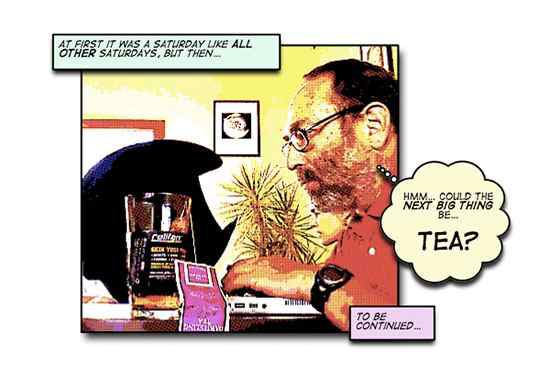
The Saturday of the Next Big Thing

3:32 PM Saturday, February 11, 2006

[What is a soft-shell crab, you ask?]

My fear: another Saturday wasted. The best day of the week, in principle. The day that it's OK not to do any of the stuff I have to do the rest of the week. The day for recreation, feeling good, detoxifying from the rest of the week. This Saturday morning, however, I had no idea how I was going to use all of that great "free" time. Not only that, the sun was out and shining brilliantly, while my East Coast relatives were hunkering down for a blizzard. It's been just like mid-spring after the rains are all over. And yet…

The other day I ate a soft-shell crab at a Thai restaurant. What is a soft-shell crab, you ask? It's a crab, prized as a delicacy on the US eastern seaboard, who has gone through its seasonal molt and discarded its old shell, a shell now too small for its growing body. But the new shell, which was there under the old shell, has not hardened yet. And so, the epicure prizes this crab because it can be eaten shell and all. As for me I can say that I've been feeling depressed, jaded, scared, stuck, paralyzed… But specifically, in terms of my persona as a Künstlertypus (artistic type), I've been feeling like a soft-shell crab about to be devoured by Father Time.

Earlier this morning, I scribbled out a mind-map page, to which I gave the title, "What is the Next Big Thing?" The phrase, I believe, is from Steve Jobs. Last year the Next Big Thing was the Coffeeblog, checking out the latest "social" software, acquiring a laptop, getting involved with Flickr, putting my paper-based artwork on the screen. I still do all of the above, and I am writing this on said laptop, but the new Next Big Thing for 2006 is a mystery. I know, from long experience, that it will not be a mystery forever. Of course, Keisuke would have said, "It is of no importance." Of course, he would have been right. Right? And, as I write this, I am starting to feel that I have not totally wasted a gorgeous, sunny Saturday morning. When the Next Big Thing arrives, it will let me know. And, no, the Next Big Thing is not tea (reference: the image above). That was a joke.

| Technorati Tags:

Send a message to Jonathan: coffeeblogger (at) doublesquids (dot) com


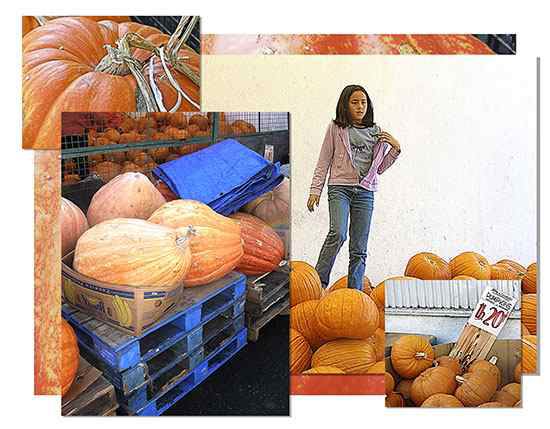
Buenas Noches Calabaza

12:23 PM Sunday, October 30, 2005

[The pumpkin is the original treat of the season.]

No, this is not really about the festival that ushers in November, the festival that begins in the middle of night on Sunday morning before the month begins, when Daylight Saving Time ceases, and ends the morning after Election Day in the US, when everybody's pumpkin has been smashed. The festival, variously called Samhain, All Hallows Evening, Hallowe'en, El Día de los Muertos, the Day of the Dead, All Saints Day, and the most macabre Guy Fawkes Day began with the pre-Christian Celts, Aztecs, and others, confronting the death of the summer and greeting their own dead, benign and malignant. Yes, we all know about ghosts, goblins, trickery, disguise, and Stingy Jack of the Lantern, who fooled the Devil and had to carry the Devil's embers around in a turnip. That festival. But as I said, this is not about the festival.

What this is about is a giant round orange-colored squash called a calabash, more frequently called a pumpkin, which brings joy, good nutrition (Vitamin A), and good cheer. This fruit, normally treated as a vegetable, was once all-American, that is a native of the Western Hemisphere, but is now grown everywhere. There is a delicious Japanese version called Kabocha (calabash?), and Irish websites tell me that Stingy Jack's turnip has been replaced with a Jack O'Lantern (pumpkin) even in Ireland, the birthplace of the US version of the festival. The pumpkin is the original treat of the season.

Being big (the world record as of Oct 5, 2005 was 1,469 lbs. which converts, appropriately enough, to 666 kilos), loaded with seeds, and round like a pregnant woman's belly, the pumpkin is obviously a fertility symbol, which most likely translates, in the iconography of the USA, as a productivity symbol (you know how we love Getting Things Done.) No less of an American icon as Charlie Brown, the creation of cartoonist Charles Schultz, saw the Great Pumpkin as the ultimate bearer of gifts, not Santa Claus. As for the people of Mexico, they reportedly greet each other on the Day of the Dead with "Buenas noches calabaza", meaning "Good evening, Pumpkin." Those of you who remember the Italian-American song-and-dance man and comedian Jimmy Durante will remember that he ended every performance with a haunting and mysterious salutation. Did he know anything about the Mexican Day of the Dead? Was he addressing a loved one of his own, his first wife perhaps? There is at least one alternative explanation, of course, but even as I child it moved me to see the old man on black-and-white television, as he signed off, "Goodnight Mrs. Calabash, wherever you are."

| Technorati Tags:

Send a message to Jonathan: coffeeblogger (at) doublesquids (dot) com


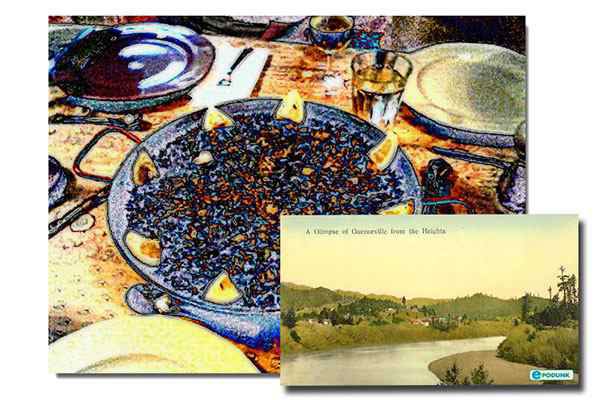
Arros Negre comes to Guerneville

8:25 PM Monday, August 29, 2005

[Catalans have maintained respect for vegetables]

Guerneville, California is a little town on the Russian River, in Sonoma County, a county better known for its vineyards and the historic Plaza of the county seat, Sonoma. The river has been home for generations to summer visitors who enjoy the resort lifestyle, the sandy beaches and cool flowing water, and the shopping for kitsch. In more recent times, Gay and Lesbian tourists have made an annual summer pilgrimage to Guerneville. Down the river near the coast the filtered golden sunlight and dramatic encounters between fog and rolling hills, harbor seals and hikers have attracted artists and outdoor recreation enthusiasts.

We (my significant other and I) are fortunate to have friends with a cabin in Guerneville, who have recently returned from a visit to Cadaqués, the former fishing village on the Costa Brava where the great Spanish Catalan surrealist painter Salvador Dalí made his home. My friends raved about the seafood specialty arròs negre, "black rice," a specialty of the Costa Brava. We decided to try a Sonoma County version. (I say try because the most fundamental ingredient, cuttlefish (Sepia officinalis), does not inhabit California waters. We decided to prepare the dish with the local Monterey Bay squid Loligo opalescens, and two species of local rockfish, using a pristine, minimalist recipe from the Internet.

Like their Basque neighbors to the north, the Catalans, whose traditional capital is Barcelona, have had a love-hate relationship with the Castilian-speaking rulers of Spain in Madrid. (The "love" part refers to the fact that they have played a major role in Spanish history in both the Old and New Worlds.) Their distinct culture includes a language and literature related to that of the French Provençal troubadors, and a marvelous cuisine (cuina in Catalan), which is the focus of this Coffeeblog item. Though prodigious eaters of meat and seafood, the Catalans have maintained respect for vegetables, especially the red bell peppers and eggplants beloved by Italians, southern French, and other Mediterraneans, and an onion of their own creation, the calçot.

As a starter course for our Guerneville black rice dish, seasoned with cuttlefish ink imported from Spain in plastic packets, we decide to make escalivada, a dish that seems to have a role in Catalan culture equivalent only to the Passover matzah, the Santa Fe green chili, and the Scottish haggis in their respective traditions. Escalivada is made from eggplant and red bell peppers charred over embers, peeled, shredded and served with generous quantities of minced garlic, the oil of arbequina olives, toasted artisanal bread rubbed with garlic and fresh tomatoes, and a garnish of anchovies. If it's not labor-intensive, it's not escalivada.

The meal was washed down wine from Geyserville, Meursault, Gascoyne, and La Mancha, and was a spectacular success. Not one shred of escalivada or one grain of black rice remained uneaten. As for Loligo opalescens, it's a cephalopod second to none on the planet.

| Technorati Tags:

Send a message to Jonathan: coffeeblogger (at) doublesquids (dot) com


Honey, I'm home

1:19 PM Friday, August 12, 2005

[Land of the bland: muse for the schmooze]

I'm back. The 2-hour plane flight from Albuquerque, like all plane flights, converted a vivid same-day experience into a near-distant memory. My grand plan to blog from Santa Fe had fallen flat.

Yes, I found free wi-fi (widely available in Santa Fe, and even at the motel where I stayed, though unadvertised.) And yes, I was able to post comments to the previous blog entry, which I had posted before leaving. I felt so busy, however, what with sightseeing, window-shopping, conference participation, and scoring ever huger portions of green chili, that I didn't feel motivated to post any text addenda in the comments.

What I did do, was snap a lot of cameraphone shots, upload them to Sprint, download them to my laptop, use iPhoto with a freebie plug-in to upload then to Flickr, and post a link to the photos in a Coffeeblog comment. The result? Quasi-nada. Near-zip. Almost zilch. A few die-hard fans did view some of the photos according to the Flickr counter, but view counts to date have not even ascended to the mind-boggling number of ten for any given photo. The Coffeeblog continued to get hits, however. Curiously, the most popular photo was a prosaic view of the Sweeney Center, a former gymnasium, a few blocks from the renowned Plaza in Santa Fe, where the conference I attended was held. Go figure.

Anyhow, now that I am back in California, land of the bland Anaheim green chile, where the Big Jims and Sandias are unattainable except in a frozen state by Internet mail-order, the blogging muse has returned and is whispering in my ear. New Mexico has provided me much to blog about, and blog I will. Watch this space.

| Technorati tags:

Send a message to Jonathan: coffeeblogger (at) doublesquids (dot) com


Yuck!

1:14 PM Monday, May 16, 2005

[It's the ceremonial ritual qualities]

Q: At a typical Northern California espresso coffeehouse, what menu item is most likely to be unsatisfactory?

A: The espresso.

After having been served two abominably bad espressos this week, I decided I had to write about it.

First of all, why would I even want to order an espresso? Why pay good money for a tiny little drink of a black, medicinal aqueous extraction of almost-burnt coffee beans?

North American tradition, which lives on in the Seattle coffee culture, requires a dilute brew in generous quantities, usually with added milk or cream. (Does anybody from New York remember "Chock Full O' Nuts"?) Espresso, on the other hand, is a Mediterranean refinement of an African ceremonial beverage brought to the rest of the world by Arab traders and the Ottoman Empire.

Ah, but it's the ceremonial ritual qualities, as well as the measured dose of caffeine, and the unique taste of espresso (a decent espresso), which make it so special.

The Espresso machine is said to have been invented by Luigi Bezzera in 1901, and, like the Ferrari and Venetian glass, exemplifies the Italian belief that style and function of utilitarian objects are inseparable. The coffee it produces is served in a tiny cup, derived from the Ottoman coffee service, and sweetened to taste before being sipped and savored. There are rules for making a perfect espresso.

Lattes and cappucinos are great, but I consider them morning drinks, a daily dose of calcium. For mid-afternoon, an espresso, if available, is the perfect coffee break.

My first bad espresso of the week was served the French Hotel Cafe, a very European-looking place in the heart of Berkeley's famous Gourmet Ghetto, a place I had visited many times for decades. I asked for a "single espresso for here", code words meaning a 35-40 milligram caffeine dose of genuine espresso in a ceramic espresso cup. Instead, I was given a few ounces of black liquid in a paper cup. I reminded them that I had said "for here", and my espresso was unceremoniously dumped into a big teacup. It was foul and bitter and there was not a trace of "crema", a foamy byproduct of the espresso process, on my expensive drink.

Yuck.

I will spare you the details of this week's second bad espresso, except that it was served at a self-described "coffee company" in San Anselmo after an interminable wait, and again delivered in a teacup. No crema, but a little more drinkable than the first.

I have now decided, whenever visiting a new coffeehouse, to try a "single espresso for here" the first time and record detailed notes in my Moleskine (which, by the way, is another Italian style refinement of an international product.) Starbucks, you have been warned. Readers, stay in touch.—JDL

Addendum: I have recently had Turkish Coffee in several different Middle Eastern places and I haven't had a bad one yet. The grounds and sugar are steeped in boiling water in a pot called an ibrik and grounds are allowed to settle before drinking. There is a Greek version called (surprise!) Greek Coffee.

| Technorati tags:

Send a message to Jonathan: coffeeblogger (at) doublesquids (dot) com


McBlogger

8:06 AM Tuesday, May 10, 2005

[La Nouvelle Cuisine Nuque-Rouge]

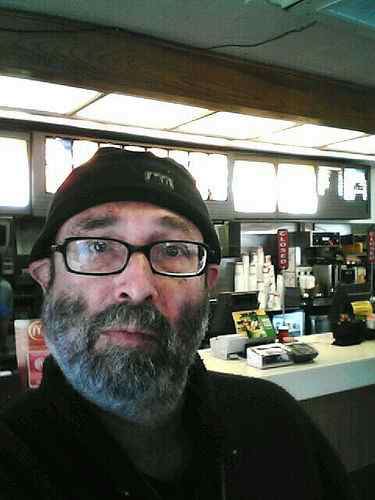
After dropping a friend off at the airport, I wanted to stop somewhere with a big table to write my weblog and have a little breakfast. I suddenly had a hankering for a Sausage Biscuit, the signature dish of Nouvelle Cuisine Nuque-Rouge. There is only one place to get one. And suddenly I realised that Mickey D's might not be a totally bad place to write a blog. There's usually table space (people eat fast and leave), and the price is right.

I was not disappointed. My Sausage Biscuit cost me $1.10 and I paid a 10-cent Eat In Tax to the State of California for the privilege of using McDonald's Corporation table space. I did not have the coffee. McDonald's coffee is by no means as bad as that served at some of the places recommended by Delocator®, but I had already had a cup of Peet's elsewhere. Instead I ordered a carafe d'eau simple. It arrived, not in a carafe, but in an official McDonald's orange juice cup. The cup even appeared on my bill, but there was no charge. The soda machine does not dispense water, so if you want it, ya gotta ask.

Now, the ambience: It was, actually a mellow place to blog, no hassles, good light, and lots of elbow room. (This was my local McD's, others are not so, and nutso.) I did indeed write this blog entry there. It was clean. The service was friendly. However, those of you who wish to avoid the working class, a multicultural staff, and a diverse clientele, are advised to look elsewhere for your kind of people.

Now to the juicy part, the famed Sausage Biscuit. McDonalds has never made a bad Sausage Biscuit, bad, that is, from the culinary standpoint. The biscuit was flaky, just crumbly enough, and lightly soaked with the succulent sausage juices. The sausage meat yielded to the teeth with just the right amount of pop. 'Twas a carnivore's delight, and was seasoned delicately with whatever sausages are supposed to be seasoned with.

But there is another meaning to the word "bad." Wicked. Decadent. Depraved. Badass. Immoral. Fattening. (McD's is not illegal yet). The nutritional tables on the back of my placemat informed me that my Sausage Biscuit contained 5 grams of trans-fat and 34 grams of carbohydrate. In fact only one trans-fat gram less than the Large Fries, and more than half the carbs. That's badass. But hey, sometimes ya just gotta break the rules.—JDL

| Technorati tags:

Send a message to Jonathan: coffeeblogger (at) doublesquids (dot) com


The Substance of Affogato Style

12:58 PM Monday, May 2, 2005

[The shot heard 'round the world]

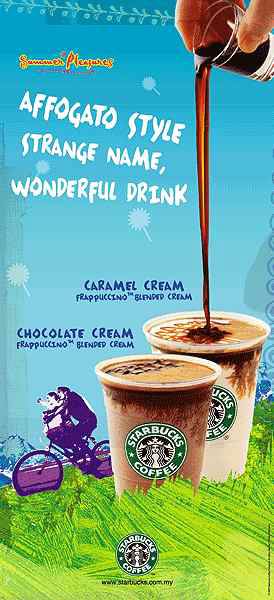
In another remarkable coincidence of fate, just around the time that I wrote my post on the Italian dessert affogato, a serving of gelato drowned with espresso (that's drowned, not shot), Starbucks came out with a new drink called an "Affogato Style", which has already attracted the scrutiny of the blogosphere. According to Starbucks, the new drink is made with Frappuccino Blended Coffee, caramel syrup, and a "shot" of espresso.,

Back in New York and Chicago, there were some Jewish delis who described their cuisine as "kosher style." That meant that it may have looked like, smelled like, and tasted like kosher food, but from the viewpoint of the Jewish orthodoxy, was unfit for human, or at least Jewish consumption.

Now please do not generalize that last statement to mean that I believe that a Starbucks Affogato Style beverage is unfit for human consumption. I have never tasted one. In fact, I have never tasted a Frappuccino®, period.

My impression is that Frappuccino® is Starbucks' attempt to revive (or more precisely, move into the market niche of) soda fountain culture, long a mainstay of mainstream America before European coffeehouses were reintroduced. I remember soda fountain culture from my mid-20th-century childhood. Specifically, there was Dan & Ann's luncheonette, which had a big sign for Hershey's Ice Cream over the door, and which was called Hershey's by my contemporaries from 6th through 9th grade. They had malts, shakes, sundaes, as well as cones. The real thing. Hersheys is history. However, I believe that the Frappuccino® is an attempt to tap into the residual American love for American-style ice-cream drinks. The soda-fountain culture has taken heavy hits from frozen yogurt, McDonald's milkshakes, juice bars, Ben and Jerry's (cute, but I knew Hershey's, and Ben and Jerry is no Hershey's), and the USDA Food Pyramid.

However, Starbucks' Frappuccino® is not a soda-fountain drink. It contains no soda water. It reportedly contains 39 grams of carbohydrate before the caramel syrup and coffee are added. It is therefore not "kosher" for diabetics, as it were.

If, therefore, you wish to consume a Frappuccino®, or an affogato-style Frappuccino® with a shot (yes, Jonas, a shot) of espresso, go for it. Maybe I'll try one some day, too. Who knows?—JDL

Relevant addendum: Gelateria Naia makes a great affogato. Unfortunately they're only in the East [side of San Francisco] Bay, and their affogato costs four and one-half bucks.

Irrelevant addendum: I have added a blogroll to this site. Look for the blogroll in the sidebar on the right.—JDL

Technorati tags: |

Send a message to Jonathan: coffeeblogger (at) doublesquids (dot) com


An Affogato at Caffe Trieste.

10:31 PM Sunday, April 17, 2005

[The Good, the Bad, and the Ugly]

Sunday nights my beloved Espresso Roma is closed after seven or eight. I had to get out of the house and decided to drive all the way to the Berkeley Caffe Trieste, not too close to home, even though gas is almost three bucks a gallon here in Northern California. I wasn't disappointed. It was too late for a latte and a weird time for a plain espresso, but they had something called an" afogato", which turned out to be a scoop of gelato with a shot of espresso. A perfect drink for a a funky Sunday evening. There was a waitress who asked me to smell a rose from her hair, and an earnest barista who appeared to be from India, who explained the "afogato" for me. There was French pop music playing, a mellow dim light, and lots of high-carb goodies in the display cases. A cute brunette customer commented on my "afogato", then ordered a giant piece of cannoli. I tried my "leave the gun, take the cannoli" joke on her but she didn't get the reference. Is the Godfather now something only us old-timers remember, like "La Dolce Vita?"

But I digress (isn't that the whole point of hypertext—digression?) When I get back to my dual-processor G5 with DOHC valves and turbo cooling, I'm going the search the internet for "afogato." Stay tuned.

… OK, he're the scoop (as it were). Affogato in Italian (note the double F) means drowned. In other words it's ice cream drowned in coffee or some other liquid. After exploring a dozen butt-ugly links in Italian (it's not all Gucci, you know), I found this, which seems to do justice to the subject.

OK, it's bedtime. Ciao.—JDL

Technorati tags:

Send a message to Jonathan: coffeeblogger (at) doublesquids (dot) com


Bette's Oceanview Diner

4:48 PM Wednesday, January 12, 2005

[Peggy Guggenheim and the Cherry Tomatoes]

After a week of rain and showers, the sun is out again. Today I wanted lunch somewhere special, a change from the routine. I decide to drive to a little oasis of high-style in Berkeley, at 4th street near the old Spenger's restaurant. I suddenly got in the mood for Bette's Oceanview Diner, a conscious effort at 50's nostalgia chic, but nonetheless a pleasant place to eat. I sat at the counter and got a big mug of coffee. Right next to the ketchup bottle, tastefully arranged against the backdrop of a chromed menu holder, were packets of Splenda, always a good sign.

A charming waitress named Angela, with a Jean Seberg-style pixie cut, served me a Cobb salad, which was super—the bacon thick and crispy, the avocado green but not hard, big chunks of blue cheese, cherry tomatoes with actual flavor. Cobb salad I imagine, was the first of the low-carb (zero-carb?) meals, long before Atkins was a twinkle. Is there a history of the Cobb salad on the Internet? (Yes.) Who was the redoubtable Mr. Cobb (or was it Mrs. Cobb?)

Anyhow, this note appears to have become a mere restaurant review, which was not the original intent of this blog. Somehow, therefore, I've got to make the connection between Cobb salad and the meaning of life. Hmmm… Aha! I've got it.

The key question is whether a 50's nostalgia diner is merely a mercenary and cynical trendy exploitation of a gullible public (as Zippy the Pinhead might conclude)—or something more. But what if the food is good, and the decor cool, as it is here?

And then I saw it for what it is. A fifties nostalgia diner does not have to be bogus, simply because 1959 ended more than 34 years ago. An entity like Bette's can be a distillation of 1950's style, a celebration of brief but triumphant era of American design, the last stage of Art Deco, the New Look, the stay-at-home Mom, the big chrome chariot, the Prom. Can a nostalgia diner be more fifties than the fifties? Yes!— in the same way, with the proper intellectual filters applied, that Peggy Guggenheim's Venice can be more Renaissance than the Venice of the Inquisition and the Black Plague.

I am glad that the fifties are over—for one thing, I graduated from high school in 1959. I am also glad that I can enjoy a Cobb salad and 2 cups of coffee in a high-energy, chromed, stylish fifties environment, unencumbered by the Army-McCarthy hearings, Tricky Dick, Nikita Khrushchev, Jim Crow, and my eleventh-grade "history" teacher Mr. Stump.—JDL

Send a message to Jonathan: coffeeblogger (at) doublesquids (dot) com


Winter at Espresso Roma

9:28 PM Monday, January 3, 2005

[In France they would charge extra for the terrace seats.]

Espresso Roma, the one across from the Monterey Market, is my favorite Berkeley cafe. The staff is friendly, the terrace is almost always usable, the coffee is good and more or less affordable, and the food is decent, especially the scrambled eggs, Mexican Style, available only on weekends before 11 AM. It's kind of my headquarters for writing entries for this blog.

When I checked out Espresso Roma on the Internet I found that they run cafes in Southern California, and several near the Berkeley campus. I was surprised—the cafes don't have a chain feel like Starbucks, and each one has its own personality. A little research revealed that they were founded by a UC Berkeley engineering graduate and that they own their own bakery and coffee roasting plant.

No, they don't charge extra for the terrace seats, which fill up when the sun is out, even on a chilly winter day. In the pouring rain everybody huddles inside.—JDL

Send a message to Jonathan: coffeeblogger (at) doublesquids (dot) com


Coffee History by the Numbers

2:46 PM Tuesday, December 21, 2004

[Do you know where your coffee has been?]

Coffee Timeline:

Excerpt from UTNE READER, Nov/Dec 94, by Mark Schapiro, "Muddy Waters"

Prior to 1000 A.D.: Members of the Galla tribe in Ethiopia notice that they get an energy boost when they eat a certain berry, ground up and mixed with animal fat.

1000 A.D.: Arab traders bring coffee back to their homeland and cultivate the plant for the first time on plantations. They also began to boil the beans, creating a drink they call "qahwa" (literally, that which prevents sleep).

1453: Coffee is introduced to Constantinople by Ottoman Turks. The world's first coffee shop, Kiva Han, open there in 1475. Turkish law makes it legal for a woman to divorce her husband if he fail to provide her with her daily quota of coffee.

1511: Khair Beg, the corrupt governor of Mecca, tries to ban coffee for feat that its influence might foster opposition to his rule. The sultan sends word that coffee is sacred and has the governor executed.

1600: Coffee, introduced to the West by Italian traders, grabs attention in high places. In Italy, Pope Clement VIII is urged by his advisers to consider that favorite drink of the Ottoman Empire part of the infidel threat. However, he decides to "baptize" it instead, making it an acceptable Christian beverage.

1607: Captain John Smith helps to found the colony of Virginia at Jamestown. It's believed that he introduced coffee to North America.

1645: First coffeehouse opens in Italy.

1652: First coffeehouse opens in England. Coffee houses multiply and become such popular forums for learned and not so learned - discussion that they are dubbed "penny universities" (a penny being the price of a cup of coffee).

1668: Coffee replaces beer as New York's City's favorite breakfast drink.

1668: Edward Lloyd's coffeehouse opens in England and is frequented by merchants and maritime insurance agents. Eventually it becomes Lloyd's of London, the best-known insurance company in the world.

1672: First coffeehouse opens in Paris.

1675: The Turkish Army surrounds Vienna. Franz Georg Kolschitzky, a Viennese who had lived in Turkey, slips through the enemy lines to lead relief forces to the city. The fleeing Turks leave behind sacks of "dry black fodder" that Kolschitzky recognizes as coffee. He claims it as his reward and opens central Europe's first coffee house. He also establishes the habit of refining the brew by filtering out the grounds, sweetening it, and adding a dash of milk.

1690: With a coffee plant smuggled out of the Arab port of Mocha, the Dutch become the first to transport and cultivate coffee commercially, in Ceylon and in their East Indian colony - Java, source of the brew's nickname.

1713: The Dutch unwittingly provide Louis XIV of France with a coffee bush whose descendants will produce entire Western coffee industry when in 1723 French naval officer Gabriel Mathieu do Clieu steals a seedling and transports it to Martinique. Within 50 years and official survey records 19 million coffee trees on Martinique. Eventually, 90 percent of the world's coffee spreads from this plant.

1721: First coffee house opens in Berlin.

1727: The Brazilian coffee industry gets its start when Lieutenant colonel Francisco de Melo Palheta is sent by government to arbitrate a border dispute between the French and the Dutch colonies in Guiana. Not only does he settle the dispute, but also strikes up a secret liaison with the wife of French Guiana's governor. Although France guarded its New World coffee plantations to prevent cultivation from spreading, the lady said good-bye to Palheta with a bouquet in which she hid cuttings and fertile seeds of coffee.

1732: Johann Sevastian Bach composes his Kaffee-Kantate. Partly an ode to coffee and partly a stab at the movement in Germany to prevent women from drinking coffee (it was thought to make them sterile), the cantata includes the aria, "Ah! How sweet coffee taste! Lovelier than a thousand kisses, sweeter far than muscatel wine! I must have my coffee."

1773: The Boston Tea Party makes drinking coffee a patriotic duty in America.

1775: Prussia's Frederick the Great tries to block inports of green coffee, as Prussia's wealth is drained. Public outcry changes his mind.

1886: Former wholesale grocer Joel Cheek names his popular coffee blend "Maxwell House," after the hotel in Nashville, TN where it's served.

Early 1900's: In Germany, afternoon coffee becomes a standard occasion. The derogatory term "KaffeeKlatsch" is coined to describe women's gossip at these affairs. Since broadened to mean relaxed conversation in general.

1900: Hills Bros. begins packing roast coffee in vacuum tins, spelling the end of the ubiquitous local roasting shops and coffee mills.

1901: The first soluble "instant" coffee is invented by Japanese-American chemist Satori Kato of Chicago.

1903: German coffee importer Ludwig Roselius turn a batch of ruined coffee beans over to researchers, who perfect the process of removing caffeine from the beans without destroying the flavor. He markets it under the brand name "Sanka." Sanka is introduced to the United States in 1923.

1906: George Constant Washington, an English chemist living in Guatemala, notices a powdery condensation forming on the spout of his silver coffee carafe. After experimentation, he creates the first mass-produced instant coffee (his brand is called Red E Coffee).

1907: In less than a century Brazil accounted for 97% of the world's harvest.

1920: Prohibition goes into effect in United States. Coffee sales boom.

1938: Having been asked by Brazil to help find a solution to their coffee surpluses, Nestle company invents freeze-dried coffee. Nestle develops Nescafe and introduces it in Switzerland.

1940: The US imports 70 percent of the world coffee crop.

1942: During W.W.II, American soldiers are issued instant Maxwell House coffee in their ration kits. Back home, widespread hoarding leads to coffee rationing.

1946: In Italy, Achilles Gaggia perfects his espresso machine. Cappuccino is named for the resemblance of its color to the robes of the monks of the Capuchin order.

Send a message to Jonathan: coffeeblogger (at) doublesquids (dot) com


blog comments powered by Disqus Comments (View)

Go: [ Home | Previous | Archive | Gods & Myths | Cafes | Coffee | Nations & Empires | People | Arts ]
[ Words | New Media | Cinema | Gastronomy | Productivity | Yiddish ]

Add to Technorati Favorites

Copyright ©2004, 2005, 2006, 2007, 2008 Jonathan David Leavitt. All rights reserved.