This is a weird time of year. Here in Berkeley it's a gorgeous day, sunny, though chilly. The magnolias are already blooming. It's not spring yet, not even winter. The looming New Year makes a guy think about transitions, the passage of time, new stuff—the usual. The numeral 2005 sounds new—shiny and pristine, just out of the box, wheareas 2004 sounds (already), old, scratched, a little battered, like my camera cellphone (which I bought in 2004). This blog is one of the transitions for the new year. I've started it This is a weird time of year. Here in Berkeley it's a gorgeous day, sunny, though chilly. The magnolias are already blooming. It's not spring yet, not even winter. The looming New Year makes a guy think about transitions, the passage of time, new stuff—the usual. The numeral 2005 sounds new—shiny and pristine, just out of the box, wheareas 2004 sounds (already), old, scratched, a little battered, like my camera cellphone (which I bought in 2004). This blog is one This is a weird time of year. Here in Berkeley it's a gorgeous day, sunny, though chilly. The magnolias are already blooming. It's not spring yet, not even winter. The looming New Year makes a guy think about transitions, the passage of time, new stuff—the usual. The numeral 2005 sounds new—shiny and pristine, just out of the box, wheareas 2004 sounds (already), old, scratched, a little battered, like my camera This is a weird time of year. Here in Berkeley it's a gorgeous day, sunny, though chilly. The magnolias are already blooming. It's not spring yet, not even winter. The looming New Year makes a guy think about transitions, the passage of time, new stuff—the usual. The numeral 2005 sounds new—shiny and pristine, just out of the box, wheareas 2004
[Tsatskes]
![]()
Twitterverse
Coffee
Popular
Coffee Websites
![]()
Cafes by Zip
Code
Coffee Podcasts
43 Folders
Anders Fagerjord
Bay Area Bloggers
Berkeley Blogs
Blue Bottle Clown College
Cafexperiment
Coffeegeek
Denver Coffeehouses
Dogmilque
Doug Miller
Emily Chang's eHub
Hewn & Hammered
Jill's Definition of Weblog
Jonas Luster
Laughing Squid
Le Blaugue à Beleg
Loïc Le Meur Blog
Mark Bernstein
Moleskinerie
Seesmic Blog
Tant Mieux
The Dynamist
Tonx Dot Org
Send Me Email:
coffeeblogger (at) doublesquids.com
"The meaning of life and other trivia." Copyright ©2004, 2005, 2006, 2007, 2008 Jonathan David Leavitt. All rights reserved.
Every page now has Seesmic/Disqus video commenting. Scroll to the bottom to see or post video comments. There are also Haloscan comments at the end of each separate blogpost article. To read a text-only version of Jonathan's Coffeeblog on your iPhone or other mobile phone, click here. Or to see the graphics with less text, click here.
Go: [ Home | Previous | Archive | Gods & Myths | Cafes | Coffee | Nations & Empires | People | Arts ]
[ Words | New Media | Cinema | Gastronomy | Productivity | Yiddish ]
Crisis Averted
Over the last five days my Coffeeblog reader stats plummeted. When I tried to look at the blog itself it kept hanging up and wouldn't load completely. I finally tracked the problem to a button which I had installed in the sidebar years ago: the Blogflux mapstats button.
I went on the Blogflux site today and found out that I am still a registed member in good standing, but he Coffeeblog continued to hang up when the Blogflux mapstats link was supposed to download. In the last hour or so, I deleted Blogflux from my template code, uploaded the Coffeeblog pages again, and everything seems to be OK.
If any of you Coffeeblog readers have experienced slow downloading or none at all, I share your frustration. I have learned the hard way not to load up my HTML code with too much unnecessary stuff. Anyone who would like to share your frustration with Coffeeblog readers there are text and video links at the bottom of each page, courtesy of Disqus and Seesmic.
Now that I have decontaminated my code from the Blogflux infestation, I must add that I bear no grudge againt Blogflux. True, their services are forgettable because I have actually forgotten why I joined Blogflux in the first place. However, software hassles can happen to anyone.
More Links: Blogflux
More Images: DeathsHead
Permanent Link to This Entry | | Technorati Tag: BlogfluxSend a message to Jonathan: coffeeblogger (at) doublesquids (dot) com
Rants and Raspberries: Video Commenting
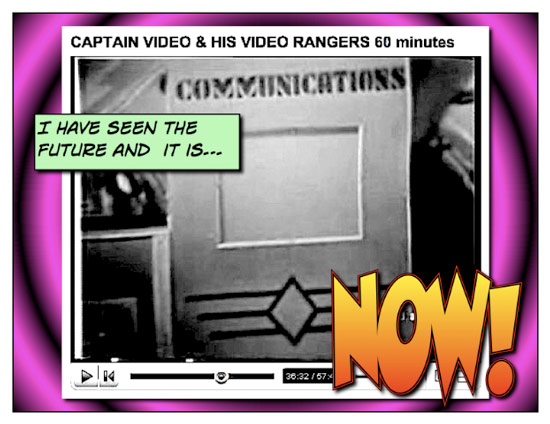
Captain Video and the Video Rangers. Remember them? If you do, you were a kid when I was, back in the 1950's. In those days there was an American company called Dumont, who manufactured a television set of the same name, and started a TV network. One of their shows, broadcast live in what would become the early prime-time slot, was a science fiction/adventure serial named after the good captain and his sidekick. A full hour of the program has been salvaged, and can be seen here on YouTube. But cowboys? Yes, there were cowboys in the show, because reruns of Westerns could be used for filler. Advertisements were frequent, long, venal, and aimed at children. The captain and his Ranger dressed in military-style uniforms and flew a spaceship resembling a propeller-driven World War Two aircraft. But that was not important; what was, besides the ads, was the video. The captain, most recordings of the show, Dumont televisions, and the Dumont network are long gone (they passed into oblivion in 1955), but their legacy is more prevalent than ever on today's Internet: the advertisements, of course, and the video.
Today is a good time to celebrate the memory of Captain Video because a new use for video has just emerged over the past few days, and today Jonathan's Coffeeblog will add the feature: video commenting. On blogs. Commenting itself has been a bone of contention, because it is vulnerable to spamming, trolling, and ranting. Some bloggers resist a comments feature. Others open commenting to registered readers, then close registration to new commenters. Most blogs that do accept comments have a system built in to moderate comments, filtering out unwanted communications. Now that video commenting has become available, someone will still have to moderate the comments, but instead of mere text, tone of voice, facial expressions, sounds, motion, and visual props can now be part of the commenting process.
In the days of Captain Video, the closest imaginable thing to video commenting would have been a letter to the local newspaper editor. Now video commenting is available, and, I predict, will soon be widely used throughout the Internet.
Video commenting is now possible due to a collaboration between two Internet start-ups. One is the web commenting service, Disqus, founded in 2007 by Daniel Ha and Jason Yan. The other is Seesmic, the brainchild of Loïc Le Meur, a powerhouse entrepreneur who helped pioneer blogging and political podcasting in France, after a start in advertising and web hosting. Seesmic, which one might call a video version of Twitter, the social microblogging hub, makes it easy to record short videos as a means of conversation. Now a Seesmic video, using the Disqus commenting apparatus, can be attached as a comment to a weblog item.
The science fiction film, 2001: A Space Odyssey, featured a realistic-appearing conversation between a space station officer and his child. Since then that kind of two-way videophone talk has been available for a while over Apple's iChat, the Skype Internet phone service, and other systems. (I just talked with my mother this morning over Skype.) She and I agree, being able to see someone's face makes a big difference.
What is special about the new Seesmic/Disqus collaboration is that two-way video, blogging, and mainstream media online magazines and "blogs" are getting closer to being fully integrated. Now, instead of writing a letter to the editor of one the dwindling number of local newspapers, you can make a few mouse clicks and give the guy the raspberry.
More Links: Disqus Seesmic VideoCommenting
More Images: Video Seesmic Twitter
Permanent Link to This Entry | | Technorati Tag: SeesmicSend a message to Jonathan: coffeeblogger (at) doublesquids (dot) com
Bacn
Poor Hormel. That's the meat-packing company that invented the canned luncheon meat in the late 1930's whose brand name has become iconic: Spam. I googled Spam and found out all kinds of cool stuff. For example, there is a kind of spam sushi, called spam musubi, popular in Hawaii. Then there is Spam Spread, which is reportedly halal, which means kosher for Muslims. Who knew? Spam, of course, is the internet nickname for unsolicited, unwanted, and deservedly deprecated email concerning strategies for enlarging the membrum virilis, keeping said membra viriles in a state of precoital readiness, and, for those who are unconcerned about the state of their membrum virilis, or have no such membrum, mortgages. Oh, yes, and get-rich-quick schemes out of Nigeria. But I digress. Why? Because I am not intending to write about Spam here. I am writing about bacn.
Bacn? Yup. The omitted "o" distinguishes it from the salty and delicious pork product that goes famously with eggs. Pancetta, they call it in Italy. And Canadians produce "Canadian bacon," although it's not the same thing. (Do Canadians just call Canadian bacon "bacon" and refer to the Anglo-American kind as "Anglo-American bacon?" An interesting question, but yet another digression, because the subject here is not bacon but bacn.)
The bacn concept emerged in October, 2007 in Pittsburgh, Pennsylvania, at a geek meet called PodCamp Pittsburgh 08. Bacn was defined concisely: email you want -- but not right now.
Wow. There's all that bacn on my computer , and I never even knew what it is called. I just checked my inbox and I have 295 unread messages. Bacn. I have already read the messages I wanted to read. Will I ever read the bacn? Will I ever delete it or transfer it to another folder? I don't know. But I could use Mac Mail's smart mailbox feature to store bacn in a bacn folder. If I wanted to. Do I? I don't know.
Bacn, of course, is merely a subset of a topic that's very hot on the Internet right now: information overload. The very fact that bacn is wanted, but its reading is to be deferred, puts it solidly in the overload category. I've written about information overload, as have many others. Furthermore (that's a grammatically correct way of beginning a sentence with the conjuction "and") I am increasing the information overload by the very act of writing this blogpost. One must never forget, however, that one man's noise is another man's signal. Or, as one might say, one man's spam is another man's bacn.
More Links: Spam InformationOverload Bacn PodCampPittsburgh
More Images: Bacon Musubi PodCampPittsburgh Pancetta
Permanent Link to This Entry | | Technorati Tag: BacnSend a message to Jonathan: coffeeblogger (at) doublesquids (dot) com
Mashup Mish-Mosh
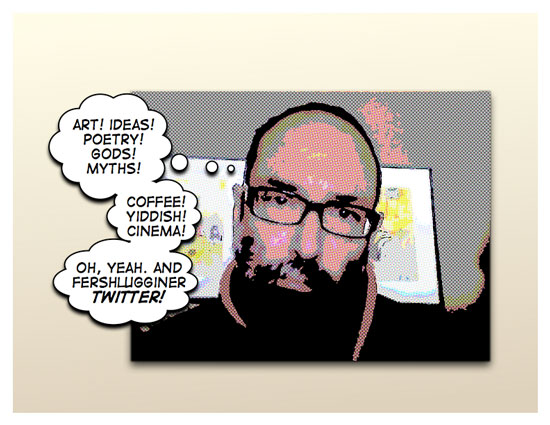
Lately the course of events I have been following on the Internet has demonstrated that the technological tail has been wagging the dog, the dog being content. In other words, what is written and shown is becoming increasingly influenced by the high-tech ways of showing it. One of the best illustrations of this increasing influence is this cartoon by blogger Hugh MacLeod, who announced that he was leaving the social networking site Twitter because it was "too easy," and because it was distracting him from the content ("art! ideas! poetry!…") that he sought back in 2005. Twitter, about which I wrote previously, is a child of the mashup phenomenon. What's that? Keep reading.
I'm assuming that there are Coffeeblog readers, perhaps the majority, who are unfamiliar with the technology behind mashups, and that it is worth explaining because it is having such a powerful influence on communiation in the 21st century. So what is a mashup? Wiktionary defines it:
(computing slang) A derivative work consisting of two pieces of (generally digital) media conjoined together in some interesting way, such as a video clip with a different soundtrack applied for humorous effect
I think that definition is already obsolete because nowadays mashups consist of many more than a mere two pieces of media. It can be hundreds or thousands. Also, the example of the humorous video clip is misleading because most mashups now have the purpose of pulling data together, with humor being a random phenomenon. The data that tend to be pulled together are mostly personal opinions, news items, and weblog entries (blogposts) which are combinations of just about anything. And that's exactly what Twitter does: pulling together thousands of short clips (140 characters maximum) from Twitter members and sources all over the Internet, many with links to click on for greater depth for those who are interested.
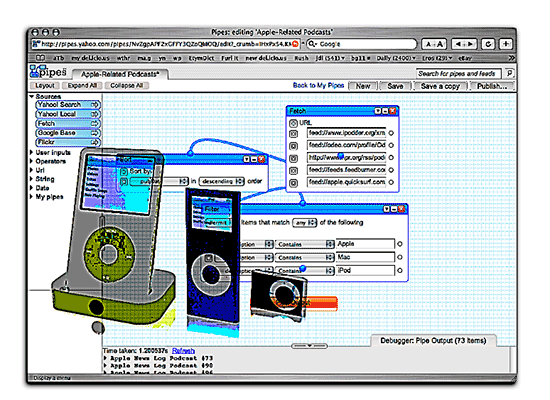
So now for the technological part. (Mom, are you still reading this? Hey, the Coffeeblog is a nobitic blog.) I'll start with newsfeeds. Any website, particularly a blog, can have its content machine-processed into a coded file called an XML file which can be read by other machines and reprocessed into a different format with the same content, that is, text, images, video, sound files, and sometimes more. There are websites (I use one called Feedburner) which will do this free for members. Once the XML file is available on the Internet, other websites can pick it up, dice it, and slice it. Often only shreds of the XML files are reprocessed into "new" websites, which actually are mashups. Once the machine programming has been completed by humans, the whole process becomes automatic.
Now for some examples. The moment that I put this Coffeeblog item on the Internet, its XML newsfeed is picked up by a website called Twitterfeed which translates it into XML that Twitter can understand. Twitter then picks up that feed and automatically puts a little blogpost under my Twitter name which contains a clickable link to this Coffeeblog item. Any of my Twitter friends who see this can go right to the Coffeeblog if they want, knowing that there's something new, interesting, enlightening, and delightfully entertaining for them to read. No emails (like the one I send to you, Mom) or checking every few hours or minutes to see if there's something new on the Coffeeblog. (That last sentence was the random humor to which I referred two paragraphs ago.)
But wait, there's more. (The preceding sentence was a mashup of actual communication and late-night television infomercial cliches, inserted for the sake of random humor.) Yes, there's more. You see, my Twitter generates another XML newsfeed which is picked up by yet another website called Friendfeed, which lists all kinds of stuff from me and my Friendfeed feed friends. If I send a photo or video to Flickr, that goes on Friendfeed. If I share an interesting newsfeed that I discover on Google Reader, that goes onto Friendfeed. If I buy an interesting new book and add it to a website called Library Thing, that goes on Friendfeed.
So where will this all end? The human brain can only handle a relatively puny amount of information, and sorting out the mish-mosh is beyond daunting and overwhelming. Merely trying to keep up with the latest tech changes is challenging enough. Friendfeed just went online a few months ago, and video on Flickr is almost brand-new. I just wrote about the idea purveyed in the New York Times that blogging is already killing the bloggers with stress. No, we don't know where this will all end. Setting priorities, of course, is a huge challenge, as Hugh MacLeod's cartoon suggests.
But wait. There's, dare I say it… more. Does anyone out there remember Marshall McLuhan? Us old-timers remember his 1964 dictum "The medium is the message." Since then, McLuhan has reportedly been named the patron saint of Wired Magazine. Taken literally, McLuhan's dictum implies that the mashup is its own content . MacLeod suggests the same thing in the last panel of his cartoon, where his entire content is "Twitter! Twitter! Twitter! Twitter!"
Fortunately, it's still a free Internet, except where it isn't, and I can post any Coffeeblog content I want. So. Back to the art, ideas, and poetry. (Well, I haven't done poetry yet, but I like to think the word "fershlugginer" is poetic in itself.)
More Links: Mashup Twitter Friendfeed Microblogging
More Images: Twitter XML Poetry Ideas
Permanent Link to This Entry | | Technorati Tag: MashupSend a message to Jonathan: coffeeblogger (at) doublesquids (dot) com
The Stress of Not Blogging
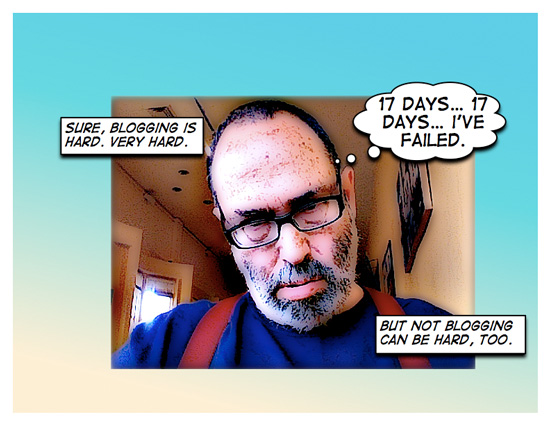
It's Tuesday, April 8, 2008 5:17:01 PM US/Pacific. I just looked at the Coffeeblog and learned that my last post was March 20: Purim. It's over. It's been over for 17 days. And yet, until this item, I haven't posted anything to the Coffeeblog. Seventeen days. Two weeks and three days. And that troubles me. I experience it as stressful. The stress of not blogging. And that brings me to a recent meme purveyed in the dead tree medium known as the New York Times. As their recent headline (April 6) trumpeted (in part) "Writers Blog Till They Drop."
Now it turns out that this was a kind of follow-up on a January 7, 2008 NYT item concerning Om Malik's heart attack, which occurred a few weeks earlier. The Times quoted Paul Kedrosky, whom they described as a friend of Om Malik: “You feel huge pressure to not just do a lot, but to do a lot with your name on it. You have pressure to not just be the C.E.O., but at the same time to write, and to do it all on a shoestring. Put it all together, and it’s a recipe for stress through the roof.”
OK. That makes sense. I too feel a huge pressure to not just do a lot, but to do a lot with my name on it. But let's get a few things straight. I'm not a CEO of anything. And the Times referred to "brand-name" bloggers, and I'm not even a Brand X blogger. My little Coffeeblog doesn't even show up on one of those Alexa charts. So I wouldn't dream of putting myself in the same league with Om Malik, Michael Arrington or any other of the surviving big-time bloggers mentioned by the Times. Could that be why I haven't had a heart attack yet?
Concerning the Maliks and Arringtons of the blogosphere, is the Times on to something? Is blogging at the root of the deadly stress the Times describes? Well, maybe, in the sense that the sheer overavailability of breaking news over newsfeeds creates a situation where the puny human brain can't keep up with the machines. The metaphor that occurs to me is a human runner in a foot-race with a locomotive.
But frankly, and obviously, humans have had heart attacks and succumbed to stress for eons before blogs existed. The sheer productive power of information technology could tempt a productive person (and the brand-name bloggers are very productive people, unlike, well, me) to push himself (or herself, but funny, the Times didn't mention any women) a little, or a lot, too hard. As for women bloggers, Virginia Postrel, whose blog The Dynamist I have mentioned before, is now a breast cancer survivor. Was her cancer stress-induced? From blogging? Harrumph.
It seems to me that the species Homo sapiens is hard-wired for productivity at some level, not always Om Malik level, and for telling stories. Blogging is a way of telling stories. And for brand-name bloggers, blogging is a very productive way of telling stories.
So here's to dead, lamented bloggers Russell Shaw and Marc Orchant, who, the Times tells us, died of heart attacks. They went out in a blaze of glory. If I were in a bar I'd drink to them. But I'm in a cafe and I already finished my Capuccino. As I look into my sad, empty cup, I think, defiantly: "Keep on blogging, people. Keep on blogging."
More Links: Productivity RussellShaw Blogging Dynamist
More Images: MarcOrchant OmMalik MichaelArrington PaulKedrosky
Permanent Link to This Entry | | Technorati Tag: ProductivitySend a message to Jonathan: coffeeblogger (at) doublesquids (dot) com
Universonal
I've been more and more satisfied with what I've posted to the Coffeeblog over the past few months, and I'm getting more page views from visitors. How much these visitors read of what I've written, I don't know. But they're visiting, and some of them, according to my statistical software, stick around and read other things I've written after they read the stuff they were searching for. There is another trend, however, over the past few months: I've been posting to the Coffeeblog less often. What does that mean? Am I getting bored with blogging? (No.) Are my standards getting higher (Yes.), and therefore am I intimidating myself about writing more and posting new images? (Maybe.) I think I know what is happening. The Coffeeblog has transcended mere ego-tripping, hobbyism, and showing off, though it is all of the above. It has become nothing less than a repository for my sense of personal identity. In decades past, that role was filled by college, job, ideological identification, and to a lesser extent, lifestyle. Now, as a certified old geezer (I collect Social Security!) I have needed to rewrite the whole saga before my demise, which even if it should happen fifty years from today, will be untimely. (I guess my health is good enough for me to still think that way.) What all of this lengthy paragraph implies is that the Coffeeblog is very, very personal. But there's much more to it than that.
Certain of the topics which I have roughly categorized in the Coffeeblog seem to be growing in importance as time goes on. The "Gods and Myths" page seems now to be the most popular landing place for new viewers. I also have been writing increasingly often about historical stuff: stories and histories, which are ultimately the same thing. Conventional American discourse is now mostly focused on just how bad George W. Bush is (or if you still like Bush, there's always Hitler, Ahmadinejad, and Hillary Clinton.) But really folks, there was a world that existed long before any of those luminaries, and that world shaped the recent era in which the same luminaries have acted. That is why people like Ismail I, Shah of Iran, Constantine and his mother, and Hulagu Khan have become more important to me than, say Jack Murtha or Dick Cheney. However, I don't want the Coffeeblog to turn into a blogospheric remake of the History Channel. And that's where the personal stuff comes in. I recently coined the lame, geekspeak term "universonal" as a portmanteau of "universal" and "personal." Perhaps a more elegant word will soon surface, but I have concluded that a good blog has to be "universonal".
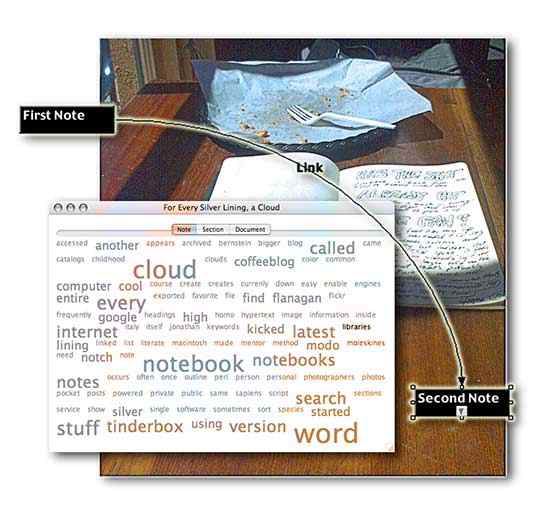
Recently Mark Bernstein gave a talk in Cork, Ireland, about blogging. Mark graduated from the same college I did, which I characterized, when I was still there, as a "boot camp for intellectuals." He went on to become a specialist in hypertext and the developer of the Tinderbox note processing software, with which I publish this weblog, and which I have discussed elsewhere on it. What does Mark have to say? He has developed a theme of Neo-Victorian Computing, an idea which would have never occurred to me. When I think of Victorians, I think of "we are not amused" (a quote from Her Majesty herself), of buffalo hunts on the Great Plains, of extravagant but spooky Queen Anne mansions, Charles Dickens, and the Sepoy Mutiny. Mark has brought to light a whole new, much more positive view of that era. If I might paraphrase a wall motto from the California History section of the Oakland (California) Museum, where a magnificent, posh display of Victoriana had greeted the visitor, "scoff now at the Victorians; there will be plenty of time for humility when they are gone." (That section, BTW, is closed for renovation, so even the motto is gone.) In a sense, Mark is saying the same thing. He has a lot to say, and I am reading and rereading his work as an ongoing process. One of his voluptuous lecture slides carries the slogan: built for people, built by people, crafted in workshops, irregular, [and] inspired. Considering Mark's Tinderbox software as a workshop (for writing) alchemized into computer software, and considering one person (myself) as "people," I believe that the Coffeeblog qualifies, in that sense, as neo-Victorian.
Mark has also coined a word, nobitic, from the Latin for "ours." He writes about nobitic blogging, that is blogging for an intimate, limited audience of friends and family. My first weblog was such a nobitic blog, for family members, and it is still online, but I do not give out the URL publicly. In that sense, the Coffeeblog is not truly nobitic. In another sense I consider the entire blogosphere, and indeed, anyone with Internet access, even if only by mobile phone in Kathmandu and Timbuktu, to be my personal, intimate audience. For that reason, I make an effort for each blogpost, not always successful, to tell a personal story regardless of whatever I am writing about. Though tempted to write stuff that might offend some of my readers (and I undoubtedly sometimes yield to that temptation without knowing it), I try to maintain a bond of civility within that universal "family." And, from the other end of the telescope, I try to consider the universality of the topic of the post I am writing. It's a tall order.
Finally, to quote from one of Mark's recent blogposts, "We can do things we have never done: what is worth doing? What is worth writing? Who are we, and what do we want?"
Exactly.
More Links: Blogging BlogTalk Weblog MarkBernstein
More Images: NeoVictorian Blogtalk08 Blogging Weblog
Permanent Link to This Entry | | Technorati Tag: NeoVictorianSend a message to Jonathan: coffeeblogger (at) doublesquids (dot) com
The Case of the Vanishing Airport Express
Since 2004, Apple has had a nifty product called Airport Express, a $100 wireless router with an audio jack that works with iTunes. Run an audio cable from the gadget to your stereo system or TV sound system, and you can play back iTunes from any computer in the house that has wireless access. It's a great way to listen to your MP3's and purchased iTunes over your best speakers. For years I've coveted Airport Express, but held off buying one, making do with a wired connection from an old iPod.
Last week, however, I finally decided "what the heck," and sauntered into an Apple Store to buy one. Guess what. They were all gone, and they didn't know when they would get some more. I tried other (non-Apple) stores, and was told of a rumor that Apple would be coming out with an new model very shortly. Today I called back the Apple Store and they were still all out, though the online store said they were available in "3-5 days."
I searched online forums and found no confirmation, just echoes of the rumor that Apple was coming out soon with an updated product. The Apple store told me that the new Time Capsule devices, coming out "in February" had no audio port.
Now, much as I want to get an Airport Express, I don't want to buy one immediately if Apple will be coming out with a new version soon.
Since the disappearance of the Airport Express from store shelves is mysterious, I began to imagine all kinds of scenarios, ranging from the most likely to the most paranoid:
Meanwhile, I've still got my old iPod hooked up to my even older stereo system, and I'm waiting for Apple's announcement of the new, improved, faster, more stylish, eco-friendly glass and aluminum $75 Airport Express, available in March.
More Links: AirportExpress Macintosh iPod
More Images: AirportExpress TimeCapsule iTunes
Permanent Link to This Entry | | Technorati Tag: iTunesSend a message to Jonathan: coffeeblogger (at) doublesquids (dot) com
Jes' me an' my iPhone.
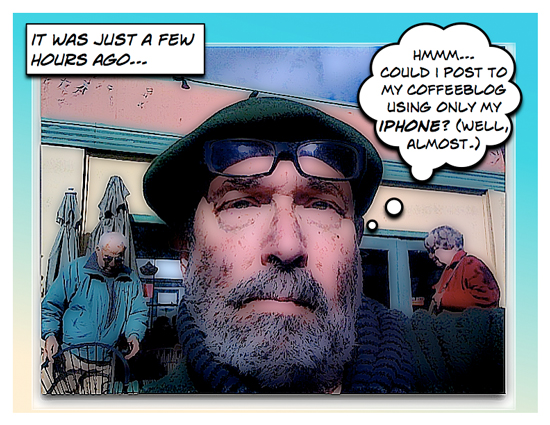
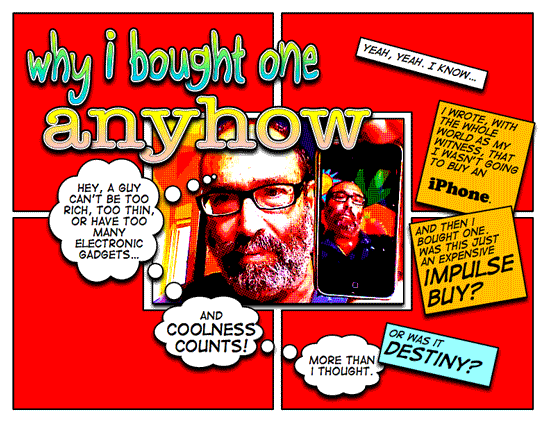
This morning I left my fat laptop at home. (I call it my fat laptop because next month there will be thin laptops, even though I don't really need one.) I'm enjoying a brief sunny respite from the Northern California winter rain, seated out on the terrace of Espresso Roma. Heck, I was even able to take a self-portrait with the iPhone for the image which you now see above if you are not using the text-only version of Jonathan's Coffeeblog.
And what is the import of all this? Simple: I can blog from an iPhone. Almost, that is. The week before last I blogged from the Microsoft Bloggers Lounge at MacWorld Expo, using only an iPhone. But I was blogging to Twitter. And, although Twitter is a real blog by any definition, blogging to Twitter is not blogging blogging. It's just blogging. Blogging to Jonathan's Coffeeblog, now that's blogging blogging.
Be that as it may, I can't put my Coffeeblogpost online with just my iPhone. I need all the computing power of my non-portable home computer. And so, I cannot finish the job of blogging blogging here on the temporarily sunny terrace of Espresso Roma. I've got to go home and finish the job.
And if you're reading this now on Jonathan's Coffeeblog, that's exactly what I've done.
More Links: Blogging Espresso NorthernCalifornia Sunshine
More Images: iPhone Espresso Berkeley Rain
Permanent Link to This Entry | | Technorati Tag: BloggingSend a message to Jonathan: coffeeblogger (at) doublesquids (dot) com
What Hath Jobs Wrought?
Yesterday was the last day of this year's (2008) MacWorld Expo, the huge Apple event in San Francisco, and as usual Apple CEO Steve Jobs was going to knock our socks off with his presentation of astounding, revolutionary new products. This year, his main offering was an ultra-thin, ultra-light laptop computer which Apple calls the MacBook Air. As I left MacWorld Expo, I was humming that great Peggy Lee standard, "Is That All There Is?" I was kinda disappointed.
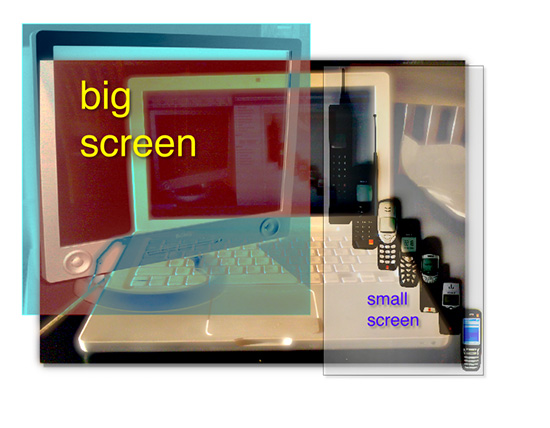
Now as I write about the MacBook Air (and I almost didn't write about it) I have to put this in context. What had I written a year ago, when Jobs introduced the iPhone and Apple TV? In a post I called Size Queens I made two points: 1. The iPhone was really a computer disguised as a telephone, and 2. What Jobs had done was not so much about telephones or televisions as about bringing Mac computing to very small and very large screens.
But I wrote more last year. I wrote, as the iPhone was about to ship in June, that cool as it was, I didn't really need one. And then I wrote, in July, that I bought one anyhow. With very unexpected and positive consequences. Now that has some bearing on what I am writing now about the MacBook Air. No, I am not going to get one, I say now. And I think I really mean it. But what Jobs has done with that new machine may ultimately be as revolutionary as the iPhone itself.
First of all, there is the style issue. Before Jobs was brought back as the Apple CEO, John Sculley, a former Pepsi exec had cranked out a long line of boring beige boxes having none of the pizzazz of the original 1984 Mac. Jobs brought style back with a vengeance. Literally. Revenge. I have written about Virginia Postrel, writer of The Future and its Enemies and The Substance of Style. In the latter book, she makes the point that style is quite substantial, and should not be dismissed as mere frou-frou. Now I may not be the most stylish guy in the world (my girlfriend would say that's an understatement), but I happen to agree with Mrs. Postrel. And to those John Sculleys out there who do believe that style is insubstantial, Jobs exacted his revenge. Curious, isn't it. Most of the new cellphones try to look like iPhones. Hmmmm…
In my admittedly unstylish opinion, the MacBook Air is unquestionably the most stylish computer every designed. And that means that the stylish people are going to buy it. The Beautiful People (and that means thin people) can't be lugging around a fat computer. I imagine that a Macbook Air and its power cords can easily be transported in a Vuitton briefcase, and subtly slipped out on to a boardroom table. Point scored. And we're not talking Power Point, although the point will have the power of one-upmanship. (BTW, does Louis Vuitton make briefcases? I get my rolling bags from REI.)
But now for the substance: Jobs has taken the gestural vocabulary of the iPhone and brought it to the MacBook Air. Experienced iPhone users will be able to scroll, zoom, double-click, and even rotate photos on the trackpad without keyboard shortcuts or any mouse clicking. But I've saved the best for last: Jobs has taken wireless to the next level. No Firewire. No CD or DVD player. No external hard drive. It's all wireless, or going to be in February. Want to see a movie? No DVD rentals. Rent one from iTunes for three bucks and download it. Need to install software from a CD or DVD? Stick it in your other computer (the Beautiful People have other computers) and it will install on your MacBook Air. Wirelessly. Need to back up. You needn't trouble your stylish mind about that. Bring your MacBook Air within range of your home network and it will be backed up. Wirelessly. And automatically.
The one wireless feature that's still not there is wireless recharging. Now that I've got to see. And have. So, Please, Mr. Steve Jobs, don't disappoint me at MacWorld Expo 2009.
More Links: MacbookAir MacWorld2008 SteveJobs Wireless
More Images: SteveJobs MacWorld2008
Permanent Link to This Entry | | Technorati Tag: WirelessSend a message to Jonathan: coffeeblogger (at) doublesquids (dot) com
I am Curiousyellow
The month after I started Jonathan's Coffeeblog, I was curious about the process of starting a blog using the Blogger website. I gave my exploratory blog the title "Curious" with the username (changed later) of "curiousyellow," which I made up on the moment, suddenly recalling the 1967 Swedish film I am Curious (Yellow). Since then, curiousyellow has been my username on many social websites, including Flickr, del.icio.us, Twitter, and Seesmic. Recently I decided to see the movie again to see if my opinion of it had changed. It has changed.
The film, directed by Vilgot Sjöman, who died last year, concerned the problems of a young woman barely in her twenties, played by Lena Nyman, as a character of the same name. To make three long stories short: 1. The movie was all about Lena's problems during the run-up to the 1968 world political cataclysm; 2. There was much explicit sexual intercourse in the film, guaranteeing its notoriety in the USA; and 3. Sjöman's postmodernesque and proto-hypertextual structuring of the film also guaranteed mass confusion among disappointed US viewers, my young self included. I came to see sex scenes so allegedly outrageous that the film was banned in Massachusetts (yes, that Massachusetts!), and saw nothing of the kind.
I remember the conventional wisdom of the time: the movie was long and boring, Lena Nyman was no Marilyn Monroe, and the sex was not sexy. Looking back forty years, I have to say that all of the above was true, but irrelevant. Curious (Yellow) was and is quite an interesting film.
The length and pace of the film had a lot to do with Sjöman's post-Hollywood style, which I will address in a moment. Lena Nyman was very cute, appeared underage, and her sexual adventures in the film appeared to be the product of sadness, frustration, desperation and unrequited love, not the lewdness one yearned for. Disappointed and outraged by a missing mother, a zhlob of a father, and a sleazebag boyfriend, Lena (the character) was a very confused, and in my mind, sympathetic young lady. If Americans had not been suffering under the yoke of Comstockery (the legacy of Anthony Comstock from 1873), the preposterous banning of the film would never have happened, and the film would have been a mere unmentioned flop in the US market.
Two real-life characters played cameo roles in Curious (Yellow), the Rev. Dr. Martin Luther King, Jr., and the Russian poet Yevgeniy Yevtushenko, author of the politically incorrect poem Babi Yar, and who now (2007) teaches in Oklahoma and New York. Both were icons of the political earthquake rumbling at the time the film was made.
Another theme running through the film was the Spanish Civil war, in which Spain's Republicans fought desperately against the dictator Generalissimo Francisco Franco, who was backed by the National Socialists of the Third Reich. In the film, Lena's father had gone to Spain to fight Franco, then changed his mind and came home. For this apparent cowardice, Lena never forgave him.
I call the structure of the film "hypertextual" because at many different points it branches off into a variety of topical subjects. Sjöman, in fact, made two versions of the film, Yellow and Blue, named after the colors of the flag of Sweden. (I haven't see Blue yet, but it's on order. It's said to be, not a sequel or prequel, but a restructuring of the same film footage used to make Yellow.) If Curious (Yellow) and (Blue) were in the public domain, it would make a great Internet phenomenon with a variety of texts and images coordinating the links to the various film clips, perhaps posted to YouTube or elsewhere. Of course, in 1967, hypertext was virtually unknown, although Ted Nelson had coined the term two years earlier.
When I call Sjöman's film "postmodernesque" I am referring to its self-referential and paradoxical qualities. It could be called a political film, and is, but Sjöman is no Michael Moore. He is subtle, intellectual, creative, and reflective. It could just as easily, today, be called a psychological study of a young woman, or even a "chick flick," if Lena were not the only "chick" of consequence in the film. Sjöman put himself in the film, as Fellini had done, in the role of the director of the very film one was viewing, and as a lover of Lena, who, like all of her significant others, also abandons her. At any point in the film (example: Lena interviews the King of Sweden) what occurs on the screen, sex included, could be part of the narrative, or more likely, a fantasy in Lena's head.
As for the real-life Lena Nyman, her acting career in Swedish films and TV is still going on, and in 1978 she co-starred with Liv Ullman in Ingmar Bergman's Autumn Sonata. As for my blog, Curious, I changed it to a photoblog, leaving the original posts intact, but I have not posted to it for years.
More Links: VilgotSjoman 1967 LenaNyman Censorship
Permanent Link to This Entry | | Technorati Tag: 1968Send a message to Jonathan: coffeeblogger (at) doublesquids (dot) com
Eulogy for the Counterculture
The Counterculture of the 1960's is dead. Kaput. History. A little over forty years ago the Summer of Love, one of the iconic events of the Counterculture, took place here in San Francisco. The following year there occurred the world-wide cataclysm of 1968, the emergence of the New Left, which challenged everything across the political spectrum, including the Old Left. However, 1968 in its turn was an echo of 1848, the year that the Communist Manifesto was published, and the suffering urban workers rose up against their nouveau-riche middle-class overlords and the still-powerful aristocracy.
The Counterculture, however, was a cultural movement, not a political one. (One might even think the same of the New Left.) It purported to be the antithesis of the established culture, but there again, it was another kind of echo, an echo of the Futurist art movement which swept Europe including Russia, but emanated mainly from Italy, home of the Papacy and of course the birthplace of the Roman Empire. The Futurists, some of whom later ironically became enamored of Mussolini's Fascism, stood as the opposition to passatismo, or past-ism. The past must be swept away, they preached. And of course there was soon to be another echo, this time in China, where Mao Zedong and his "little red book" attempted to sweep away millennia of China's past.
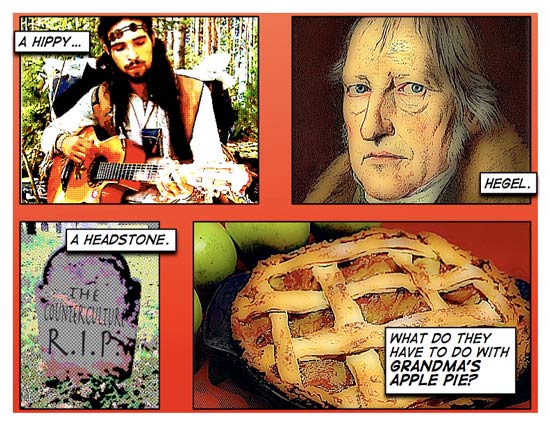
Did the Counterculture sweep away the established culture here in the USA? In the ungrammatical but emphatic American vernacular: not hardly. Sure, we've still got the hippies and the sexual revolutionaries, and the vociferous critics of Big Business, the "hip capitalists," the open-source high-tech movement , and the escalating dissolution of national boundaries. In my view, however, all of the above are historically as American as the apple pie our grandmothers used to make, though they appeared under different names and in different guises: the religious utopians (the Amish, the Amana Colonies, and even the puritanical Pilgrims of Plymouth Rock), the formerly sexually defiant polygamous Mormons, the communal "complex marriage" of the Oneida Community (look it up!); and self-described Progressives from Teddy Roosevelt through Henry Wallace. Did national boundaries change radically before the 1960's? Ask Mexico. As for the open-source movement, it wasn't always high-tech, but as always there were the unscrupulous opportunists, politicians included, running roughshod over the pioneers. We called it the Wild West. Watch a Deadwood DVD' and you'll see it in action.
If, however, the Counterculture is now dead, as I claim, and it merely recycled American tradition rather than revolutionizing it, why a eulogy? For one, because it was one hell of a party. Secondly, it merged the European discourse, such as Futurism, with the American experience, where lots of folks never gave a damn about the past in the first place. Surely the Counterculture brought new European and Asian ideas to the US heartland. But what about the reverse? Did the Counterculture Americanize the rest of the world? A preposterous, shocking, even blasphemous question, perhaps, but ask Nicolas Sarkozy, and when you're done talking to him, ask Osama bin Ladin.
So if the Counterculture is dead, as I have been saying, how did it die? Simple: it merged fairly seamlessly with the established culture. Karl Marx was a great fan of the German Philosopher Hegel, and an explanation of how the Counterculture of the 1960's could have merged with the established culture can be found in Hegel's theory of the dialectic: thesis, antithesis, and synthesis. Thesis: We need an established culture. Antithesis: Down with the established culture! Synthesis: It's more fun and a lot easier if you've got 'em both.
More Links: Counterculture 1960's SummerOfLove Psychedelic
More Images: Psychedelic NewLeft Anti-War 1960's
Permanent Link to This Entry | | Technorati Tag: CountercultureSend a message to Jonathan: coffeeblogger (at) doublesquids (dot) com
Where angels fear to tread
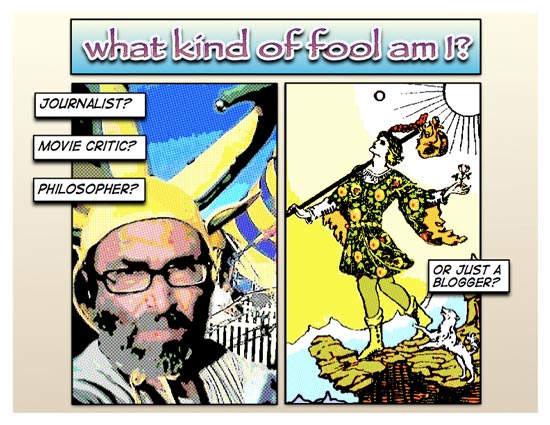
I'm not a journalist, editor, publisher, food writer, art director, art historian, graphic designer, cartoonist, movie critic, historian, television personality, videographer, video editor, software engineer, philosopher, sage, or pundit. I've never been, and I never will be, at least by professional and academic standards. And that's exactly the point. Thanks to the recent explosion of technological innovation, however, I and anyone with a computer or even a high-end cell phone can be any of the above. Sort of. Or pretend to be. Is that a good thing? Yes, according to me. (I am writing that being sort of a pundit, or pretending to be.)
In order to be a journalist, editor, etc., that is, a "real" one, one must be employed as such by a publisher, studio, or religious entity. Or, as a publisher, one must make money. Jonathan's Coffeeblog does not make money, not one red cent. It has a business plan, or more accurately, a non-business plan: 1. It is not about making money, and 2. It is all about not making money.
But why would I say that it is a good thing that amateurs, indeed rank amateurs, might now set themselves up, pretentiously or otherwise, as journalists, editors, etc.? The answer: All of those professions or callings must answer to a higher power, one who shapes, polishes, indeed often or usually dictates their production. The only higher powers I must answer to are my Internet service providers, and one or more gods, should they exist.
Very well, but a skeptic might argue that the plethora of amateurs is overwhelming our media with worthless trash. There are, I assert, two good arguments to refute the skeptics:
More Links: Blogging Publishing NewMedia
Permanent Link to This Entry | | Technorati Tag: PunditSend a message to Jonathan: coffeeblogger (at) doublesquids (dot) com
Osanpo Video
There is a very popular group on the photography-oriented social networking website Flickr: Osanpo Camera. It is so popular that they have a daily limit on the number of photos that can be posted. Now, osanpo is a Japanese word that means, essentially, "free walking," If the o at the beginning of the word means "honorable," as it does in many other Japanese words, than osanpo means "honorable free walking." In my opinion osanpo deserves to be honored; it is a fascinating yet very democratic art form. I wanted to read more about it, but I can't read Japanese and most Internet references to osanpo are in that language. However. I would like to believe that a new project of mine, a video project, is in the best osanpo tradition.
My video project began with a need that had nothing to to with osanpo. I was spending too much time indoors with my laptop and not enjoying the beautiful fall weather. I dreamed up a wild scheme to build walking into a computer project: walk when the weather's nice, and shoot whatever came up with my iPhone. Of course, I had reinvented osanpo photography with that idea, but I didn't think of it at that time. What I did think about was scrawling text on the pavement with chalk and photographing the text, essentially creating titles for the photos.
Then I had an epiphany. I could find my camcorder, literally dust it off (I hadn't used it since 2004), and shoot in front of me as I walked. That would give me an opportunity to play with the new version of iMovie that Apple had just shipped: a version that infuriated experienced iMovie editors, because it purported to simplify the movie-making process while eliminating many of the cool features of the previous edition. Apple claimed that the new iMovie made it possible to create a finished "home movie" in one-half hour with the new iMovie.
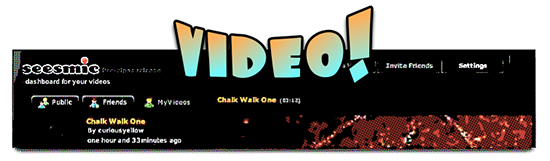
The video shown above was indeed created with iMovie, but it took more than one-half hour. In fact, it took four hours. I know that for a fact because I got a parking ticket for going overtime in a 90-minute parking zone. But I was able to edit all my stuff, upload it to YouTube, and even compose the opening music theme in Garageband, all in four hours. After putting the video on YouTube, I also uploaded it to Seesmic, a website just created in the past few weeks by Loïc Lemeur. Seesmic is very cool, and I will write more about it another time. In the meantime, I hope that Coffeeblog readers will enjoy my osanpo video, entitled "Chalk Walk One," which they can watch courtesy of Seesmic.
More Links: Osanpo Vlogging Seesmic iMovie
More Images: Osanpo Seesmic iMovie
Permanent Link to This Entry | | Technorati Tag: SeesmicSend a message to Jonathan: coffeeblogger (at) doublesquids (dot) com
When Stasists Hijack Dynamism
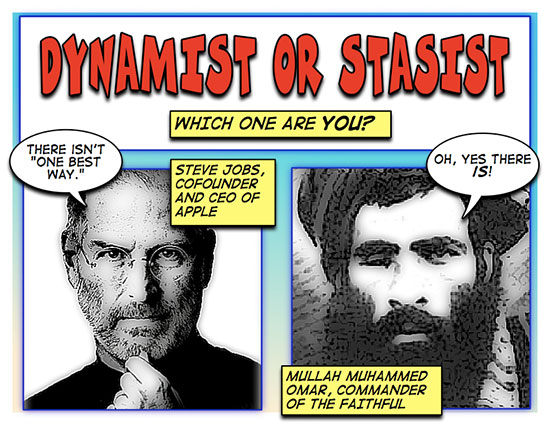
In 1999, Virginia Postrel, then editor of Reason magazine, produced her book The Future and its Enemies, which introduced the idea (a radical, world-changing idea, I think) that humanity can be divided, not into liberal vs. conservative, or rightist vs. leftist, or god-fearing vs. atheist, or bourgeois vs proletarian, but into stasist vs. dynamist. In brief, stasists are opposed to change and innovation, dynamists welcome both. Since The Future and Its Enemies, Mrs. Postrel has elaborated on the status of the stasist-dynamist dynamic in her excellent blog, The Dynamist, and written another radically innovative book, The Substance of Style. The Internet, where Jonathan's Coffeeblog lives, is a product of the dynamist world view. It seems to me that that some of the world most extreme stasists are utilizing the Internet to spread their ideas in order to fulfill their goal of controlling the future by stifling innovation and change. By using the Internet that way, what stasists are doing is paradoxical if not hypocritical. However, before going into detail, I want to clarify, in Virginia Postrel's own words, just what is meant by a stasist and a dynamist:
On one side of the new political landscape you have what I call "stasists." They view the future as a dangerous abyss. To avoid the abyss, some stasists want a return to some imagined, more stable past.
On the other hand:
On the other side of the new political landscape are what I call "dynamists." They see the future as an exciting process of experimentation and learning. That process has many different outcomes, for different people. There isn't "one best way." Dynamists celebrate such open-ended processes as scientific inquiry, market competition, artistic innovation, or technological invention.
Mrs. Postrel appears to view stasists as control freaks:
Other stasists want to build a safe "bridge" to the future. They want to control the future. You get a lot of that among politicians. In either case, stasists first decide the one best future for everyone and then they work to impose it.
Whereas dynamists are less so:
Dynamists tend to be less overtly political than stasists, because they aren't trying to grab government power to impose their ideas. But their vision—especially of the economy as a process—increasingly affects our politics.
In the "New Media" category of Jonathan's Coffeeblog, I have described many of the innovations created by dynamist thinking related to the Internet. What have not said explicitly, however, is that they are all capable of bringing about extreme and unpredictable social change, the kind of change that strikes terror in the heart of all true stasists. Granted, in what I believe to be a reasonable interpretation of Mrs. Postrel's ideas, I leave room for the possibility there there is a little bit of stasism in every dynamist (or maybe more than a little bit) and vice versa. Nevertheless, I believe there really is such a thing as a stasist as well as a dynamist, and their ideas and values are at odds with each other. Now, on to the paradox:
To begin with, any online stasist who is openly condemns modern technology would be self-refuting, and so I searched for websites operated by Amish and Neo-Luddites. The former is a religious group that is known its opposition to modern technology, especially electrical technology, whereas the latter is considered an prominent anti-technology political movement. It turns out that finding a genuine Amish website and a genuine Neo-Luddite website is not as easy as I thought. There are plenty of websites about the Amish, but so far I could not find one which claimed to be a genuine Amish website. I had a little more success with this "Neo-Luddite" website, which denies that they are anti-technology. However that website is an archive and is no longer active. I tried the URL "www.luddite.com" and found that the it has been registered, but appears to be up for grabs. Wikipedia's article on Neo-Luddism suggests that most Neo-Luddies do not identify themselves as such.
Still, Internet dynamism is commonly exploited by stasists, which is why I call such behavior "hijacking." Mrs. Postrel's comment about finding "a lot of" stasist agendas among politicians makes it easy to find the hijackers. My list of control freaks include the US House of Representatives, the Presidents of Russia and Iran (check out the cool URL of the Russian President) and the government of the People's Republic of China. And what is Osama bin Ladin if not a stasist (check out one of his fansites)? And something tells me that the United Nations and the European Union are seething hotbeds of stasism. But politicians and globalist bureaucrats are an easy target. The dynamist battle against creeping or galloping high-tech stasism is ongoing. If you visit the Electronic Frontier Foundation's page on innovation, you will find some of the latest battles against the stasists who would, in their view, stifle innovation on the Internet.
More Links: Dynamist Future VirginiaPostrel Stasist
More Images: Future
Permanent Link to This Entry | | Technorati Tag: DynamistSend a message to Jonathan: coffeeblogger (at) doublesquids (dot) com
Instant Gratification
It's taken me years to come up with this format for Jonathan's Coffeeblog, and meanwhile things keep changing on the Internet. Now they've got Jottit, created by Simon Carstensen and Aaron Swartz. It's basically a website for making websites. Instant websites. I mean, really instant. Go to the URL (http://jottit.com) and you're immediately asked to create a "page," meaning a web page. Type something. BAM! You've got a web page. Just email the URL to others and they can read what you've got there. If you name the pages for the date and time you wrote them, you've got a blog. You can't put images on it (yet) except for ASCII images (remember them?) But you can put links and even format the text a little bit.
OK. So what? So this. It's quicker and easier than any other way I've seen to put up a website. I've done blogs on Blogger and I've joined LiveJournal and Vox and Facebook, all of which can put up new blogs in less than an hour, to which you can post as often as you want, but they're not instant, because you've got to set them up first. I have Apple's iWeb, which is a quick way to make elegant or humorous formatted blogs and web pages using iWeb's templates, which include places for photos, video, and even podcasts. It's almost instant. But it's not instant. And then, there's the Coffeeblog. The Coffeeblog is not instant. Oy, is it not instant!
I've created a monster. But it's my monster, and I love my monster. So do a lot of readers who show up in my site stats. It's taken me a long time to get the Coffeeblog the way it is now, and I like it that way. I even like the new background color. And I especially like the graphics that I create for each blogpost. As a kid, I loved comics, and the whole culture of comics, and so I have to have a comic-like image with every Coffeeblog post. It didn't used to be comics, but now it is, because I like it that way. But you can't make an instant comic and I can't post to the Coffeeblog instantly, because it's too complex. I do it from my home computer, which means I have to be at home. And so I will be posting this to the Coffeeblog in due course, maybe tomorrow. First I have to create the comic, which means that I will have to think about how I will represent the theme graphically. I suppose I could show images of myself looking puzzled and frustrated about the lack of instant Coffeeblog posts.
Yeah, I could do that. But I like instant gratification. I want to post this web page NOW!!! OK, I will. I'll post it to Jottit. I'll consider it a sneak preview of my next Coffeeblog post.
More Links: Jottit iWeb webware
More Images: Jottit iWeb WebsiteDesign
Permanent Link to This Entry | | Technorati Tag: JottitSend a message to Jonathan: coffeeblogger (at) doublesquids (dot) com
Could the iPhone Change Your Life?
It's not even a month since I shelled out 600 smackers and an obscene amount of tax for my iPhone, and it's already changed my life. Could it change yours? If you avoid computers, email, and mobile phones, probably not. But then, you wouldn't be reading this. For me, however, things have already changed. I'm no longer tethered to Wi-Fi. I can access websites, send and receive email, check in with my Twitter buddies, and do text messages anywhere where my old cellphone worked. Since the iPhone has a speaker, I can play podcasts in the car while driving, then walk off at my destination without interrupting the program. (Audio podcasts, dammit! Watching videos while driving could change your life by ending it. It's more tempting than you think.) The iPhone camera is easier to use and captures better images that my old cameraphone, so I'm taking more photos than ever (here are some).
As a kid I was called a "walking encyclopedia." Somehow I never took it as an insult, though it was meant as such. Now, the walking encyclopedia can walk with an encyclopedia in his pocket. I'm referring to Wikipedia, of course. And if Wikipedia lacks the information, there is the whole fershlugginer Internet at my disposal. Whereas Superman once dashed into a phone booth to change, Superbrain can now dash into his iPhone booth (it's called a car) for rapid enlightenment, on, say, the full bio of an artist whose work I have just seen in a museum or gallery, or the filmography of a director whose movie I am about to see. (Of course, Superbrain, if he is really smart, will not show off this instantly gained knowledge in conversation, especially with women, if he wants to keep the few friends he has left.)
Given some of the iPhone's current technical limitations, I've changed my use of the Internet somewhat. I bookmark a lot more RSS feeds than I used to, and use them on the iPhone instead of overly complicated websites. (Sadly, this is essential with Flickr. Trees grow faster than a Flickr page downloading on an iPhone over AT&T's Edge network.) Apple has created a great feed reader at http://reader.mac.com/mobile, viewable only on iPhones. I've also created a bookmarks folder called iPhonics where I keep my favorite iPhone links.
Since I am an amateur website designer, who never got a penny for creating a website, i have always preferred the "less-is-more" approach (no need for a zillion links in the front page, although I admit that the Coffeeblog has too many already.) All of a sudden, some of my old creations like this one are lookin' real good on the iPhone. I was at a gallery opening last Friday evening and, to my surprise, a crowd gathered around to look at my iPhone. The gallery's own site was, er, hard to navigate (to be kind), so I switched to the above-referenced site and knocked a few socks off among my iPhone's admirers.
The iPhone's calendar currently lacks to-do items, but I frankly don't use iCal to-dos very often because they stay there, undone. However, I found some new ways to do to-do's with much ado (am I making too big a to-do about doing to-do's?) I use email. The iPhone touchscreen keyboard makes it very easy to write a one-line subject which can then be mailed, and deleted when the to-do is done. My emailed to-do list is never farther then my pocket, because I carry my iPhone everywhere.
But it gets even better. I use paper for to-do lists. Paper? Paper. This is for when I want to brainstorm a topic and list all the incomplete tasks hanging over my head, and being a putzer and an ornery cuss, i have many. I can get them all down on one sheet of paper (usually the back side of a spam fax I have received), fax it to myself c/o an old computer, whence it is automatically emailed to me as a pdf. The iPhone displays pdf's magnificently, and once can enlarge the contents for readability.
And finally, there's video. The boob tube is fighting back. I once though I was rid of it forever. How naive. I should have seen the handwriting (giant LCD screen?) on the wall when I wrote this. But, you know what? There is so much to write about how iPhone video has changed my life that I will postpone it for another post to Jonathan's Coffeeblog.
More Links: iPhone Minimalism RSS Wikipedia
To see a larger version of the graphic image accompanying this blogpost, click here.
More Images: Minimalism Wikipedia iPhone RSS
Permanent Link to This Entry | | Technorati Tag: WikipediaSend a message to Jonathan: coffeeblogger (at) doublesquids (dot) com
Nel Blu Dipinto di...
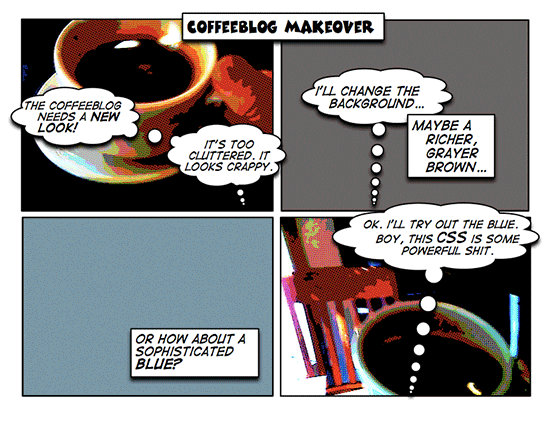
OMG. What have I done to the dear old Coffeeblog? What was I thinking?
Every time I look at it, and yes, I've actually been avoiding it, that blue color hits me in the eye, but I feel it in the solar plexus.
By the time you're reading this, the Coffeeblog with the blue background will be history, and the new sophisticated grey-brown will be up.
And if I can't stand that, I'll go back to the old "PC" version of the weblog. Hey, we can't all be Steve Jobs' designer.
More Links: Microsoft+Design MacVsPc Blue
More Images: Blue PC Zune SteveJobs
Permanent Link to This Entry | | Technorati Tag: MacVsPCSend a message to Jonathan: coffeeblogger (at) doublesquids (dot) com
Easier on the Eyes?
I suppose that it had something to do with my new iPhone. That Apple minimalism got to me. Actually it may have begun earlier this year when I spent more than 200 bucks on a pair of Prada glasses. On a cost-per-wear basis, that's not too bad, but that was the first time I spent a lot of extra money just because something looked stylish. My old Japanese glasses cracked right across the bridge of my nose, and I couldn't fix them with duct tape. Are you beginning to see a trend here? A life-long nerd suddenly craves high style. Not that I can or will change my whole life. The Prada glasses and the iPhone are merely tokenistic. I still love my rust-colored fleece jacket which I bought on sale at REI when the color became very unfashionable. My girlfriend hates it but it's an old friend.
Anyhow, I finally decided that I didn't like the design of the Coffeeblog any more. I kept adding more and more tsatskes, links, and badges. Suddenly it began to look very PC. By that I don't mean "politically correct." I mean PC, as in Apple's Mac vs. PC ads, pitting a stylish looking hip yuppie or preppy hipster, or whatever he is, representing the world of Apple, against a paradigm nerd, representing the PC. For some reason, the abbreviation PC for "personal computer" usually excludes any Apple product, which is much too hip and much too stylish to be a mere computer, however personal.
And so I embarked on my latest journey: could I redesign the Coffeeblog website to do honor to my Prada glasses and my iPhone? As it happened, I was tipped off about a new piece of software which enables the user (a Mac user, of course) to make changes in the CSS stylesheet of any website to see the results, without changing the actual site on the Internet. I suddenly found myself changing the background color of the Coffeeblog, which was incredibly easy, actually merely changing one six-digit number in the stylesheet, I'm still not sure I like the blue backgroumd that you are now seeing, but I think I will make the changes incrementally. Ars longa, vita brevis.
Yes, I realize that most of you out there may not have heard of CSS or stylesheets, and I owe you an explanation. A stylesheet is a set of coded instructions that tell a web browser how to display pieces of a web page, including text, backgrounds and images. For great examples of this see the CSS Zen Garden website, which is now growing a little long in the tooth. Click the links to see all the radically different designs. The text is the same on every page, though displayed with different fonts, sizes and positions. The images and backgrounds are different. The SS in "CSS" stands for "stylesheets." The "C" stands for "cascading," Why cascading? Don't ask.
More Links: WebDesign CSS GraphicDesign Color
More Images: Color CSS GraphicDesign WebDesign
Permanent Link to This Entry | | Technorati Tag: CSSSend a message to Jonathan: coffeeblogger (at) doublesquids (dot) com
I Caved
Yep. I bought one. An iPhone. Although I said I wouldn't. Am I sorry now? Quoting Frank Sinatra, "Regrets? I've had a few, But then again, too few to mention. I did what I had to do And saw it through without exemption." How, you might ask, did this sudden major reversal of declared intent come to pass?
My eldest daughter was visiting. She wanted to look at the new MacBooks. I suggested that we go to the Apple Store. In retrospect, I was sabotaging my resolve. I rationalized it by telling myself that they would have no iPhones for actual sale, only for display. I was wrong. They had them. And there was no line at the counter. I strolled right up and heard myself saying, "I want to buy an iPhone." It gets worse. The sales girl asked, which one do you want?" Translation: do you want to drop five hundred bucks plus an obscene amount of tax, or six hundred bucks, ditto? I had to think fast. I could double the memory for only 20% more. Not a bad deal. And forthwith I forked over my credit card and blew a hole in my bank balance to the tune of $651.44. Obscene indeed.
Do I like my iPhone? Yup. Now I'm watching much more YouTube than ever before. In bed. Hey, there's some cool stuff on YouTube. Did you know that? I thought it was all crap. I'm checking my email constantly. I'm writing notes with the iPhone notes widget and sending them to myself so I check them with the rest of the email. I'm looking up stuff on Wikipedia in the art museum. (No, I don't take photos or make phone calls there; that would be rude.) I'm looking at video podcasts now. I'm even making phone calls. And enjoying it. I usually hate to make phone calls.
I said it gets worse and it even gets worse than that. I now have two AT&T phone accounts. I kept my Sony-Ericsson account so I could compare the functioning of the two phones. With the iPhone, I can't do cut-and-paste, I can't transfer files to my laptop via Bluetooth, and can't shoot video, albeit crappy video. I will close one of the two accounts in due course. Meanwhile I will be constantly comparing the world of pre-iPhone wireless with the New World Order. It's sort or like playing both characters in the Mac vs. PC ads. Have I retired my rolling bag which holds my electronics and other stuff? Nope. I now carry my iPhone gear in it.
In the Coffeeblog I wrote about Apple's strategy to bring full-power computing to the huge screens and tiny screens that are not available. As Steve jobs said in his January 2007 keynote, Apple has designed a whole new interface. But do I think that the new iPhone is cool? Yup. Is that worth $651.44? Yup. Is that of no importance? My erstwhile Zen master Keisuke to the contrary notwithstanding, it is not of no importance.
More Links: interface Apple YouTube iPhone
More Images: iPhone interface Apple YouTube
| | Technorati Tag: iPhoneSend a message to Jonathan: coffeeblogger (at) doublesquids (dot) com
Why I'm Not Buying an iPhone
…this weekend, that is. It's going on sale tomorrow at six PM. Steve Jobs is one of my top hi-tech heroes, so I hope he doesn't take it personally. That doesn't mean that I won't ever buy one. In fact, I'm fairly certain that I will buy an iPhone within the next few years, barring some unexpected disaster, Hey, I wrote about it when it was first announced. But right now, I'm telling Apple, "Thanks, but no thanks."
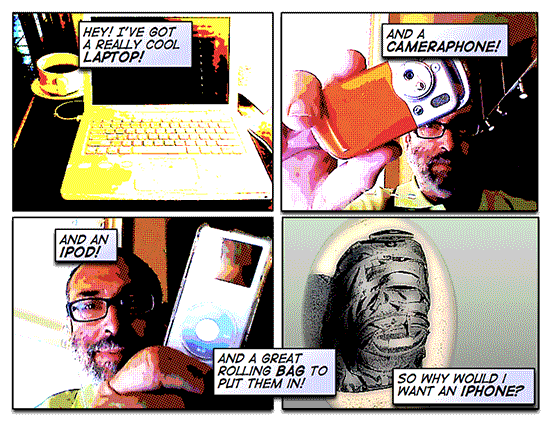
My core reason for not buying one now is that I don't need another computer immediately, and I still maintain that the iPhone is a computer being marketed as a cellphone. I already have all of the functionality of an iPhone on a MacBook, an iPod nano, and a Sony-Ericsson w600i cameraphone. At least I think I do. Having never laid hands on a functioning iPhone, I it's conceivasble that it could do things that my three gizmos don't. Of course, the iPhone integrates many of the capabilities of the three gizmos and has the trademark Apple minimalist esthetics and out-of-the-box functionality. Gizmo-wise, I'm still learning that I can do things with my Sony-Ericsson that I didn't know I could do when I bought it a year and a half ago.
Why else am I not buying an iPhone? For one thing, I'm not only an ornery cuss, I'm a cheap ornery cuss. Five hundred bucks plus an obscene amount of tax is a lot of money, and that leads me to the fact is that the iPhone, like the iPod before it, will be improved, upgraded, tweaked, debugged, and eventually I will be able to buy an even better iPhone (I'm guessing with double or triple the memory of the present iPhone) for the same 500 bucks plus probably even more tax. Oh, yeah, and I realize that I probably couldn't even get my hands on an iPhone if I wanted to this weekend because they'll be all sold out and I'd end up having to wait for it to be delivered, maybe weeks or even months from now. Hey, I don't camp out in front of stores, but even if I did, it's already too late.
Finally, there's one more thing about which I'm reasonably certain. When I finally do buy an iPhone, I'm going to turn it on, carry it around, make calls on it, send and receive emails, surf the internet, maybe watch YouTube, and I'll be saying to myself, "Damn, this is cool. How could I ever have lived without it? I should have bought one in June, 2007, when it first came out."
More Links: SteveJobs Macintosh Apple iPhone
More Images: SteveJobs Macintosh Apple iPhone
Permanent Link to This Entry | | Technorati Tag: SteveJobsSend a message to Jonathan: coffeeblogger (at) doublesquids (dot) com
Happy Birthday, Ted Nelson
Theodor Holm Nelson, generally credited with inventing hypertext, calls himself a nexialist. Although the word does not appear in the Wiktionary or have a Google definition, I find it to be a very appealing and useful world, meaning, presumably, someone who studies the connections between things which are ordinarily studied in isolation by various scientific specialties. The word comes from a science fiction novel by A. E. Van Vogt.
I went to a college on the outskirts of Philadelphia called Swarthmore. During my freshman year, Ted Nelson returned to the campus to participate in the Hamburg Show, a traditional theatrical event, and to express his opinion on various topics. Being a nexialist, Ted Nelson is unlikely to speak on any single particular topic, but on a whole host of connected topics, or in his term, (which does appears in Wikipedia), topics which are intertwingled. The words intertwine and intermingle appear in dictionaries, and Ted says the term is a portmanteau, or intertwingling, as it were, of the two.
I would have not known about Ted Nelson's birthday had I not read about it in Mark Bernstein's blog. Mark, another Swarthmorean, has dedicated his career to creating innovative and powerful hypertext software, which includes Tinderbox, the very software with which this weblog is created, and which makes it piece of cake for me to intertwingle gastronomy, theology, popular culture, and comics.
Mark gives a link (this one) to a podcast of Ted's lecture at the University of Southampton, during which Ted proposes interesting solutions to problems such as nuclear holocaust and AIDS, as well as giving a thumpin' (to borrow President Bush's term) to the World Wide Web as presently implemented, which Ted sees as a gross disservice to the whole concept of hypertext. Ted actually apologizes for any inadvertent role he may have played in the creation of the Internet. If you suspect that you may have nexialist proclivities, by all means watch the podcast. The whole podcast. Yes, it was Ted's birthday on June 17, exactly 70 years since he was brought into the world by his mother Celeste Holm (the Celeste Holm, who won an Oscar for Gentlemen's Agreement in 1947). Intertwingle that.
More Links: TedNelson Intertwingularity Hypertext ProjectXanadu
More Images: Hypertext TedNelson Hypermedia Intertwingularity
Permanent Link to This Entry | | Technorati Tag: TedNelsonSend a message to Jonathan: coffeeblogger (at) doublesquids (dot) com
Lolcats
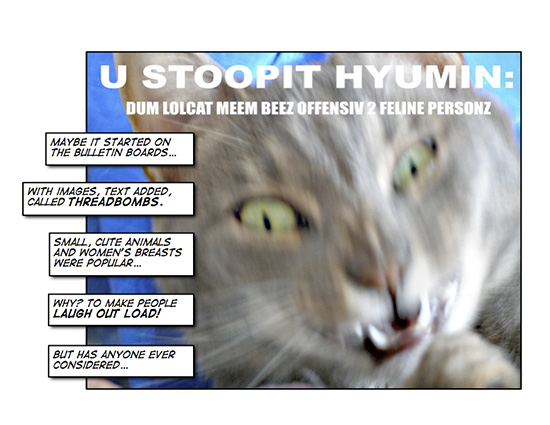
I'll get right to the point: The lolcat is a species of cartoon. As I did, you may have seen one or more without knowing what they were called, because lolcats are a big Internet fad, or in Internet jargon, a viral meme. A basic lolcat consists of a cute cat photo overprinted with a humorous caption. Cuteness is essential, and is usually intensified by the use of odd spelling and bizarre grammar. The lol, of course refers to the abbreviation for "laughing out loud," found throughout the anglophone Internet. (Hmmm… I wonder: what is the expression in, say, the Hungarian Internet?)
As cartoon taxonomy goes, a lolcat is a subspecies of the gag cartoon, a one-panel pictorial joke, as exemplified currently in the New Yorker magazine. Gag cartoons are to be differentiated from multi-panel comics and animated cartoons. My last post to Jonathan's Coffeblog documented the rise of a multimedia empire from a single gag cartoon. The availability of digital cat photos, downloaded or homemade, and of software which can superimpose a caption, has made cartooning (like weblog publishing, typography, and videography) possible for almost anyone.
Wikipedia describes lolcats as a form of image macro, a high-falutin' term for another Internet medium, the thread bomb. Thread bombs are lobbed by Internet bulletin board participants, who want to make a point emphatically. One of my favorite thread bombs is, "Holy retarded topic, Batman!" An exploration of the amusing fare dished out by threadbombing.com reveals a particular interest in the human female breasts in addition to cats and other small animals.
This element of sexism gave rise to the idea reflected in the lolcat I created for the image accompanying this blogpost. (Acknowledgement is due here to my cat Mazel for posing for the photo.) Is it possible that crude humor at the expense of members of the species Felis cattus is nothing more that crass speciesism? In other words are those of us, me included, who derive amusement from lolcats little more than speciesist pigs? But on further reflection, it is unquestionably speciesist to hurl political invectives, such as "racist p--" at the expense of the species Sus scrofa domestica. Gee, life in the 21st Century is complicated.
More Links: Lolcat ThreadBomb Cartoon
More Images: Lolcat Cat FurryFriday Cartoon
Permanent Link to This Entry | | Technorati Tag: LolcatSend a message to Jonathan: coffeeblogger (at) doublesquids (dot) com
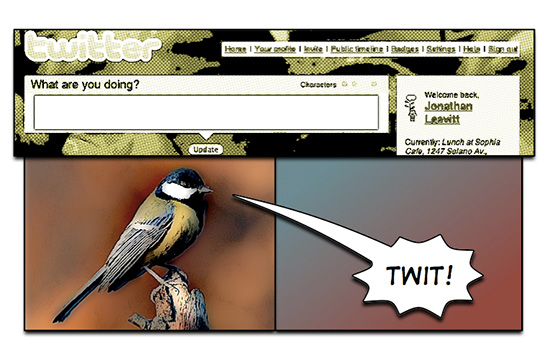
Brevity Is the Soul of Twit
What can I say about Twitter in 140 characters?
More Links: Twitter Twittermap Twittervision Twitterholic
More Images: Twitter SXSW Twitterholic Twittervision
Permanent Link to This Entry | | Technorati Tag: