[Tsatskes]


Twitterverse Coffee
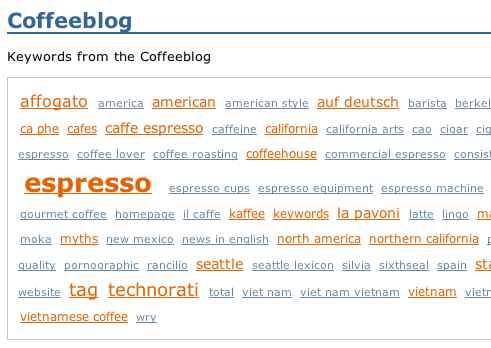
Popular Coffee Websites

Cafes by Zip Code
Coffee Podcasts

[Readers]

Locations of visitors to this page

[About]


[Blogroll]

43 Folders
Anders Fagerjord
Bay Area Bloggers
Berkeley Blogs
Blue Bottle Clown College
Cafexperiment
Coffeegeek
Denver Coffeehouses
Dogmilque
Doug Miller
Emily Chang's eHub
Hewn & Hammered
Jill's Definition of Weblog
Jonas Luster
Laughing Squid
Le Blaugue à Beleg
Loïc Le Meur Blog
Mark Bernstein
Moleskinerie
Seesmic Blog
Tant Mieux
The Dynamist
Tonx Dot Org

[Go]

Send Me Email:

coffeeblogger (at) doublesquids.com

Other Berkeley Blogs


SF Bay Bloggers
<<
#
Blogs That Flickr
?
>>
Blogcritics: news and reviews
Who Links Here


"The meaning of life and other trivia." Copyright ©2004, 2005, 2006, 2007, 2008 Jonathan David Leavitt. All rights reserved.

Every page now has Seesmic/Disqus video commenting. Scroll to the bottom to see or post video comments. There are also Haloscan comments at the end of each separate blogpost article. To read a text-only version of Jonathan's Coffeeblog on your iPhone or other mobile phone, click here. Or to see the graphics with less text, click here.

Go: [ Home | Previous | Archive | Gods & Myths | Cafes | Coffee | Nations & Empires | People | Arts ]
[ Words | New Media | Cinema | Gastronomy | Productivity | Yiddish ]

Denixonizing China

1:55 PM Saturday, April 26, 2008

[Is there a double standard in Beijing?]

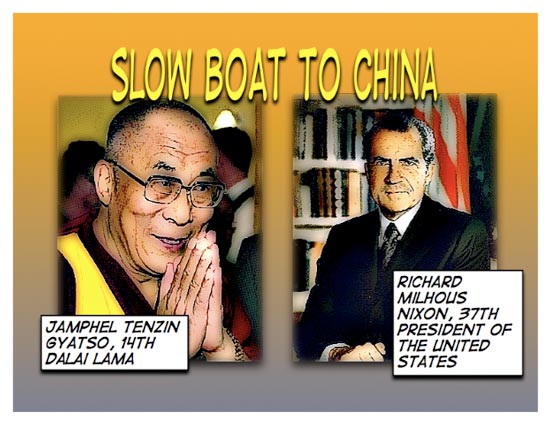
Slow Boat to China

Recently when the Olympic Torch passed through San Francisco, city officials engaged in well-intended skulduggery when they extinguished the original torch and successfully routed a second torch in another part of town. On the announced route, fans, onlookers, and angry demonstrators on both sides of the "Free Tibet" issue had gathered to show their enthusiasm and outrage. It turned out that the rerouting subterfuge prevented violence, but I was struck by the era-defining implications of this event, and other demonstrations which had begin on March 10 in China's Tibet Autonomous Region and soon after had become internationalized. I decided to write something about this in the Coffeeblog, and this is it. The more I learn about Tibet, however, the more complex the issue appears. Read on.

As an old-timer, I remember the days when the People's Republic of China was generally viewed as a international bad guy or villain in most of the American press and the general American consciousness. Then, in 1972, President Nixon visited China and met with Mao Zedong, the legendary Communist leader. Since then, with some notable exceptions, China's reputation has become generally favorable in the USA, as a manufacturing titan and "most favored nation" on a voyage, no matter how slow the boat, to freedom, democracy, and rights for the individual. Now, it appears, with the convergence of the Tibet issue and the Beijing Olympics, once again China's Communist leadership is being seen here as an international malefactor.

Why, when some of the regime's other warts and blemishes (like mass murder and the attempted extinction of individual rights and groups like Falun Gong) tend to generally pass unnoticed in the international press, has the "Free Tibet" campaign gained some traction? Has it reached the point of international humiliation of the folks in the once-Forbidden City before, during, and after the Olympics? A good starting place to answer such questions is Tibetan Buddhism itself, of which the Dalai Lama is the acknowledged spiritual leader outside of China. The Wikipedia asserts:

"In the wake of the Tibetan diaspora, Tibetan Buddhism has gained adherents in the West and throughout the world; there are estimated to be tens of thousands of practitioners in Europe and the Americas. Celebrity Tibetan Buddhism practitioners include [movie actor] Richard Gere, [Beastie Boy] Adam Yauch, [martial artist] Jet Li, [the late beat poet] Allen Ginsberg; [composer] Philip Glass, and [movie actor] Steven Seagal (who has been proclaimed a [reincarnate lama himself])."
And, yes,the near-legendary Italian-American director Martin Scorsese had made a 1997 film called Kundun about the life and exile of the Dalai Lama.

Add to that the events in the Tibet Autonomous Region beginning March 10 of this year, when rumors of beatings and killings of monks by Chinese government authorities reportedly triggered violent retaliation. The Dalai Lama stated, "we remain committed to taking the Middle Way approach and pursuing a process of dialogue in order to find a mutually beneficial solution to the Tibetan issue," after being accused by high China officials of having masterminded the the violent conflict stemming from the high-visibility "Free Tibet" campaign

In my view, another international generation, heirs of the 1960's counterculture, and sympathetic to Buddhist ideals and peaceful solutions to problems, has now reached maturity as a huge critic of the methods used by the Chinese Communist gerontocracy.

But, as the Dalai Lama also said, "The problem of Tibet is very complicated." Yup. It is. Let's roll back the time machine. The recent Tibetan uprising included violent attacks on otherwise innocent members of the ethnic groups moving into the Tibet area in increasing numbers, presumably with the approval and encourangement of Beijing officials. These not only include Han Chinese (members of the majority nationality in China, and known worldwide simply as "Chinese.") Many of the migrants to Tibet include Chinese citizens of a nationality know as Hui.

Hui? Who are Hui? Several sources tell met that Hui are predominantly Chinese-speaking Han Chinese individuals with one important distinction: they are Muslims, descended from Muslim traders, Islamic Mongol and Turkic warriors and settlers, and even from far-eastern Nestorian Christians.

OK. So? Aren't they just Han Chinese like the rest of those moving into geographical Tibet? Well, yes and no. The no part is that their religion, Islam, appears to be not only tolerated, but approved by the Beijing communists, whose Marxist view is reportedly promotion of atheism. This pro-atheist, anti-religious view could be cited as a reason for exiling the Dalai Lama and his "lamaist" followers from Tibet.

Do Chinese communists promote atheism in the same way it was promoted by Stalin in the Soviet Union? A good question. Marx had called religion the opiate of the people. But a multiculturalist perspective might consider a religion to be a colorful folk custom of an ethnic group. Is that the Chinese view, before and after Mao Zedong?

Is there a double standard in Beijing? Do Chinese communists view religion as OK among Hui Muslims, but not among Tibetan Buddhists? Is Han chauvinist piggery a factor? Or are there history-based political reasons for Beijing's perceived, and probably accurately perceived desire to crush Tibetan lamaism and even the Tibetan ethnic group itself.

Supposedly, the Dalai Lamas have been backed by the Mongols, who had taken over the Beijing empire during the Yuan Dynasty, before being ousted by the Han-led Ming Dynasty in 1368, 604 years before Nixon visited China. A Mongol khan, Altan, reportedly bestowed the title of Dalai Lama on the third one in 1578 when the Mings still ruled. Is Beijing still steamed about the Mongol-Dalai Lama alliance? Are the lamas still steamed about the way the Hans treated them and their allies?

Hey, don't ask me. I'm just a guy in a cafe with a laptop and a cappuccino. I doubt that Nixon knew back in 1972. I have a pretty good hunch, however, that the Dalai Lama knows something about this. And, assuming that his karma is as good as it's cracked up to be, perhaps even Steven Seagal knows too.

More Links:

More Images:

Permanent Link to This Entry | | | Technorati Tag:

Send a message to Jonathan: coffeeblogger (at) doublesquids (dot) com


The Stress of Not Blogging

8:23 PM Tuesday, April 8, 2008

[A productive way of telling stories.]

Hard. So Hard.

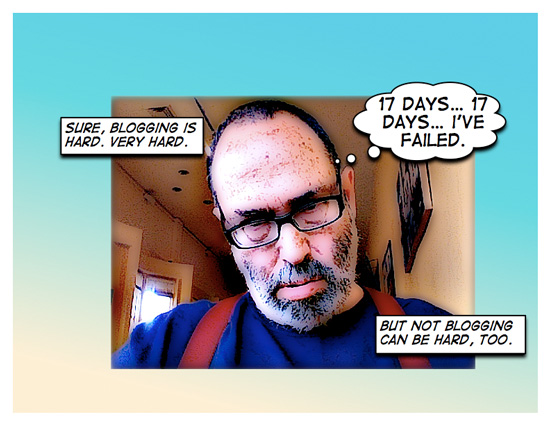
It's Tuesday, April 8, 2008 5:17:01 PM US/Pacific. I just looked at the Coffeeblog and learned that my last post was March 20: Purim. It's over. It's been over for 17 days. And yet, until this item, I haven't posted anything to the Coffeeblog. Seventeen days. Two weeks and three days. And that troubles me. I experience it as stressful. The stress of not blogging. And that brings me to a recent meme purveyed in the dead tree medium known as the New York Times. As their recent headline (April 6) trumpeted (in part) "Writers Blog Till They Drop."

Now it turns out that this was a kind of follow-up on a January 7, 2008 NYT item concerning Om Malik's heart attack, which occurred a few weeks earlier. The Times quoted Paul Kedrosky, whom they described as a friend of Om Malik: “You feel huge pressure to not just do a lot, but to do a lot with your name on it. You have pressure to not just be the C.E.O., but at the same time to write, and to do it all on a shoestring. Put it all together, and it’s a recipe for stress through the roof.”

OK. That makes sense. I too feel a huge pressure to not just do a lot, but to do a lot with my name on it. But let's get a few things straight. I'm not a CEO of anything. And the Times referred to "brand-name" bloggers, and I'm not even a Brand X blogger. My little Coffeeblog doesn't even show up on one of those Alexa charts. So I wouldn't dream of putting myself in the same league with Om Malik, Michael Arrington or any other of the surviving big-time bloggers mentioned by the Times. Could that be why I haven't had a heart attack yet?

Concerning the Maliks and Arringtons of the blogosphere, is the Times on to something? Is blogging at the root of the deadly stress the Times describes? Well, maybe, in the sense that the sheer overavailability of breaking news over newsfeeds creates a situation where the puny human brain can't keep up with the machines. The metaphor that occurs to me is a human runner in a foot-race with a locomotive.

But frankly, and obviously, humans have had heart attacks and succumbed to stress for eons before blogs existed. The sheer productive power of information technology could tempt a productive person (and the brand-name bloggers are very productive people, unlike, well, me) to push himself (or herself, but funny, the Times didn't mention any women) a little, or a lot, too hard. As for women bloggers, Virginia Postrel, whose blog The Dynamist I have mentioned before, is now a breast cancer survivor. Was her cancer stress-induced? From blogging? Harrumph.

It seems to me that the species Homo sapiens is hard-wired for productivity at some level, not always Om Malik level, and for telling stories. Blogging is a way of telling stories. And for brand-name bloggers, blogging is a very productive way of telling stories.

So here's to dead, lamented bloggers Russell Shaw and Marc Orchant, who, the Times tells us, died of heart attacks. They went out in a blaze of glory. If I were in a bar I'd drink to them. But I'm in a cafe and I already finished my Capuccino. As I look into my sad, empty cup, I think, defiantly: "Keep on blogging, people. Keep on blogging."

More Links:

More Images:

Permanent Link to This Entry | | | Technorati Tag:

Send a message to Jonathan: coffeeblogger (at) doublesquids (dot) com


Universonal

7:38 PM Tuesday, March 18, 2008

[When the personal is universal and vice versa.]

Universonal?

I've been more and more satisfied with what I've posted to the Coffeeblog over the past few months, and I'm getting more page views from visitors. How much these visitors read of what I've written, I don't know. But they're visiting, and some of them, according to my statistical software, stick around and read other things I've written after they read the stuff they were searching for. There is another trend, however, over the past few months: I've been posting to the Coffeeblog less often. What does that mean? Am I getting bored with blogging? (No.) Are my standards getting higher (Yes.), and therefore am I intimidating myself about writing more and posting new images? (Maybe.) I think I know what is happening. The Coffeeblog has transcended mere ego-tripping, hobbyism, and showing off, though it is all of the above. It has become nothing less than a repository for my sense of personal identity. In decades past, that role was filled by college, job, ideological identification, and to a lesser extent, lifestyle. Now, as a certified old geezer (I collect Social Security!) I have needed to rewrite the whole saga before my demise, which even if it should happen fifty years from today, will be untimely. (I guess my health is good enough for me to still think that way.) What all of this lengthy paragraph implies is that the Coffeeblog is very, very personal. But there's much more to it than that.

Certain of the topics which I have roughly categorized in the Coffeeblog seem to be growing in importance as time goes on. The "Gods and Myths" page seems now to be the most popular landing place for new viewers. I also have been writing increasingly often about historical stuff: stories and histories, which are ultimately the same thing. Conventional American discourse is now mostly focused on just how bad George W. Bush is (or if you still like Bush, there's always Hitler, Ahmadinejad, and Hillary Clinton.) But really folks, there was a world that existed long before any of those luminaries, and that world shaped the recent era in which the same luminaries have acted. That is why people like Ismail I, Shah of Iran, Constantine and his mother, and Hulagu Khan have become more important to me than, say Jack Murtha or Dick Cheney. However, I don't want the Coffeeblog to turn into a blogospheric remake of the History Channel. And that's where the personal stuff comes in. I recently coined the lame, geekspeak term "universonal" as a portmanteau of "universal" and "personal." Perhaps a more elegant word will soon surface, but I have concluded that a good blog has to be "universonal".

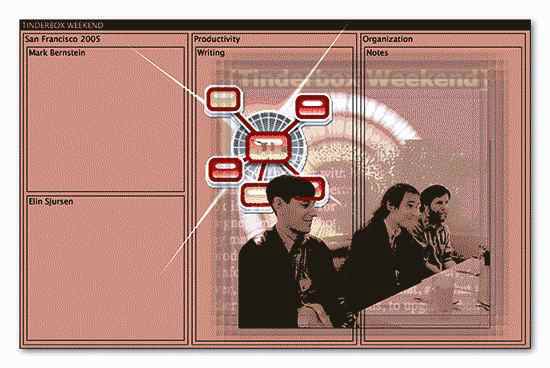
Recently Mark Bernstein gave a talk in Cork, Ireland, about blogging. Mark graduated from the same college I did, which I characterized, when I was still there, as a "boot camp for intellectuals." He went on to become a specialist in hypertext and the developer of the Tinderbox note processing software, with which I publish this weblog, and which I have discussed elsewhere on it. What does Mark have to say? He has developed a theme of Neo-Victorian Computing, an idea which would have never occurred to me. When I think of Victorians, I think of "we are not amused" (a quote from Her Majesty herself), of buffalo hunts on the Great Plains, of extravagant but spooky Queen Anne mansions, Charles Dickens, and the Sepoy Mutiny. Mark has brought to light a whole new, much more positive view of that era. If I might paraphrase a wall motto from the California History section of the Oakland (California) Museum, where a magnificent, posh display of Victoriana had greeted the visitor, "scoff now at the Victorians; there will be plenty of time for humility when they are gone." (That section, BTW, is closed for renovation, so even the motto is gone.) In a sense, Mark is saying the same thing. He has a lot to say, and I am reading and rereading his work as an ongoing process. One of his voluptuous lecture slides carries the slogan: built for people, built by people, crafted in workshops, irregular, [and] inspired. Considering Mark's Tinderbox software as a workshop (for writing) alchemized into computer software, and considering one person (myself) as "people," I believe that the Coffeeblog qualifies, in that sense, as neo-Victorian.

Mark has also coined a word, nobitic, from the Latin for "ours." He writes about nobitic blogging, that is blogging for an intimate, limited audience of friends and family. My first weblog was such a nobitic blog, for family members, and it is still online, but I do not give out the URL publicly. In that sense, the Coffeeblog is not truly nobitic. In another sense I consider the entire blogosphere, and indeed, anyone with Internet access, even if only by mobile phone in Kathmandu and Timbuktu, to be my personal, intimate audience. For that reason, I make an effort for each blogpost, not always successful, to tell a personal story regardless of whatever I am writing about. Though tempted to write stuff that might offend some of my readers (and I undoubtedly sometimes yield to that temptation without knowing it), I try to maintain a bond of civility within that universal "family." And, from the other end of the telescope, I try to consider the universality of the topic of the post I am writing. It's a tall order.

Finally, to quote from one of Mark's recent blogposts, "We can do things we have never done: what is worth doing? What is worth writing? Who are we, and what do we want?"

Exactly.

More Links:

More Images:

Permanent Link to This Entry | | | Technorati Tag:

Send a message to Jonathan: coffeeblogger (at) doublesquids (dot) com


Milos Obilic and the First Battle of Kosovo

9:27 PM Monday, February 25, 2008

[Never again? Please.]

Milos Obilic and the Blackbird Field

Later in life I'm becoming a history buff. In college I considered the study of history burdensome, with all those details to memorize for the exam, but now, whenever I hear a news headline about some world trouble spot, I want to go immediately to the Internet to get the background. This impulse has led to previous Coffeeblog posts such as The Right-Left Politics Meme, Anselm Kiefer's May-Beetle, and Ismail and the Safavids. Well, it's happened again. This past week or so, the new nation of Kosovo declared its independence, following which it was recognized by the US, following which there were huge demonstrations in Serbia against the US, plus riots by angry Serbs who set fire to a US Embassy office, a McDonalds restaurant, and multiple American Flags. "So what else is new?," you might be saying if you're a Christian, a Jew, or an atheist, who has not kept up-to-date on your Serbian history. "Of course the Muslims are burning the US Embassy. That's what Muslims do. The US must have been caught flushing another Koran or something." But guess what? The Serbs are not Muslims. They are Christians (Serbian Orthodox) or atheists too. So why are they angry? Well, the brand-new nation of Kosovo is populated primarily by ethnic Albanians (there is also an independent nation of Albania}, and most of the ethnic Albanians in Kosovo are Muslims. So the US supports a new Muslim nation and the Christians burn our flag? Well, yeah. For me, that means it's Google time again.

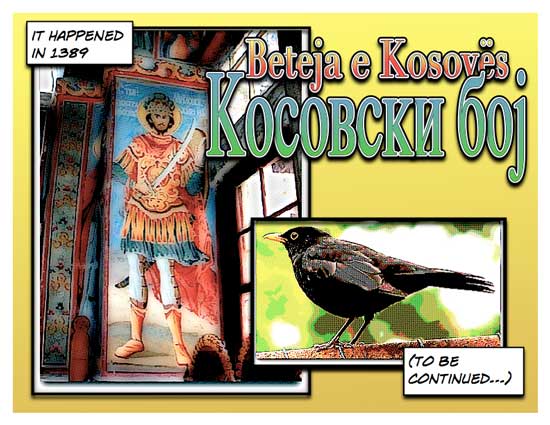
So what did I learn? Lots. I'll skip over the part where Putin and the Russians, who are traditional allies of the Serbs, are capitalizing on the huge anti-American sentiment in Serbia, and get to the history part. And that takes me to the story of Milos Obilic (pronounced mee-losh o-bee-litch: sorry, my software can't do the Serbian Cyrillic or diacritical marks). The Albanians call him Millosh Kopiliq. There is a stadium named after him in Belgrade. Obilic was a Serbian knight who died on or about June 15, 1389. How did he die? He was executed by the Ottoman Turks. Why? Because he assassinated the Turkish Sultan, Murad I, that's why. There is some dispute about how or why he was able to do this deed, but Turks and Serbs reportedly agree that he did so. There is a fresco of Milos Obilic on the wall of the Mt. Athos Greek Orthodox monastery which I used for the Coffeeblog illustration above. The Greek Orthodox, Russians, and Serbs seem to be very fond of Milos Obilic, but I would guess that there are probably no stadiums named after him in Turkey or Albania. So what was this assasination all about? And that takes us to the First Battle of the Blackbird Field.

The field, named for the blackbirds who apparently like to forage there, is located in an area called Gazimestan, about 5 km. from Pristina, the capital of the new nation of Kosovo. In Serbian, "kosovo" means "of the blackbird," hence the name of the field, the region, the new nation, and the battles. Yes, there have been multiple battles of Kosovo, and, frankly, I think we have not seen the last of them. The first battle, the one in which Milos Obilic died in 1389, was a battle between the Serbs with their Christian allies, and the Turks. The Serbs lost.

Now, generally, it is the winner of the battle who generally gets to write the history, but there are some exceptions. Remember the Alamo? That was a battle between Texans and the centralist government of Mexico, in which the Texans lost. They were all killed, but the Alamo is still there, and it is a kind of shrine to Texans, located in San Antonio, Texas. Another battle where the losers got to write the history was Thermopylae, in Greece, where the Greeks lost after being outnumbered by a huge Persian army. The Blackbird Field was such a place where the losers got to write the history, at least the history as taught in Serbia, and in Greek monasteries. The larger theme, of course, was the jihad by some Muslim rulers to spread Islam in Europe, and the crusades by some Christian rulers to resist the jihad.

The Ottoman Empire, in fact, ruled Kosovo for a time as the Vilayet of Kosovo, and later, Kosovo was integrated into Serbia, and then Yugoslavia. The land that is today Albania was controlled by the Ottoman Empire from 1385 until 1913, a lot of time for many Albanians to identify thoroughly as Muslims. In 1443, an Albania hero named Skanderbeg led a rebellion against the Ottomans under a flag which was derived from the Byzantine double-headed eagle of the Palaeologus family. That flag is still the national flag of Albania. The majority of Albanians are reportedly Sunni Muslims, but there is a long pre-Muslim history of Christianity and pre-Christianj religions, and during the 20th Century Communist regime of Enver Hoxha, atheism must have been the official religion. The proportion of Muslims in the new nation of Kosovo might even be higher than in Albania proper. Will they fall (or have they fallen) under the influence of Muslim preachers who denounce the USA as the Great Satan? We will find out, probably sooner than later.

As of six days ago, Israel announced they would not recognize Kosovo "for now." As of 11:58 AM today in Washington, where allegations of horrific Serbian massacres of Muslims in Kosovo have been taken very seriously since the Clinton Adminstration, it was announced by the US State Department that Kosovo will "never again" be part of Serbia. Never again? Please. In the Balkans or the Middle East, there is always a high risk that those words might have to be retracted.

More Links:

More Images:

Permanent Link to This Entry | | | Technorati Tag:

Send a message to Jonathan: coffeeblogger (at) doublesquids (dot) com


What Hath Jobs Wrought?

6:23 PM Saturday, January 19, 2008

[Taking wireless to the next level.]

Who Needs a MacBook Air?

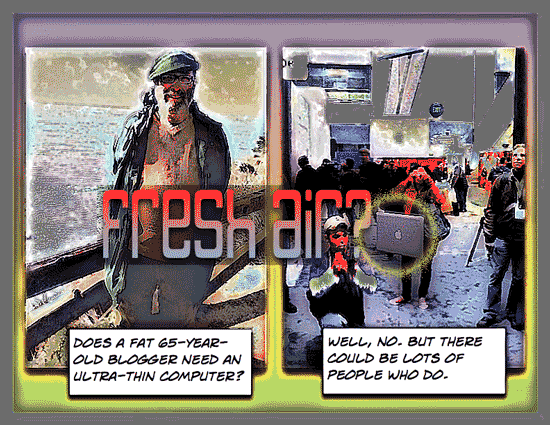
Yesterday was the last day of this year's (2008) MacWorld Expo, the huge Apple event in San Francisco, and as usual Apple CEO Steve Jobs was going to knock our socks off with his presentation of astounding, revolutionary new products. This year, his main offering was an ultra-thin, ultra-light laptop computer which Apple calls the MacBook Air. As I left MacWorld Expo, I was humming that great Peggy Lee standard, "Is That All There Is?" I was kinda disappointed.

Now as I write about the MacBook Air (and I almost didn't write about it) I have to put this in context. What had I written a year ago, when Jobs introduced the iPhone and Apple TV? In a post I called Size Queens I made two points: 1. The iPhone was really a computer disguised as a telephone, and 2. What Jobs had done was not so much about telephones or televisions as about bringing Mac computing to very small and very large screens.

But I wrote more last year. I wrote, as the iPhone was about to ship in June, that cool as it was, I didn't really need one. And then I wrote, in July, that I bought one anyhow. With very unexpected and positive consequences. Now that has some bearing on what I am writing now about the MacBook Air. No, I am not going to get one, I say now. And I think I really mean it. But what Jobs has done with that new machine may ultimately be as revolutionary as the iPhone itself.

First of all, there is the style issue. Before Jobs was brought back as the Apple CEO, John Sculley, a former Pepsi exec had cranked out a long line of boring beige boxes having none of the pizzazz of the original 1984 Mac. Jobs brought style back with a vengeance. Literally. Revenge. I have written about Virginia Postrel, writer of The Future and its Enemies and The Substance of Style. In the latter book, she makes the point that style is quite substantial, and should not be dismissed as mere frou-frou. Now I may not be the most stylish guy in the world (my girlfriend would say that's an understatement), but I happen to agree with Mrs. Postrel. And to those John Sculleys out there who do believe that style is insubstantial, Jobs exacted his revenge. Curious, isn't it. Most of the new cellphones try to look like iPhones. Hmmmm…

In my admittedly unstylish opinion, the MacBook Air is unquestionably the most stylish computer every designed. And that means that the stylish people are going to buy it. The Beautiful People (and that means thin people) can't be lugging around a fat computer. I imagine that a Macbook Air and its power cords can easily be transported in a Vuitton briefcase, and subtly slipped out on to a boardroom table. Point scored. And we're not talking Power Point, although the point will have the power of one-upmanship. (BTW, does Louis Vuitton make briefcases? I get my rolling bags from REI.)

But now for the substance: Jobs has taken the gestural vocabulary of the iPhone and brought it to the MacBook Air. Experienced iPhone users will be able to scroll, zoom, double-click, and even rotate photos on the trackpad without keyboard shortcuts or any mouse clicking. But I've saved the best for last: Jobs has taken wireless to the next level. No Firewire. No CD or DVD player. No external hard drive. It's all wireless, or going to be in February. Want to see a movie? No DVD rentals. Rent one from iTunes for three bucks and download it. Need to install software from a CD or DVD? Stick it in your other computer (the Beautiful People have other computers) and it will install on your MacBook Air. Wirelessly. Need to back up. You needn't trouble your stylish mind about that. Bring your MacBook Air within range of your home network and it will be backed up. Wirelessly. And automatically.

The one wireless feature that's still not there is wireless recharging. Now that I've got to see. And have. So, Please, Mr. Steve Jobs, don't disappoint me at MacWorld Expo 2009.

More Links:

More Images:

Permanent Link to This Entry | | | Technorati Tag:

Send a message to Jonathan: coffeeblogger (at) doublesquids (dot) com


An American Folk Hero: The Dropout

2:54 PM Thursday, January 10, 2008

[Everything a decent kid was not supposed to be.]

Henry Miller and Who?

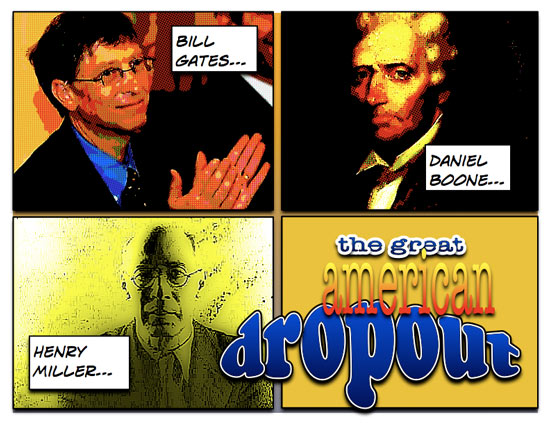
This past weekend I celebrated another year of my life with an annual visit to Big Sur on California's central coast. Named in Spanish for the big river of the South, El Rio Grande del Sur, Big Sur was barely accessible until the 1940's when Highway 1 was built along the precarious cliffs where the mountains of the Ventana Wilderness meet the rocky shore of the Pacific. Writers Robinson Jeffers, Jaime de Angulo, and Henry Miller brought fame to the region as a place for Americans and Europeans who wanted to get away from it all; in other words, to Drop Out.

1960's drug guru Timothy Leary gave us the mantra, "Tune in, Turn On, and Drop Out," but the Dropout was part of American folklore and mythology long before the 1960's, before getting stoned on acid became a short-lived part of the tradition. For me, growing up in the 1950's, a "dropout" was the paragon of everything a decent kid was not supposed to be. The term referred, of course, to an adolescent who dropped out of high school because he had other plans. Mark Twain's legendary fictional dropout, in his novel Adventures of Huckleberry Finn (1884) dropped out before high school, and went rafting with erstwhile "good" kid Tom Sawyer and with an African-American pal named N-Word Jim, who was also a Dropout, not from school but from the whole slavery thing.

A contemporary dropout hero (villain to some) is Bill Gates, who dropped out of Harvard University in 1975. A high-ranking Boy Scout, son of a prominent Seattle lawyer, and a natural entrepreneur, Gates made $20,000 in a business he founded at the age of 14. In his joint venture with Paul Allen, he took a "leave of absence" from Harvard in order to form a company they called "Micro-Soft". In 2007, Gates did get a degree from Harvard, but it was an honorary one.

In his novel Tropic of Cancer, Henry Miller created his own version of the Dropout myth. The book, which took decades to achieve fame and notoriety, and longer to make money was described by Miller as "a gob of spit in the face of Art." It is a rambling account of Miller's Paris years after he quit his job as a manager for Western Union, which Miller called it the Cosmodemonic Telegraph Company. Supported by a taxi-dancer wife and handouts from friends, he struggled to survive in a 1930's Paris which was no longer the haven it had been for American expatriates like Ernest Hemingway. While there Miller collaborated with Anais Nin, who was not a dropout but the wife of a successful American banker with an overseas job. Miller stayed in Paris until the Nazi occupation forced him to leave, and after much traveling, settled in Big Sur, where he stayed until he got too old and had to move to Pacific Palisades.

Miller's version of the Dropout was another kind of dropout, a dropout from the corporate grind called the "Rat Race," a term I had heard in the 1950's while I was still preparing to become a racing rat. Decades later, I found much appeal in Miller's self-created dropout persona.

Bad boys, maverick tycoons, and ex-rat racers aside, the Dropout has always been part of the American ideal. From the beginning the United States has been a nation of dropouts, while paradoxically growing into the role of the world's leading racer of rats and largest exporter of a variety of rat races. Dropouts Henry David Thoreau and Walt Whitman celebrated dropping out from a conventional and oppressive social system. Whitman, incidentally (he was one of Henry Miller's heroes) dropped out of school at age eleven years. The earliest European immigrants braved the Atlantic ocean and a hostile wilderness in order to drop out of the rigid religious and class systems of the Old World.

Another version of the iconic American Dropout is the frontiersman, the man who lived beyond the edge of civilization. One such fellow was the ex-Pennsylvanian Daniel Boone, whose Quaker brother and sister married out of the faith, resulting in expulsion of the Boone family from their Quaker community. Boone himself, who eventually pioneered the settlement of Kentucky, preferred to wear felt hats, but fur hats made from the skin of a raccoon, Native American style, became the iconic symbol of the American frontiersman including Boone. The coonskin cap was popularized in the 1950's by Walt Disney, another high school dropout, who tried unsuccessfuly to get into the Army at age sixteen.

More Links:

More Images:

Permanent Link to This Entry | | | Technorati Tag:

Send a message to Jonathan: coffeeblogger (at) doublesquids (dot) com


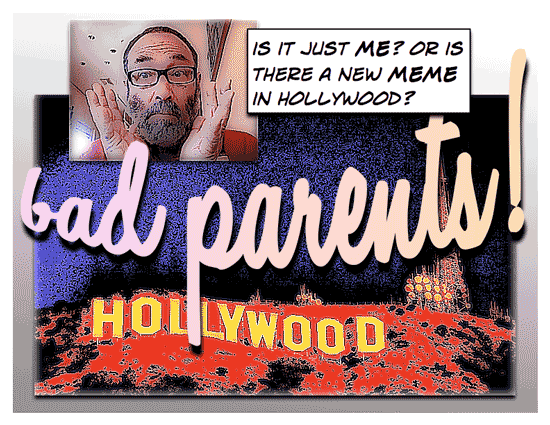
Bad Parent Movies

2:38 PM Sunday, December 30, 2007

[Is the new Hollywood really the old Hollywood?]

The New Hollywood Meme?

For some reason I haven't written for Jonathan's Coffeeblog for a few weeks, but I've been busy with other stuff, including much frustrating interaction with bureaucracies. However, I did watch a few movies during that time, three of which, by strange coincidence, all dealt with impassioned young people who were overreacting to nasty, overbearing "control freak" parents. Did I discover a new Hollywood obsession, a meme as it were, or perhaps an unconscious personal motive in the choice of films to see next: Into the Wild (in a theater), Transamerica, and Factory Girl (the latter two on DVD)? In the first of the three, a recent male college graduate resentfully makes a charitable donation of $24,000 given to him by his parents to buy a new car. He then disappears and goes on a grim journey, which he considers liberating, during which he works as a Dakota combine operator, travels with sympathetic hippy couple, tries life as a wetback (he abandons his ID before re-entering the US from Mexico), as a homeless street person and as a daredevil river kayaker. He becomes a surrogate grandson to a lonely old man, and finally tests his mettle alone against Alaska's Denali wilderness. The wilderness wins.

Based on the true story of Christopher McCandless, the film's premises are mixed and vague. The film is nevertheless interesting, extolling glorious old-school mythic themes with the help of superb high-budget Hollywood production values: the manifest destiny of the American West; the rugged individual who will not be fenced in; the wild land that refuses to be tamed or polluted to death; and the reincarnated wanderlust of Jack Kerouac in On the Road and Henry Miller in The Air-Conditioned Nightmare. Still, I could not help thinking, as I watched the tale unfold, that if the protagonist had ever been to Boy Scout camp or gone hunting with his father and learned how to dress a deer, the outcome would have been different. For him. The West is still the West, and a cowboy in any other guise is still a cowboy. Could that have been the premise of the film? Is the new Hollywood really the old Hollywood?

But what if the cowboy would rather be a cowgirl? That was the question asked in Transamerica, in which a male protagonist, uncomfortable with the gender he was born with, and grossed out by an outrageous cartoonish mother, decides that he can become a better woman than she is by undergoing male-to-female sex-change surgery. Just before the final operation, in which his "outie" is to be converted to an "innie," a male teenager contacts him, claiming to be the son he never knew about, the offspring of a brief romance with a woman who later died. The hero/heroine of the film, played brilliantly and fetchingly by Felicity Huffman, eventually learns that he can be a paren, and not a bad one, if not exactly either a mother or a father.

The third film, Factory Girl, addresses the Achilles heel of the great artist Andy Warhol, identified (correctly in my opinion) as the artist whose work inspired the art trends of second half of the 20th Century. Warhol, who could never stop trying to please his mother, who in turn would never accept him to be the homosexual that he was, engages in an intense relationship with a pretty Santa Barbara heiress named Edie Sedgwick, one of many children raised by a deeply disturbed father isolated on a huge ranch. Although Warhol worked with paint, photography (still and cinematic) and silk-screen printing, the medium that he mastered most effectively was the mainstream press and network television. And, yes,the art form that he perfected more than any other artist of the Pop school was the art of celebrity. Thus, he was irresistible to Edie, because he could, and did, turn her into a superstar. (Did Warhol invent that word? I think maybe he did.)

But Edie Sedgwick miscalculated. Knowing what everybody else knew, that Andy was gay, she took up with Bob Dylan, or someone very much like or close to Bob Dylan. That did not fit in with Warhol's plan to present her to his mother as the girlfriend that the mother had always longed to see. In the film, he does take her home to his mother; but after Edie became involved with Dylan, Warhol, who had easily made her into a superstar, changed her into a non-superstar, and then a nonentity. Edie died before she turned thirty. The whole Factory Girl story was true, or said to be true, by the witnesses and participants in the Warhol entourage, who are interviewed in the special features program of the DVD. (Bob Dylan did not participate in the special features and was called Danny Quinn in the Factory Girl cast.)

When I started writing this about Factory Girl I had planned to say that the film was not really about Andy Warhol, but about Edie Sedgwick. But thinking about it as I wrote, I realized that the film really was about Andy Warhol, with Edie playing the role of a tragic foil, just another pretty face, with a father who was, yes, a bad parent.

And while writing that I started to ask myself, was the film really about Andy Warhol? Maybe it was really about Andy Warhol's mother.

More Links:

More Images:

Permanent Link to This Entry | | | Technorati Tag:

Send a message to Jonathan: coffeeblogger (at) doublesquids (dot) com


Are Christians an endangered species?

4:23 PM Saturday, December 1, 2007

[From the Milvian Bridge to Lebanon]

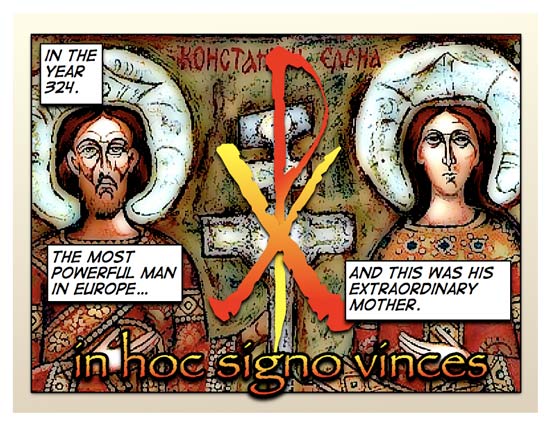
Helen & Constantine

As a boy growing up in Pennsylvania I felt like a small Jewish fish swimming in a vast, boundless sea of Christians, while Buddhists, Muslims, and Hindus were the stuff of storybooks. Now, however, I am repeatedly encountering the idea, on the Internet and in the mass media, that Christianity is running out of time. Today I Googled the phrase "demise of Christianity" and got 766,000 hits. The themes under that category included secularization of former Christians; the choice not to have children; a preference for personal spirituality over organized churches, and escalating geographic relocations due to competition from other, more assertive religions. Many believe that Christianity is not only vanishing from places like Lebanon and Iraq, but drastically losing numbers in Italy, the UK, and elsewhere. These dramatic current events described aroused my curiosity about where all of the Christians came from in the first place, and that led me to the story of the Roman emperor Flavius Valerius Aurelius Constantinus, and that of his mother Flavia Iulia Helena Augusta.

The short version of those fascinating stories is that Helena (sometimes called St. Helen in English) became a Christian and influenced her son, a powerful and dynamic leader who reunited a broken Roman Empire, legalized Christianity in that empire (lions, remember?) , and rebuilt the ancient Greek town of Byzantium as a city in his own name, which kept the Roman Empire going until 1453. (No, the occupation of Rome by Germanic tribes in 476 was not the end of the empire, but of the western, Latin-speaking half. The Greek-speaking eastern half survived until Constantinople was occupied by the Ottoman Empire under the Sultan Mehmet II.) Constantine convened a council of Christian bishops in 325 in Nicaea, a town on the Asian side of the Bosporos strait, and it was this council, perhaps more than any other historical event, which turned Christianity into an "organized" religion. Sixty-six years later another emperor, Flavius Theodosius, proclaimed the Christianity of Nicaea as the state religion of the whole Roman Empire. Theodosius banned worship of the ancient pagan gods, closed their temples, and, in 391, extinguished the "eternal" fire of the Vestal Virgins.

Helena Augusta, who was made a saint by both the Roman Catholic and Eastern Orthodox branches of Christianity (there is a popular visitor's destination in the California Wine Country named after St. Helena), was reportedly the daughter of an innkeeper who bore the imperial son of Constantine's father, also named Constantine. The father later abandoned Helena for a political marriage, and St. Helena is now a patron of divorced people. However, Helena's greatest claim to fame, other than gaining her son's sympathy for Christians, was an extraordinary journey at the age of eighty to Jerusalem in search of the same cross upon which Jesus of Nazareth was said to have been crucified. With the help of a bishop, and the permission of her son the Emperor, Helena began an archaeological dig at a Temple of Venus, believed to have been over the tomb of Jesus. (She has also become the patron saint of archaeologists.) The remains of three crosses were found. But which one was the cross upon which Jesus had been crucified?

If such a question were to be answered today, a huge database of historical information and the use of scientific techniques such as radio-carbon dating and DNA testing would be invoked. Helena had none of these tools, so she employed a method more in the spirit of the time. Taking samples from each of the three crosses, she made rounds of the sick, touching each patient with a cross sample. One woman suddenly recovered from her illness. By the "science" of the time, the True Cross had been identified. Kept for a while in Jerusalem, it eventually suffered from being cut into pieces, which were fought over by an Iranian Shah, crusaders, and countless churches. In a church in Spain, a relic is currently considered to be the largest remaining piece of the True Cross.

As for Constantine himself, who was not baptized until he was near death, a notable story was the decisive battle of the Milvian Bridge, a stone structure across the Tiber on the Via Flaminia. A rival emperor of the divided Empire chose the bridge as the battleground to keep Constantine's troops out of Rome. According to various legends, Constantine had a vision, or a dream, in which he saw a powerful symbol, and heard the words in hoc signo vinces, "in this sign you conquer." He is said to have had the sign painted on the shields of his men before the battle. But what was the sign? To some, it was a cross, but apparently the most popular version is that it was the letter X superimposed over the letter P (the labarum), which are also the Greek letters chi and rho, which are also the first two letters of the Greek word christos, meaning "anointed." That, of course, is that name by which Jesus of Nazareth is known throughout the Christian world: Jesus the anointed Christ.

More Links:

More Images:

Permanent Link to This Entry | | | Technorati Tag:

Send a message to Jonathan: coffeeblogger (at) doublesquids (dot) com


I am Curiousyellow

12:07 PM Thursday, November 15, 2007

[Long? Boring? Banned in Massachusetts?]

Curious (Yellow)

The month after I started Jonathan's Coffeeblog, I was curious about the process of starting a blog using the Blogger website. I gave my exploratory blog the title "Curious" with the username (changed later) of "curiousyellow," which I made up on the moment, suddenly recalling the 1967 Swedish film I am Curious (Yellow). Since then, curiousyellow has been my username on many social websites, including Flickr, del.icio.us, Twitter, and Seesmic. Recently I decided to see the movie again to see if my opinion of it had changed. It has changed.

The film, directed by Vilgot Sjöman, who died last year, concerned the problems of a young woman barely in her twenties, played by Lena Nyman, as a character of the same name. To make three long stories short: 1. The movie was all about Lena's problems during the run-up to the 1968 world political cataclysm; 2. There was much explicit sexual intercourse in the film, guaranteeing its notoriety in the USA; and 3. Sjöman's postmodernesque and proto-hypertextual structuring of the film also guaranteed mass confusion among disappointed US viewers, my young self included. I came to see sex scenes so allegedly outrageous that the film was banned in Massachusetts (yes, that Massachusetts!), and saw nothing of the kind.

I remember the conventional wisdom of the time: the movie was long and boring, Lena Nyman was no Marilyn Monroe, and the sex was not sexy. Looking back forty years, I have to say that all of the above was true, but irrelevant. Curious (Yellow) was and is quite an interesting film.

The length and pace of the film had a lot to do with Sjöman's post-Hollywood style, which I will address in a moment. Lena Nyman was very cute, appeared underage, and her sexual adventures in the film appeared to be the product of sadness, frustration, desperation and unrequited love, not the lewdness one yearned for. Disappointed and outraged by a missing mother, a zhlob of a father, and a sleazebag boyfriend, Lena (the character) was a very confused, and in my mind, sympathetic young lady. If Americans had not been suffering under the yoke of Comstockery (the legacy of Anthony Comstock from 1873), the preposterous banning of the film would never have happened, and the film would have been a mere unmentioned flop in the US market.

Two real-life characters played cameo roles in Curious (Yellow), the Rev. Dr. Martin Luther King, Jr., and the Russian poet Yevgeniy Yevtushenko, author of the politically incorrect poem Babi Yar, and who now (2007) teaches in Oklahoma and New York. Both were icons of the political earthquake rumbling at the time the film was made.

Another theme running through the film was the Spanish Civil war, in which Spain's Republicans fought desperately against the dictator Generalissimo Francisco Franco, who was backed by the National Socialists of the Third Reich. In the film, Lena's father had gone to Spain to fight Franco, then changed his mind and came home. For this apparent cowardice, Lena never forgave him.

I call the structure of the film "hypertextual" because at many different points it branches off into a variety of topical subjects. Sjöman, in fact, made two versions of the film, Yellow and Blue, named after the colors of the flag of Sweden. (I haven't see Blue yet, but it's on order. It's said to be, not a sequel or prequel, but a restructuring of the same film footage used to make Yellow.) If Curious (Yellow) and (Blue) were in the public domain, it would make a great Internet phenomenon with a variety of texts and images coordinating the links to the various film clips, perhaps posted to YouTube or elsewhere. Of course, in 1967, hypertext was virtually unknown, although Ted Nelson had coined the term two years earlier.

When I call Sjöman's film "postmodernesque" I am referring to its self-referential and paradoxical qualities. It could be called a political film, and is, but Sjöman is no Michael Moore. He is subtle, intellectual, creative, and reflective. It could just as easily, today, be called a psychological study of a young woman, or even a "chick flick," if Lena were not the only "chick" of consequence in the film. Sjöman put himself in the film, as Fellini had done, in the role of the director of the very film one was viewing, and as a lover of Lena, who, like all of her significant others, also abandons her. At any point in the film (example: Lena interviews the King of Sweden) what occurs on the screen, sex included, could be part of the narrative, or more likely, a fantasy in Lena's head.

As for the real-life Lena Nyman, her acting career in Swedish films and TV is still going on, and in 1978 she co-starred with Liv Ullman in Ingmar Bergman's Autumn Sonata. As for my blog, Curious, I changed it to a photoblog, leaving the original posts intact, but I have not posted to it for years.

More Links:

More Images:

Permanent Link to This Entry | | | Technorati Tag:

Send a message to Jonathan: coffeeblogger (at) doublesquids (dot) com


Moleskinerie (Part One of Three)

1:21 PM Thursday, October 11, 2007

[Like Alfa Romeos and bruschetta.]

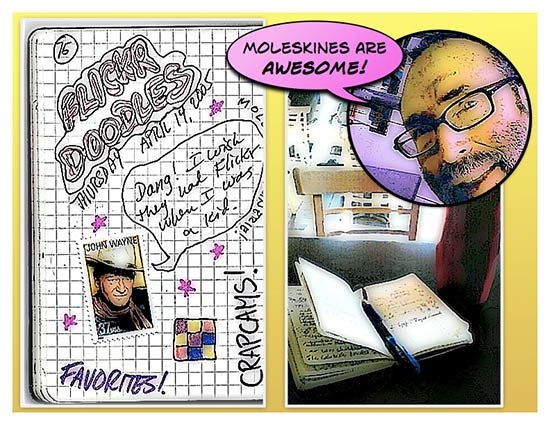
Moleskines are Awesome

For those of you who may not know what a "Moleskine" is, it's a notebook made by an Italian firm, Modo e Modo, and marketed in bookstores, art supply stores, upscale stationery stores, museums, and the like. What makes a Moleskine different from other notebooks is that it's probably better-made than most (though there is some serious competition, especially price competition), it has some Italian pizzazz (like Alfa Romeos and bruschetta), it has an unusual name, and, probably most importantly, it has become a cult object, creating in turn, an aura of celebrity among certain other examples of such a prosaic product as a notebook. Moleskines come in assorted sizes, bindings, page layouts, and with or without pre-loaded information.

I happen to be a devotee of the Moleskine cult because I think that Moleskines are, well, cool. I like the fact that the hardbound editions have what I call a "Bible Ribbon", a sturdy fabric ribbon sewed into the spine that serves as a bookmark, just like those in the Gideon Bibles I used to see in hotel rooms as a kid. (Gee, do they have Korans in hotel room drawers in Mecca? Guess I'll never find out.) Another feature that I like is a little end pocket for storing tickets, receipts, and other ephemera for artists and their ilk. And the paper quality is pretty good. Although I have a variety of sketchbooks, I prefer drawing and writing in my Moleskines.

I am pondering the question whether the Moleskine cult would exist, or be as huge as it is, without the contribution of a web-savvy fellow born in the Philippine Islands, Armand Frasco, who has put Moleskine on the map. The popular blog he founded, Moleskinerie, after which I named this Coffeeblog post, has a great deal to say about the notebook and those who use it, in fact much more than I have read. There is is also a Moleskinerie group on Flickr.

How did Moleskine get it's unusual name? As I understand it, it was once made in France, where it was bound with a kind of oilcloth called "moleskin," an English word for a fabric which was once made of, or at least simulates, the skin of the blind insectivorous mammal called a mole. The moleskin fabric, made mostly in England, had a short soft pile on one side, resembling the fur of the mole, and could be used for making comfortable clothes. The French, marketing their "moleskin" notebooks, added a silent E at the end to make the French pronunciation more like the English. When Italians took over the product, the kept the E, which is pronounced in Italian, resulting in the American pronunciation of the notebook's name as "mole-uh-skeen-eh". And that's what I call mine.

The animal, the mole, is called taupe in French. Taupe, by the way, is also a French word descritbing a color resembling the actual skin of an actual mole. My new Coffeeblog background color is almost taupe, but not quite. And I decided that I don't hate it. Put that in your Moleskine and call it Art.

More Links:

More Images:

Permanent Link to This Entry | | | Technorati Tag:

Send a message to Jonathan: coffeeblogger (at) doublesquids (dot) com


Fall Colors: In Berkeley?

2:55 PM Monday, October 8, 2007

[Try visiting a beach on Christmas Day.]

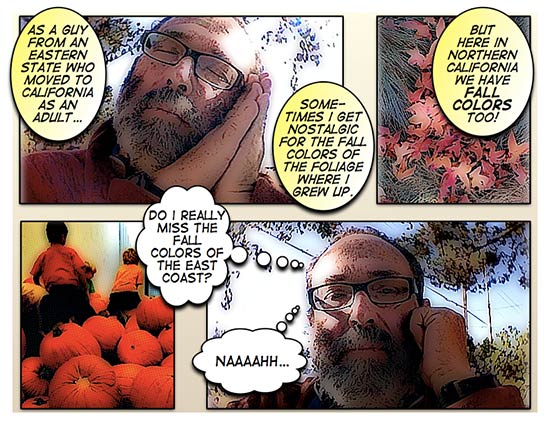
Nostalgia for the East?

The colors of the foliage during autumn in New England are legendary, at least here in the USA. We Californians who were born and raised in the Eastern USA lament the loss of the seasonal changes, especially as October rolls around. An occasional earthquake or mudslide we can stand, but we are nostalgic for fall foliage. Or so we believe. As for me, at this time of year, I am always pleasantly surprised: we do have fall colors. Autumn is a beautiful time in Berkeley.

Part of the problem is that the native plants of Northern California tend to be evergreen, or turn a muted brown as winter approaches, as do the sycamores of Big Sur. The bright reds of the Vermont hillsides, or flaming aspen gold of Colorado is indeed absent. In Berkeley, there are a lot of exotic plantings which add color, especially pyracantha with its orange berries, and the Japanese maple, though small, which turns very red.

Another problem is that the garden flowers, so spectacular in the spring, die back in autumn. Other agricultural products, including gourds and pumpkins become more colorful, but they are no substitute for the flowers. Pumpkins are very big here, and in the seaside town of Half Moon Bay, south of San Francisco, there is an annual pumpkin festival.

The greatest thing about autumn in Northern California, however, is the light. True, the days end earlier now, but the gold from the sky, swooping in at an angle, in a way artists call "raking" must be seen to be believed. Van Gogh is said to have raved about the light of Southern France. Bah. Humbug. The light of the Golden State goes on and on past Thanksgiving Day deep into December. Really. Try visiting a beach on Christmas Day (if it's not raining, of course.) You'll see what I mean. Arrive in the late morning.

More Links:

More Images:

Permanent Link to This Entry | | | Technorati Tag:

Send a message to Jonathan: coffeeblogger (at) doublesquids (dot) com


Hulagu's Exit Strategy

3:22 PM Thursday, September 13, 2007

[Ink and Blood]

Hulagu's Exit Strategy (Coffeeblog)

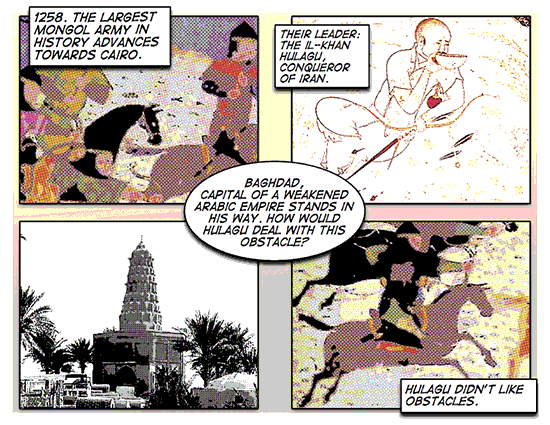
In the year 1258, the Mongol Il-Khan Hulagu ordered the sack of Baghdad, which for 508 years had been the capital of a Muslim empire, ruled by a Caliph, and called the Abbasids after `Abbas ibn `Abd al-Muttalib, paternal uncle and companion of the Prophet Mohammad. The Abbasids were staunch Sunni Muslims. Baghdad, prior to Hulagu's arrival, was renowned for its architecture and culture, including the House of Wisdom, a huge library and scholarly institution housing works in, and translated from Persian, Syriac, and Greek in the fields of astrology, mathematics, agriculture, medicine, and philosophy.

By the time of Hulagu's arrival, the once-huge Abbasid empire had been whittled down to the provinces of Iraq and Syria, and was ruled by a Caliph, Al-Musta'sim Billah, a mellow fellow who had been convinced (says Wikipedia) that the Mongols could be driven off with stones tossed by the women of Baghdad. As it happened, Hulagu had assembled the largest army in Mongol history. His February 10, 1258 conquest of Baghdad was a cakewalk. Superstitious about spilling the blood of the heir of Mohammad (although Hulagu was not a Muslim, and had a Christian mother and wife), according to legend he had the Caliph wrapped in a carpet before having horses trample him to death.

The context of all of this was that a Khagan, that is, a Khan of Khans or Emperor of the Mongols, Güyük, grandson of the first and most famous Khagan, Genghis, had wanted the Mongols to end the Abbasid Caliphate and extend the Mongol Empire to Egypt, but, being an alcoholic who died prematurely, did not live to realize this dream. The honor, as it were, fell to Hulagu, another grandson of Genghis Khan, but of lesser rank, an Il-Khan, who had already conquered Persia and established an Ilkhanate dynasty in the Iranian lands. It seems that he picked up a lot of support from Iranian Shia Muslims on the way. There are even stories that Musta'sim, the Caliph who ended his life rolled up in a rug, had thrown the manuscript of a poem by a respected Shia poet into the river, and the that the vizier, or adviser, who convinced Musta'sim that women throwing stones at the Mongols would drive them off, was a Shia mole for the Mongols. Whatever, the case, Hulagu had serious Shia backing, and having conquered Baghdad, now needed an exit strategy.

For most of history, there was a custom of giving conquering troops a time-limited opportunity to loot a conquered city, grabbing as much of the good stuff as they could. There was also a custom of killing men who could arm themselves later and cause trouble. Finally, Mongols, who lived most of their life on horseback, living in small, portable shelters, had no tradition at the time of taking over cushy palaces and villas and living the soft life. That made Hulagu's exit strategy a no-brainer. His men, including his Iranian Shia supporters (either enthusiastically or merely following orders) trashed Baghdad, which has never been the same since, slaughtered staggering numbers of Sunni men, women, and children, and dumped the contents of the House of Wisdom into the river. The legend is that the river ran red from the blood of the Arabs and black from the ink of the library's books.

Another aspect of Hulagu's exit strategy was to intimidate future victims into surrendering, as the Persians did, rather than resisting and suffering mass executions and ruthless destruction. That worked when Hulagu moved on to Damascus, Syria soon after Baghdad. But it didn't work when he tried to take over Cairo as part of the Khagan Güyük's grand plan. For centuries, the Abbasid Muslims had captured slaves and recruited them as slave-soldiers, called Mamluks (Mamelukes), who were converted to Islam and then trained as cavalry. Eventually the Mamluks had taken over Egypt, and they were there to defeat Hulagu at the Spring of Goliath (Ain Jalut) in the Valley of Jezreel, now part of Israel. The Mongol Empire, once the largest contiguous empire in all history, went into decline after Ayn Jalut, and rapidly disintegrated into smaller empires. Today, Mongolia is an independent nation, 85% of whose population are ethnic Mongols, and half of whose population are Tibetan Buddhists. Genghis Khan is still revered there. As for the descendants of the survivors of Hulagu's 1258 sack of Baghdad, there is still said to be bad blood between some Sunni and Shia Muslims, and between some Arabs and Iranians.

More Links:

More Images:

Permanent Link to This Entry | | | Technorati Tag:

Send a message to Jonathan: coffeeblogger (at) doublesquids (dot) com


444 Ocampo Drive

7:35 PM Sunday, August 19, 2007

[On a bluff over the Pacific]

444 Ocampo Drive

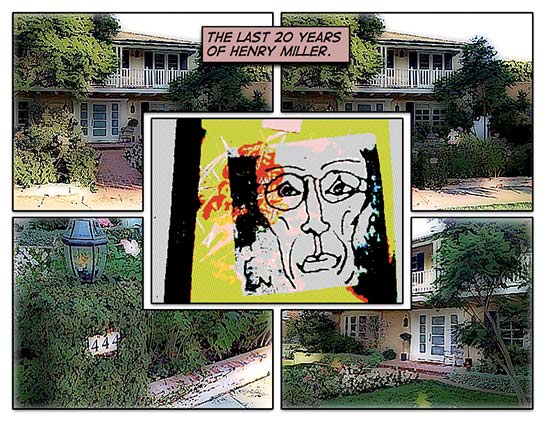
I finally went there to see it: the house in Pacific Palisades, California, where Henry Miller spent the last 20 years of his life. Miller died on June 7, 1980; I believe he died in that house. It is a typical upper-middle-class American house (or at least it was when Miller lived there.) It is now for sale for almost 5 million dollars. When I walked around, there was no plaque, sign or other visible reference to Miller; there is a plaque on the front of the apartment he shared in the Paris suburb of Clichy, about which he wrote Quiet Days in Clichy.

Living in California, I've been meaning to see 444 Ocampo Drive for years, and I finally took the opportunity after a visit to the Getty Museum. The traffic was only moving in one direction: towards the ocean; and Pacific Palisades is on the ocean. When Henry wasn't too sick, he must have walked to the town beach south of Malibu, which is not far off, but the house does not overlook the Pacific like his Big Sur cottage did.

In 1960, a battered and exhausted Henry had finally left Big Sur, where he had held court, wrote, painted watercolors, raised two children with wife Lepska, and then survived more marriages. In Big Sur, he had lived high on a bluff over the Pacific, surrounded by friends and relishing the isolation which had brought about a reconciliation with his native country, the United States of America. He had once loved Brooklyn, where he grew up, but became an expatriate in Europe during the Great Depression, a decade after Hemingway, the Steins, and the other more famous expats had their heyday.

In Pacific Palisades Miller entertained many visitors, had an unconsummated marriage, painted, but wrote little. His novel, which I consider his best (but critics think otherwise), Tropic of Cancer (1936), was 34 years behind him when he left Big Sur. Twinka, daughter of California painter Wayne Thibaud, stayed with him at 444 Ocampo Drive and later wrote her Reflections. They say (and he said) that Miller was "always merry and bright," and I would like to believe that he was until the end.

More Links:

More Images:

Photo Credits: Photographs and Monoprint by Jonathan David Leavitt. Comics-style art by Jonathan David Leavitt.

Permanent Link to This Entry | | | Technorati Tag:

Send a message to Jonathan: coffeeblogger (at) doublesquids (dot) com


Titus Flavius Josephus

7:38 PM Sunday, July 1, 2007

[Shedding light on contemporary tensions.]

Vespasian and the Jews

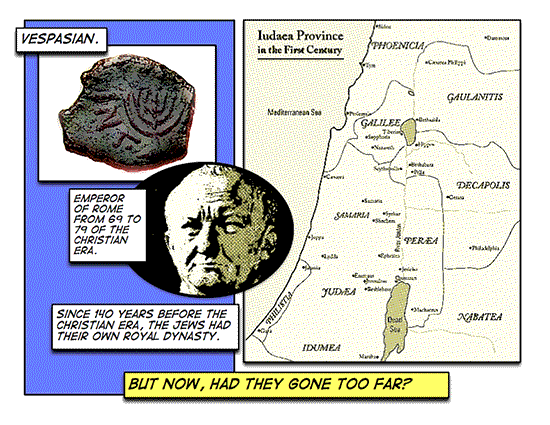
While working on a Coffeeblog post about theocracies I discovered that the word, Greek-derived (meaning dictatorship of a god) appeared in the writing of T. F. Josephus, a fascinating fellow who was born in the land of Israel around 37 years before the Christian era. Descended from priests of the Temple in Jerusalem, he wrote in Greek and became a citizen of Rome. Having written about Jesus, his writing has become part of the controversy among secular scholars and historians whether Jesus actually existed. I find Josephus fascinating for a variety of reasons, shedding light on contemporary tensions between religion vs. secularism, empires vs. "national liberation," and theocracy vs. liberalism. His life also makes vivid the nature of the Near East before Mohammad, and how those pre-Islamic cultures impact the region, and the world, today.

Josephus is described as a historian, but the accuracy of his writing has been disputed. Bear in mind that in Italian, the word for history is storia, which also means a story. I just started Josephus' first chapter in a freebie Google Books download, and what struck me immediately is how a studio could make a great action movie from it. Josephus was a rip-roaring storyteller. (It is my belief, by the way, that the capacity for storytelling is what most distinguishes the human species from other mammals.)

Having started out as a teenager choosing among the three sects of Judaism, the Pharisees, the Sadducees, and the monastic, ascetic Essenes, as an adult Josephus was caught up in the politics of the Galilee region, where local rulers, the Roman empire, and religiously inspired Jewish insurgents clashed with much bloodshed. It seems that Josephus was caught in the middle. When an insurgent band robbed a traveling wealthy Roman woman's caravan, intending to divide the spoils, Josephus kept the loot intact, planning to return it to the victim, or, if necessary, to sell it and spend the proceeds on rebuilding local infrastructure, depending on which way the local political winds were going to blow. He was thus proclaimed a traitor by young militant insurgents (Jewish, of course), who tried repeatedly to kill him. After much adventure and the passage of time, during which a full-scale war broke out between Judea and Rome (the first of three), Josephus became a client of the Roman Emperor Vespasian.

What did it mean to be a client in the Roman Empire? The word does not mean a "customer" in the modern sense. The Romans lived by patronage and clientage, relationships which continue today primarily among politicians and in the Cosa Nostra. For example, if you are a Sopranos fan, consider Paulie Walnuts. In the ancient Roman tradition Paulie would have been considered a client of Tony Soprano. As Vespasian's client, Josephus took the names Titus and Flavius, honoring Vespasian's family. In fact Vespasian was known as the first of the Flavian emperors, and Josephus' documentation about Jesus is known among Christian scholars as the Testimonium Flavianum. It was Vespasian's successor, Titus, who finally crushed the Jews and renamed Judea as Palestine.

More Links:

More Images:

Permanent Link to This Entry | | | Technorati Tag:

Vespasian Josephus JewishWars RomanJews

Send a message to Jonathan: coffeeblogger (at) doublesquids (dot) com


Happy Birthday, Ted Nelson

8:30 PM Tuesday, June 19, 2007

[How could intertwingularity be a piece of cake?]

Intertwingularity for the Nexialist

Theodor Holm Nelson, generally credited with inventing hypertext, calls himself a nexialist. Although the word does not appear in the Wiktionary or have a Google definition, I find it to be a very appealing and useful world, meaning, presumably, someone who studies the connections between things which are ordinarily studied in isolation by various scientific specialties. The word comes from a science fiction novel by A. E. Van Vogt.

I went to a college on the outskirts of Philadelphia called Swarthmore. During my freshman year, Ted Nelson returned to the campus to participate in the Hamburg Show, a traditional theatrical event, and to express his opinion on various topics. Being a nexialist, Ted Nelson is unlikely to speak on any single particular topic, but on a whole host of connected topics, or in his term, (which does appears in Wikipedia), topics which are intertwingled. The words intertwine and intermingle appear in dictionaries, and Ted says the term is a portmanteau, or intertwingling, as it were, of the two.

I would have not known about Ted Nelson's birthday had I not read about it in Mark Bernstein's blog. Mark, another Swarthmorean, has dedicated his career to creating innovative and powerful hypertext software, which includes Tinderbox, the very software with which this weblog is created, and which makes it piece of cake for me to intertwingle gastronomy, theology, popular culture, and comics.

(Click here for Ted's photo license.)

Mark gives a link (this one) to a podcast of Ted's lecture at the University of Southampton, during which Ted proposes interesting solutions to problems such as nuclear holocaust and AIDS, as well as giving a thumpin' (to borrow President Bush's term) to the World Wide Web as presently implemented, which Ted sees as a gross disservice to the whole concept of hypertext. Ted actually apologizes for any inadvertent role he may have played in the creation of the Internet. If you suspect that you may have nexialist proclivities, by all means watch the podcast. The whole podcast. Yes, it was Ted's birthday on June 17, exactly 70 years since he was brought into the world by his mother Celeste Holm (the Celeste Holm, who won an Oscar for Gentlemen's Agreement in 1947). Intertwingle that.

More Links:

More Images:

Permanent Link to This Entry | | | Technorati Tag:

Send a message to Jonathan: coffeeblogger (at) doublesquids (dot) com


Ismail and the Safavids

3:05 PM Thursday, May 17, 2007

[The contemporary consequences.]

The Safavid Dynasty and its Founder

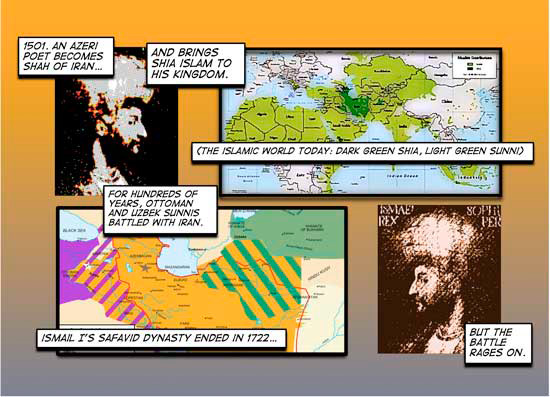
This is a story about an extraordinary man who was born in 1487 and died at age 36, of a broken heart, it is said, because his beloved wife was taken hostage by the Turkish Sultan. He was a famous poet who wrote in two languages under the pen name of Khata'i. He was better known, however, by the name of Ismail the First, Shah of Iran, who came to the throne before the age of 16. (This Coffeeblog post is based on Wikipedia articles.)

There have been many Shahs of Iran and countless poets, so what was special about Shah Ismail? Read current news any day on the Internet or the mainstream media, and you will be reading about the contemporary consequences of the career of Ismail I of Iran. It was he who brought Shia Islam permanently to Iran, at least permanently until the day I am writing this. He was the founder of the Safavid Dynasty, the first major Shia dynasty of Iran.

Ismail the First was descended from Iranians, Turks, and Greeks, and is identified with the Azeri ethnic group. His great-grandfather on his mother Martha's side was the Greek King John IV Komemnos of Trebizond on the Black Sea. On his father's side, he was the great-great-great-great-grandson of Sheikh Safi al-Din Ardabil, a Sufi Grand Master, for which the Iranian dynasty was named. Militant Sunnis today refer to the Iranian Shiites as heretics or "Safavid Apostates", impugning the followers of Sheikh Safi. Go ahead, Google it. When I did, I got 999 hits.

The Ottoman Turks, loyal Sunnis, fought the Safavid Dynasty from 1501 until a shaky treaty was signed in 1639. In 1722 Afghans moved in and ended the dynasty, but, spurred by opportunists, Shia and Sunnis fight on to avenge past atrocities in the region. The most hotly contested turf between Safavid Iranians and Turkish Ottomans was the area between the Tigris and Euphrates rivers, known to the Greeks as Mesopotamia. In the news reports you may be reading today, it's called Iraq.

More Links:

More Images:

Permanent Link to This Entry | | | Technorati Tag:

Send a message to Jonathan: coffeeblogger (at) doublesquids (dot) com


Contact your contacts. Please.

6:46 PM Tuesday, March 13, 2007

[220.8 million brand new Aunt Claras]

Contact Comix: 220.8 New Aunt Claras

I suppose it started with Aunt Clara, my mother's aunt. She was a very interesting lady in her own way, and if she were still alive and had email, I would probably now be asking her a lot of questions about the 1930's in bohemian New York and similar topics. But, as my father used to say, "if my grandmother had wheels, she'd be a taxi cab," and Aunt Clara, who was never to know the thrill of incoming email, died decades ago. The last time I saw her, which was when she was visiting San Francisco, she pointed towards the Golden Gate, and said, "Oh I see they built a bridge there!" (I didn't make that up. Yes, she had been here before. Long before.)

Anyhow, the thing about Aunt Clara was that I was always derelict in my duty to communicate with her. Where did I get such an idea? Well, from Aunt Clara, for one. You see I lived in New York when she was still alive and I did visit her once or twice (well, once I think) I never got around to seeing her again, despite many invitations. We could have done lunch; she offered to let me stay in her midtown apartment (I lived in the far Bronx); there was a lot we could have done, but I didn't call her, and now, of course, it's too late.

Beyond Aunt Clara, there were all the thank-you notes that I was supposed to write for gifts (yes, even sweaters) that I had received from her and other relatives. I never got caught up with those notes. In fact, thank-you notes were probably the original medium with which I honed my highly developed skills in the fine art of procrastination. My mother had great fear, well-founded, that I might totally abandon the family and never communicate with them again. In those days nobody ever heard of blogs, email groups, or the World Wide Web. When friends and relatives did not have elegant little note cards delivered to their mailboxes they were to consider themselves forgotten and abandoned. For all eternity. Or at least until the next December holiday season.

And now, what do we have? Online social networking with Web 2.0 scripting. I wrote recently about the human squirrels who collect contacts like nuts set aside for a harsh winter. But there's another angle. In April, 2006, Technorati's Dave Sifry wrote that the blogosphere doubles in size every six months. That should put its size at 138 million by next month. Let's make the very modest assumption that each of those bloggers has acquired at least two new contacts via friending, comments, or email. Let's subtract 20% for error, phony blogs, and dead blogs. But we're still left with 220.8 million brand new Aunt Claras who deserve, at the very least, one line of email. How about you? Have you written to Aunt Clara yet?

More Links:

More Images:

Permanent Link to This Entry | | | Technorati Tag:

Send a message to Jonathan: coffeeblogger (at) doublesquids (dot) com


Deadwood

3:56 PM Friday, February 2, 2007

[There is a lot of bluntness in Deadwood.]

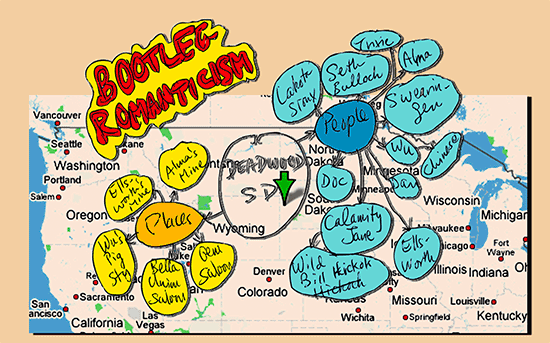
Deadwood: Bootleg Romanticism

A few years ago, fed up with my local monopoly cable TV service, I cancelled it and instead subscribed to DSL internet access for around the same cost. Giving up TV was not all that hard—for a while—but I gradually found myself spending more time watching Blockbuster rentals, and finally, I joined Netflix. What have I learned? Among other things, I learned that there are great movies out there that never get shown in the theaters (as, for example, those produced by HBO, the "home box office"}. Great in what sense? As series that can go on for thirteen hours every year, for years, they can make use of character, plot, and background material in ways that can't be done in a typical feature film. Compare, for example, the Godfather I through III feature film series, with The Sopranos.

Deadwood is such a series, focused on the former mining camp in the Dakota Territory, land of the Lakota Sioux, and now a town which attracts tourism with legalized gambling. The unity of time and place in the series is the period before statehood (1870's), when there was literally no law, and order was a work in progress. There were many legendary characters who were there at the time: Wild Bill Hickok, Calamity Jane, Seth Bullock, and they are portrayed in the series along with fictional characters.

The TV series functions well on several levels. First of all, it is excellent drama with believable human dilemmas in each episode, but not at the expense of melodramatic action. Bluntly (there is a lot of bluntness in Deadwood), there is plenty of violence, some sex, and every episode is rarely if ever boring. Secondly, the series is highly researched, a historical film par excellence, and grittily realistic, down to the profanity that malodorous drunks and filthy miners would have used in that era, or at least a reasonable facsimile thereof. Thirdly, Deadwood works hard to show the humanity of every major and many of the minor characters, good, evil and mostly a combination of both. But it is not simply a "slice of life" exercise in realism or naturalism.

At its highest levels, Deadwood dares to tackle themes of morality, of what is right and what is wrong, including what is right and wrong not only in an anarchic mining camp but also with constitutional but flawed government, then and now. And even as a morality play, Deadwood functions on two levels. There are the stock villains of contemporary political correctness: white racists, obscene male chauvinist pigs, fat greedy corrupt businessmen, and a religious zealot who is actually a madman. On yet another level, however, there is what Ayn Rand called "bootleg Romanticism." There are good guys and bad guys (and gals), people who chose to be good or bad and acted on their choices with some or even a fair amount of success, in spite of the grinding determinism of trauma and poverty. In my childhood, good guys and bad guys were portrayed in Westerns wearing white hats and black hats respectively. In the Deadwood TV series, almost everyone literally wears black hats or none at all, but the viewer has the satisfaction of making moral judgments, which, as in life itself, is not always easy.

More Links:

More Images:

Permanent Link to This Entry | | | Technorati Tag:

Send a message to Jonathan: coffeeblogger (at) doublesquids (dot) com


Lili, Lale, and the D-Day Dodgers

8:53 PM Thursday, November 9, 2006

[The Songs of War: Part 2]

Lale Andersen Sings

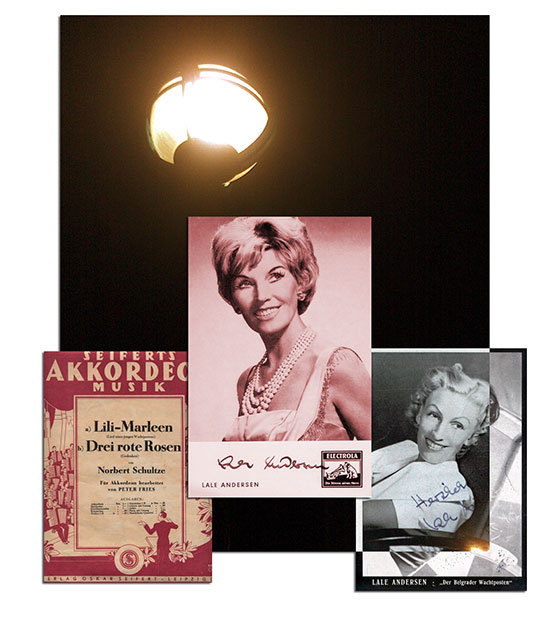
Some time ago I threatened to write a series about war songs, and I hereby post part 2 of that series. Lili Marleen, written as a poem by Hans Leip in 1915, and set to music by prolific German songwriter Norbert Schutlze in 1938, concerned a girl waiting for her soldier boyfriend underneath a lantern: "Wenn sich die späten Nebel drehen, werd' ich bei der Laterne stehen, wie einst Lili Marleen, Wie einst Lili Marleen." (If the late-night mists swirl, I'll be standing by the lantern, as I once did, Lili Marlene.")

An actress and cabaret singer from Bremenhaven recorded the song in 1939 under her stage name Lale (pronounced "Lolla") Andersen, and the song, admired by the Afrika-Corps' field marshal Rommel, became a hit on the Radio Belgrade station of the German armed forces, from where it was picked up by the Allies and translated into many languages. Joseph Goebbels, the Nazi propaganda minister, did not like the song, however, and banned Lale from public performances for nine months. Among other things, Andersen had a long collaboration with the Jewish composer Rolf Liebermann. The song's popularity led to its later reputation as the "greatest war song of all time." Lale Anderson died in Vienna in 1972 and is buried on an island off the German coast where a sculpture commemeorates Lili's eternal Laterne.

Following the Allied intervention in Fascist Italy in 1943, troops of the British Eighth Army rewrote the lyrics as the "D-Day Dodgers" because of their uninvolvement in the Normandy invasion: "We landed at Salerno, a holiday with pay; Jerry brought the band down to cheer us on our way. We all sang the songs and the beer was free; we kissed all the girls in Napoli; for we are the D-Day Dodgers, over here in Italy."

More links: ,

More Images:

Permanent Link to This Entry | | | Technorati Tag:

Send a message to Jonathan: coffeeblogger (at) doublesquids (dot) com


A Dinky Little Ride

7:28 PM Sunday, October 15, 2006

[Five minutes of total fun.]

I have intermittently intimated in Jonathan's Coffeeblog that this weblog is not really about coffee, but about the meaning of life. It would not be hard to prove the assertion that it is not really about coffee, but the meaning-of-life thing is more ephemeral. It usually comes up in my daily planning when I am confronted by my 43 inboxes and must choose among paying an overdue bill, getting rid of more junk mail from my house or car, writing something for the coffeeblog, or just putzing the day away in the gallant spirit of dolce far niente. A firm grounding in the meaning of life is helpful when such decisions are to be made.

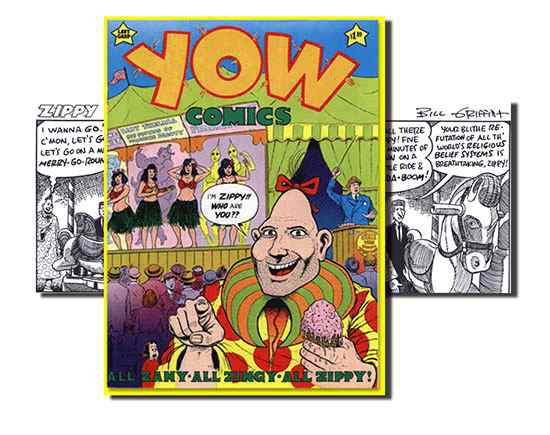
However, my fascination with the meaning-of-life topic was jolted when I read the Sunday, August 6, Zippy the Pinhead comic strip, wherein the muu-muu-clad clown asserts, "five minutes of fun on a dinky little ride & then bada-boom." The title of the strip is "Existence and Stuff," which makes it clear that the cartoonist, Bill Griffith, knew that Zippy was referring to the meaning of life. Of course Zippy himself, a lover of pop culture, diner food, doughnuts, and oft-repeated inanities, does not exist other than the abstraction of that ideal human that we all strive to be (or at least I strive to be.) Five minutes of total fun. Have I ever had five minutes of total fun outside of sex and netsurfing? Wow.

Not content to merely bask on the glow of Zippy's enlightenment, I looked him up in Wikipedia. I knew he would be there. I have never looked him up in Wikipedia before, but I knew that even in a world menaced by North Korean nuclear holocaust, global warming, and bird flu, the all-merciful gods would not condemn us to a place where the Wikipedia did not have an article on Zippy the Pinhead. I was right, of course. I learned that Zippy first appeared in the Berkeley Barb in 1976, and was dropped for a second time by the San Francisco Chronicle in 2004. Why was